
Actin particles may drive cells to change shape without outside signals
A Japanese team reports that mobile actin assemblies can push cell membranes outward, offering a mechanism for spontaneous cell morphogenesis.
By Priya Raghavan · Science Reporter
3 min read
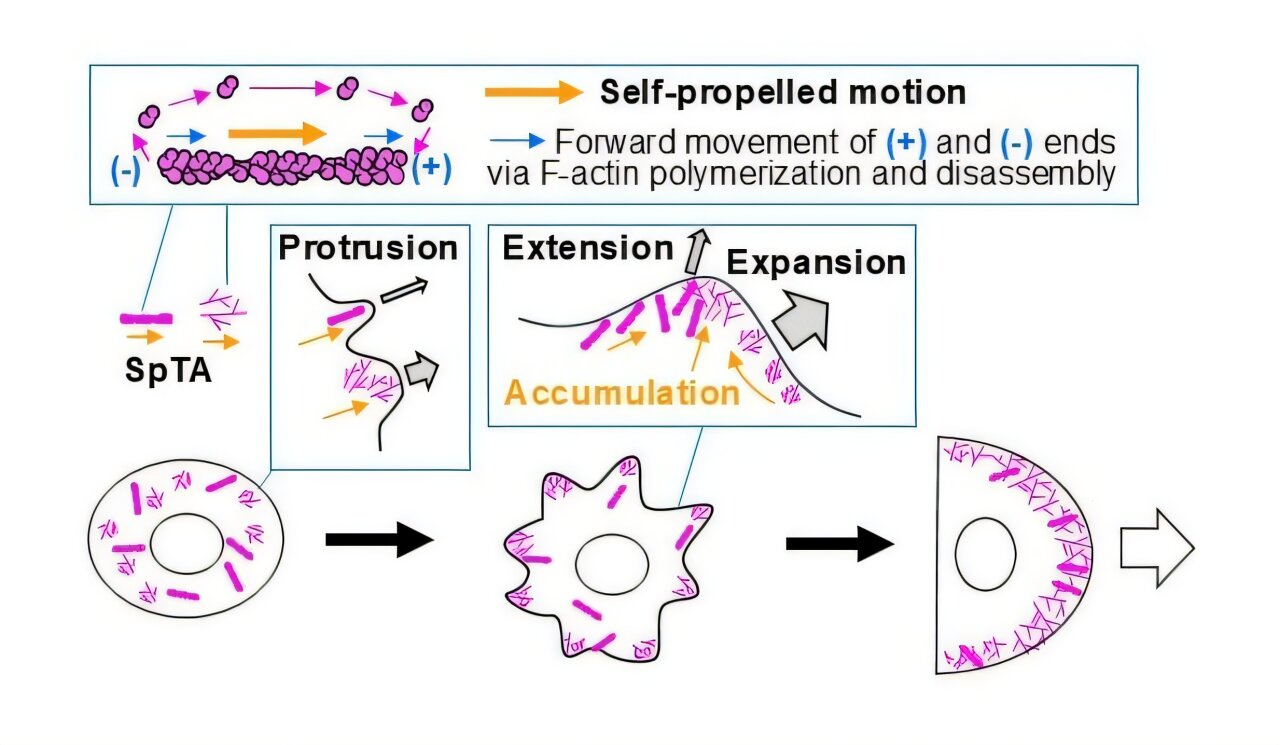
Researchers in Japan have identified mobile actin structures that may explain how cells reshape themselves without outside instructions. The finding matters because cell shape changes underpin immune responses, nerve-cell connections and cancer cell movement, according to Nara Institute of Science and Technology.
The team reports in EMBO Reports that the structures act like self-propelled particles inside living cells. The researchers named them self-propelled treadmilling actin filaments, or SpTAs, and said they can gather at the cell edge and push the membrane outward to form protrusions.
Actin is a protein that helps build a cell’s internal support system, Nara Institute of Science and Technology said. That internal scaffold can press against the cell membrane from within, allowing a cell to alter its shape during movement and other biological processes.
Scientists have known that external signals can tell cells where to build or reorganize actin filaments, the institute said. The harder question has been how cells make protrusions and shift shape when no clear external cue is present.
Tracking actin in live glioma cells
To study that question, the research group examined human glioma cells, which Nara Institute of Science and Technology said can migrate spontaneously without outside signals. Using high-resolution live-cell microscopy, the team watched actin filament assemblies moving through the cells.
The researchers said the observed structures differed from previously described actin waves. Rather than spreading like a chemical reaction across the cell, the actin assemblies behaved more like individual moving objects, resembling self-propelled particles studied in physics.
The team’s analysis found that the motion comes from treadmilling, a process in which actin building blocks are added at the front of a filament and removed at the rear. Nara Institute of Science and Technology said the process uses cellular energy and can move the filament assembly forward.
How protrusions grow
Further experiments and computer modeling showed that SpTAs can deform the cell boundary, according to the study. When the filaments reach the membrane, they press it outward, creating a small protrusion.
The researchers said other SpTAs then accumulate at the same site, helping the protrusion extend. In that model, random motion at the molecular scale can become organized enough to help define the larger shape of the cell.
Kio Yagami said the team had discovered SpTAs and established actin filament assemblies as a new class of biological active particles. Yagami said the finding helps address the problem of biological self-organization and shows how molecular-scale movement can produce higher-order organization.
Naoyuki Inagaki said the researchers expect the work to connect modern biology and physics in studying self-organization. The paper, “Spontaneous membrane protrusion and cell morphogenesis via self-propelled actin filaments,” was published in EMBO Reports with the DOI 10.1038/s44319-026-00804-6.
This story draws on original reporting from Phys.org.