
Stretchable antenna wearable sensors keep signals stable during movement
Penn State-led researchers report a soft RF antenna that stayed tuned while stretched, a step toward more reliable wearable health monitors.
By Tom Brennan · Health & Medicine Correspondent
3 min read
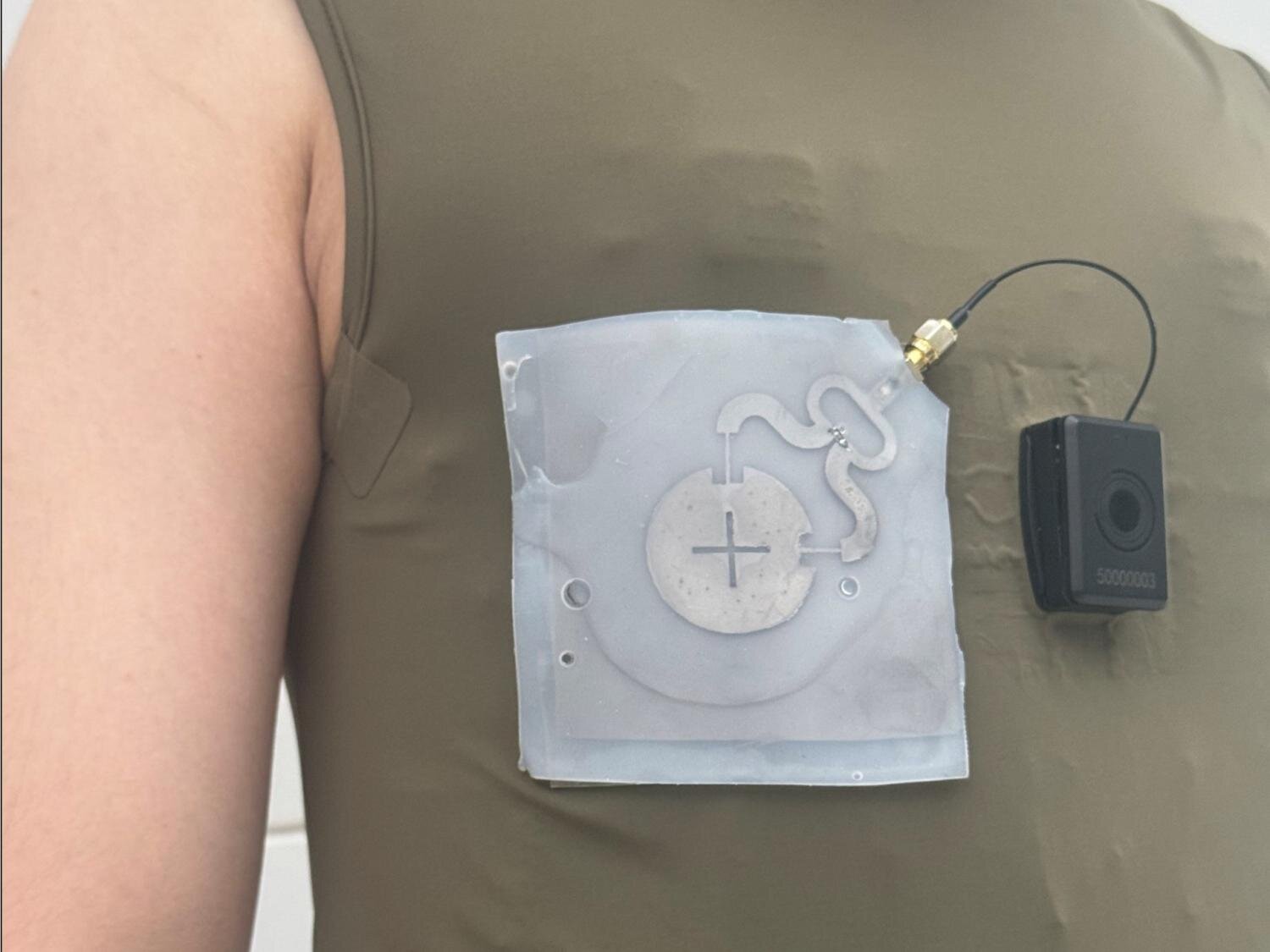
Penn State researchers and international collaborators have developed a stretchable antenna wearable sensors could use to keep wireless signals steady while a person moves. The team says the design may make health monitors more reliable during exercise, rehabilitation and daily activity, where bending and stretching can disrupt communication.
The work was published in Nature Communications. Huanyu “Larry” Cheng, the James L. Henderson Jr. Memorial Professor of Engineering Science and Mechanics at Penn State and a corresponding author, said medical use is the group’s main focus because of the potential for monitoring human health.
How does the stretchable antenna work?
The antenna is built for radio-frequency communication, the wireless technology category that includes Bluetooth, Wi-Fi and sensor links. Antennas can send data and also collect energy from radio waves to help power a sensor or another part of a monitoring system.
Stretching normally changes an antenna’s resonant frequency, which can move it away from the frequency it was designed to use. Cheng said that if an antenna intended for 2.4 gigahertz shifts under strain, a Bluetooth module may fail to receive the signal or energy as intended.
The researchers addressed that problem with a soft circular antenna containing tiny liquid metal particles in Ecoflex, a rubber-like material. They added a cross-shaped opening at the center, which the team said helps preserve signal stability as the antenna is pulled in different directions.
Senhao Zhang, a visiting scholar, engineering science and mechanics doctoral candidate and co-corresponding author, said a round hole can help with stretching from any direction but removes conductive material and lowers efficiency. A single slot keeps more material but works better for certain pulling directions, so the cross shape was chosen to balance performance.
What did the researchers show in tests?
According to the Penn State team, the antenna stayed close to its operating frequency when stretched as much as 45% in multiple directions. Cheng said that matters because earlier stretchable antenna approaches often performed best only when strained along one direction, while the human body moves in less predictable ways.
The researchers ran two system demonstrations. In one, the antenna gathered energy from radio waves and produced enough electricity to power a small LED while stretched by about 30% in different directions. The team said a conventional stretchable antenna used for comparison lost stable power delivery after about 5% stretch.
In another demonstration, the team used a related antenna in a wireless health-monitoring setup. The antenna was mounted on a smart T-shirt with electrocardiogram electrodes and connected to a Bluetooth Low Energy monitoring system.
The system sent stable ECG signals from about 6 feet, or 1.8 meters, to more than 300 feet, or more than 90 meters, after the antenna had been stretched, according to the researchers. It also captured recognizable ECG readings during arm raising and upper-body stretching.
In an outdoor test described by the team, a volunteer ran toward a receiver from more than 300 feet away while the system recorded ECG, heart rate and acceleration. Cheng said the demonstration showed the antenna could be integrated into a system that both harvests energy and transmits data.
The researchers said the nearest use case is likely health care, where continuous monitoring depends on devices keeping contact and communication during motion. Zhang said related soft RF systems could also be considered for flying robots or environmental sensing, including monitoring conditions such as temperature.
The study is titled “Multidirectional strain-insensitive stretchable RF electronics.” Its DOI is 10.1038/s41467-026-74900-5.
This story draws on original reporting from Medical Xpress.