
PM2.5 exposure linked to more aggressive bladder cancer in Taiwan study
National Taiwan University researchers report that fine particle pollution can activate pathways that help bladder cancer cells migrate and invade tissue.
By Tom Brennan · Health & Medicine Correspondent
3 min read
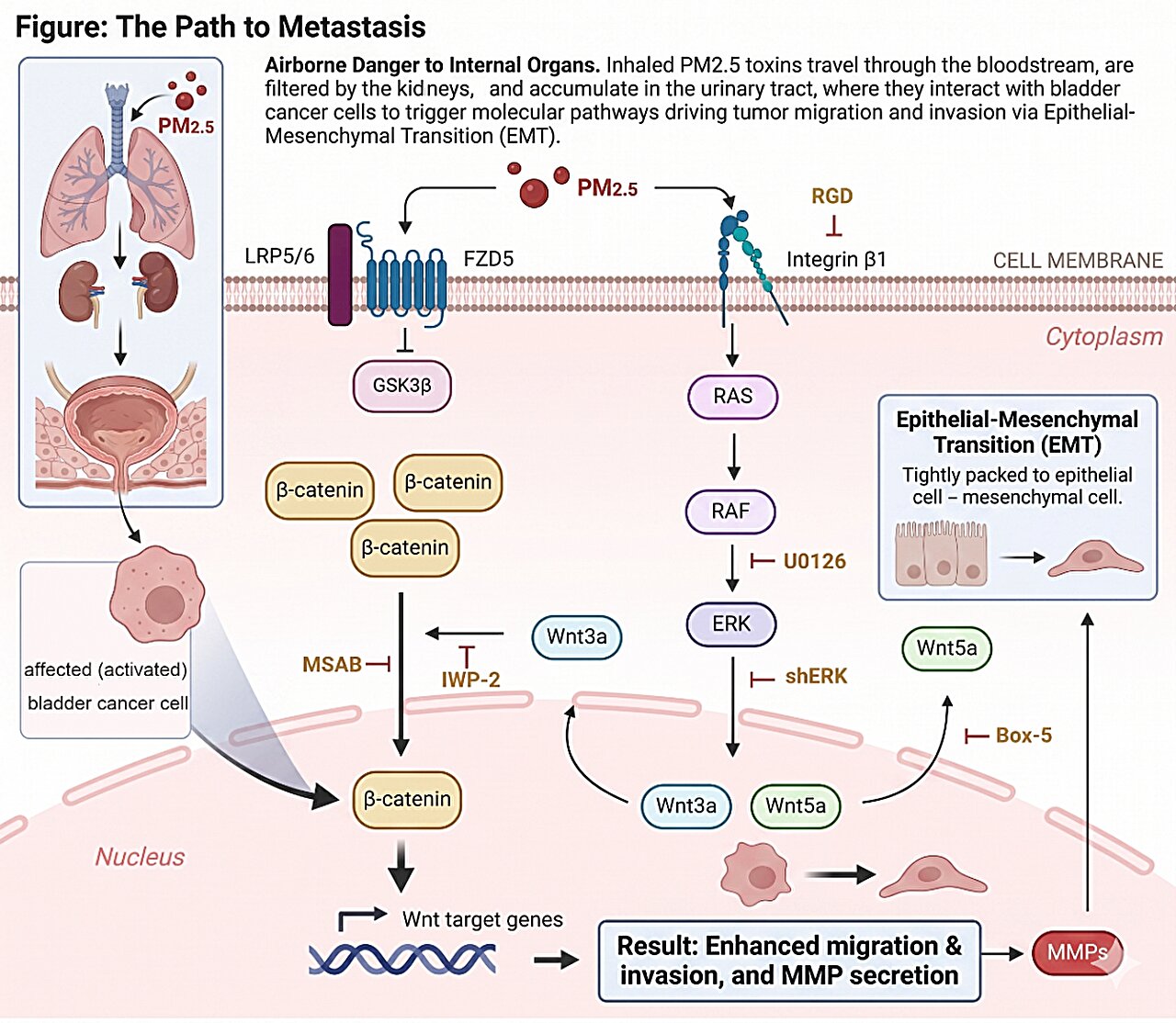
Fine particle air pollution may help bladder cancer cells become more mobile and invasive, according to research from National Taiwan University. The finding matters because it points to a possible route by which inhaled pollution can affect organs far from the lungs.
The study, published in Particle and Fibre Toxicology, examined how exposure to PM2.5 changes bladder cancer cells in experimental models. PM2.5 refers to fine particulate matter small enough to be inhaled into the respiratory system.
According to the National Taiwan University team, earlier research had linked long-term PM2.5 exposure with systemic cancers, but the biological process behind bladder cancer progression had remained unclear. The new work identifies molecular activity that the researchers say can make bladder cancer cells more aggressive.
How pollution may reach the bladder
The researchers said inhaled PM2.5 does not pose a risk only at the point of entry in the lungs. Water-soluble components of the particles can be filtered by the kidneys and then held in the bladder, according to the team.
That process can expose the urothelium, the bladder’s inner lining, to concentrated pollutants for extended periods, the researchers said. The study frames the urinary tract as a potential target of air pollution-related harm, alongside the better-known respiratory and cardiovascular effects.
In the laboratory models, PM2.5 exposure activated a process called epithelial-mesenchymal transition, or EMT. During EMT, cancer cells lose some of the traits that keep them anchored in place and gain features associated with movement.
The researchers reported that exposed bladder cancer cells showed increased migration and invasion into nearby tissue. Those behaviors are tied to metastasis, the spread of cancer to other parts of the body.
Pathways identified
The paper by Yung-Ting Cheng and colleagues identifies crosstalk between integrin-mediated MAPK/ERK signaling and Wnt/β-catenin pathways as part of the mechanism. The authors report that these pathways help drive the migration and invasion seen after PM2.5 exposure.
By naming those molecular targets, the study offers a possible direction for future cancer treatment research, according to National Taiwan University. The team said interventions that block the pathways could be explored as a way to counter pollution-related cancer aggressiveness, particularly for people in areas with high PM2.5 exposure.
The researchers also said the findings support tighter air quality controls to reduce cancer-related risks from fine particle pollution. The study does not report a clinical trial in patients; it describes mechanisms observed through experimental models.
The paper is titled “Particulate matter 2.5 promotes bladder cancer cell migration and invasion through the crosstalk between integrin-mediated MAPK/ERK and Wnt/β-catenin pathways.” It was published in 2026 in Particle and Fibre Toxicology.
This story draws on original reporting from Medical Xpress.