
Lymphedema skin sensor could help track tissue changes at home
Northwestern researchers report a wireless wearable that measures skin stiffness and sends soft tissue data to clinicians remotely.
By Tom Brennan · Health & Medicine Correspondent
3 min read
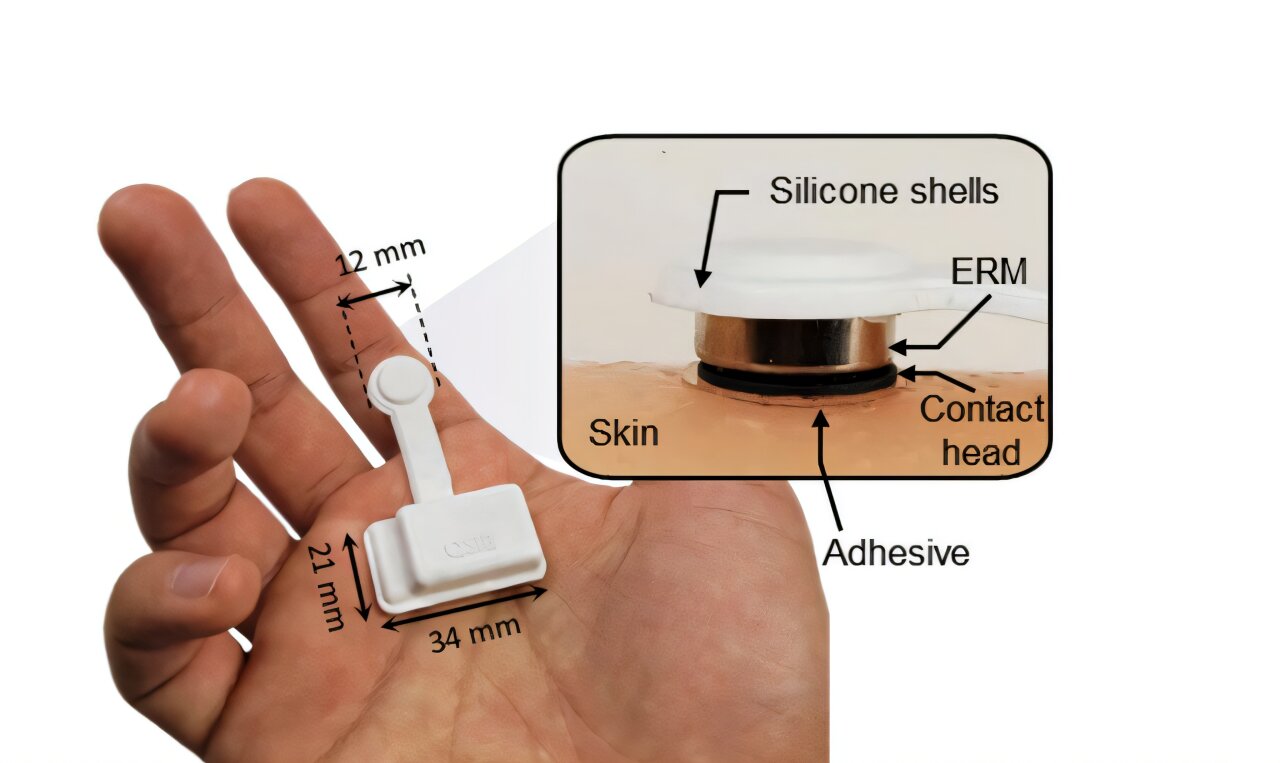
A lymphedema skin sensor developed by Northwestern University researchers could let patients track tissue changes from home and share the data wirelessly with clinicians. The flexible device measures skin elasticity, a marker tied to soft tissue disorders, according to a study published in Science Advances.
The research team says the wearable may help with earlier detection and follow-up for conditions including lymphedema and systemic scleroderma. Lymphedema is chronic swelling caused by lymph vessel damage from infection, cancer treatment or some genetic mutations, and Northwestern says ongoing monitoring is needed because the condition has no cure and can worsen or lead to infection.
The device is placed directly on the skin and is designed to work on different parts of the body. Northwestern says it records biomechanical information about soft tissue and can send disease-progression data to a health care provider without requiring an in-person exam each time.
How does the wireless skin sensor work?
The sensor uses vibrations generated through an accelerometer to assess how skin and underlying tissue respond. Min-Seung Jo, a postdoctoral fellow in the laboratory of Northwestern engineer John Rogers and lead author of the study, said the team can analyze vibration amplitude and frequency to determine a skin modulus value, a measure related to stiffness.
Rogers’ laboratory developed the technology behind the flexible wearable, according to Northwestern. The research team says the device can capture information on stiffness, elasticity and resistance to pressure, then transmit those readings wirelessly for review.
Ann Marie Flores, an associate professor of physical therapy and human movement sciences and medical social sciences at Northwestern and a co-corresponding author, said the long-term aim is a home-based unit that can communicate patient data directly to a physician. She said the approach could be useful for people who know they are at risk and need frequent monitoring.
Why current lymphedema monitoring is limited
Northwestern says clinicians now assess lymphedema using several methods, including limb volume measurement, bioimpedance spectroscopy, tissue dielectric constant testing and clinical examination. Skin stiffness can also be checked with indentation testing, suction testing or elastography imaging.
Those tools can be effective, according to the university, but they often require larger equipment and hands-on exams. Northwestern also says some existing methods become less sensitive as lymphedema advances.
The new wearable was tested in patients with cancer-related lymphedema and in patients with systemic scleroderma, a rare autoimmune disorder in which excess collagen causes abnormal skin thickening, according to the study. The investigators reported that the sensor’s larger contact area allowed deeper tissue monitoring and improved assessment of severity and progression.
Northwestern says the device showed stronger correlation than commercially available systems based on bioimpedance and tissue dielectric constant for detecting early-stage lymphedema. The researchers also reported that it could distinguish among three lymphedema stages and better measure skin stiffness during muscle movement and relaxation.
What happens next?
The device is not presented as a replacement for clinical diagnosis. Northwestern says medical expertise remains necessary to diagnose and stage lymphedema, while the wearable could support monitoring between visits.
Flores said the team’s next steps include studying how to make the system truly home-based, how consistently patients use it for lymphedema monitoring and what information providers want from the data. The study, “A wearable biomechanical system for medical evaluation of soft tissue disorders,” was published in Science Advances with DOI 10.1126/sciadv.aeg2631.
This story draws on original reporting from Medical Xpress.