
Habit formation neural pathways split how habits start and persist
Kyoto University researchers found two mouse brain circuits that separately govern habit formation and how strongly habits are performed.
By Tom Brennan · Health & Medicine Correspondent
3 min read
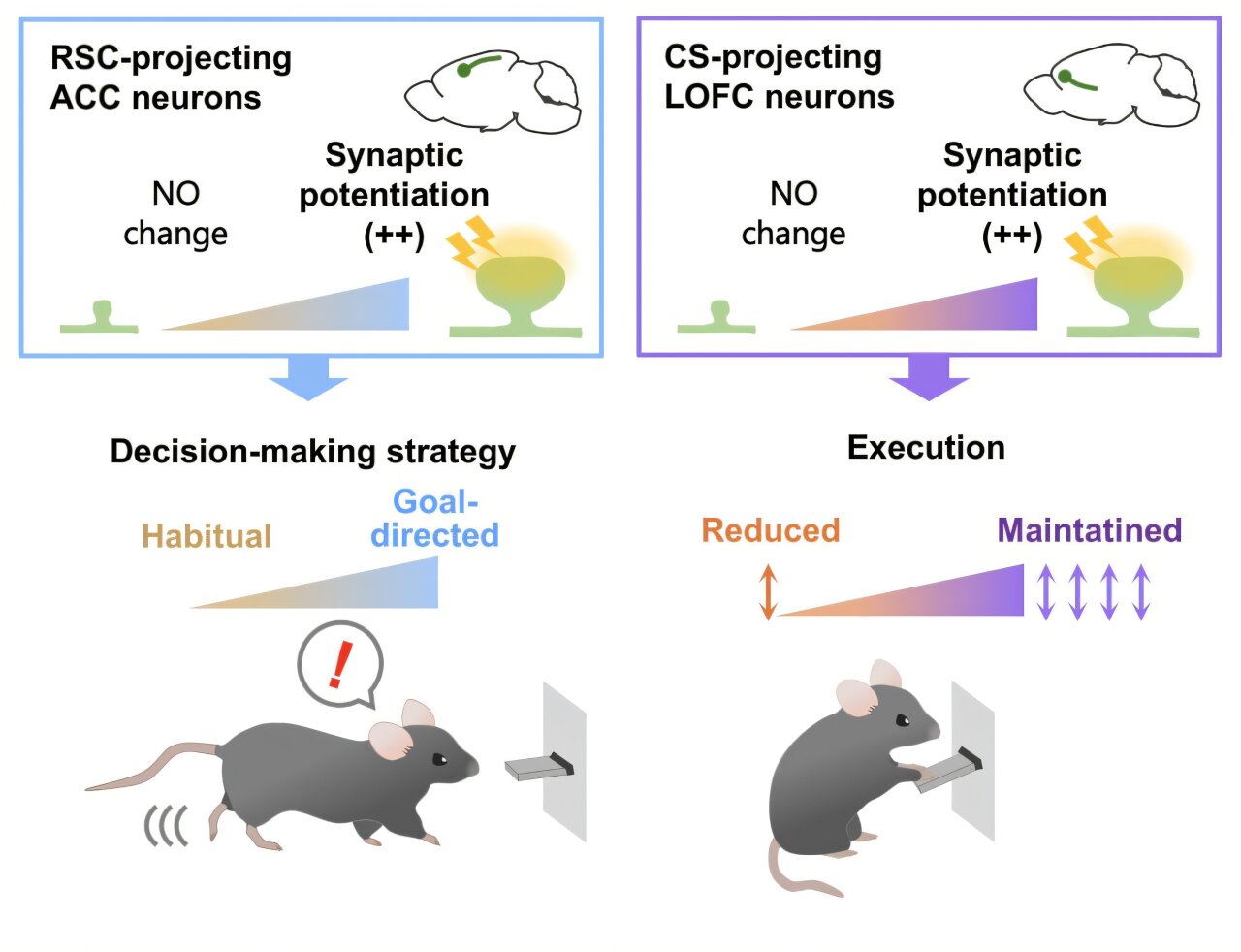
Habit formation neural pathways appear to divide two jobs in the brain: turning an action into a routine and setting how strongly that routine continues, according to Kyoto University researchers. The finding matters because it may help explain why repeated behaviors become automatic in some cases and vary so much from one individual to another.
Habit formation is the process in which a repeated behavior shifts from deliberate choice to automatic action. The Kyoto University team reported in Nature Communications that two separate brain circuits in mice had distinct roles in that shift.
The researchers said studying habits has been difficult because they can take time to develop, making it hard to compare brain activity in the same animal before and after a behavior becomes habitual. To address that problem, the team created a two-stage mouse training method designed to speed up the transition.
In the first stage, mice were trained to use goal-directed strategies, according to Kyoto University. The animals then received four additional days of training intended to encourage habitual strategies, allowing researchers to follow the change within individual mice.
What neural pathways control habit formation?
The study identified one pathway from the anterior cingulate cortex to the retrosplenial cortex as a circuit tied to whether a behavior becomes a habit. Kyoto University said the connections in that pathway weakened as mice shifted from goal-directed behavior to habitual behavior.
A second pathway, running from the lateral orbitofrontal cortex to the central striatum, was linked to how much the habit was carried out. The researchers said this circuit helped account for individual differences in the level of habitual behavior after a habit had formed.
In mice that showed strong neural responses in the second pathway, habitual behavior stayed at high execution levels, according to the study. Mice with weaker responses showed lower levels of the behavior, even after the habit-forming process had succeeded.
The team also reported that artificially changing activity in these pathways produced different effects. Manipulating one pathway could promote habit formation, while manipulating the other could change how strongly the behavior was performed, supporting the idea that the circuits have separate functions.
Why do habits differ from person to person?
The findings challenge a simpler view of habits in which repetition turns an action into an automatic copy of the original behavior. Kyoto University said the mouse results suggest that habit formation and habit intensity can be controlled separately in the brain.
Nozomi Asaoka, a co-corresponding author, said the work addresses how habits operate and may eventually point toward ways to gain better control over them. Team leader Yasunori Hayashi said the study revealed control mechanisms that had been overlooked and may help explain why habits are expressed differently across individuals.
The researchers said they plan to study what drives differences in habit intensity. Kyoto University said a clearer account of those mechanisms could support efforts to build beneficial habits and improve treatments for problematic habits associated with conditions such as obsessive-compulsive disorder.
This story draws on original reporting from Medical Xpress.