
GHP-88310 blocks measles-like virus spread in ferret study
Georgia State researchers say the oral antiviral stopped contact and airborne spread in a ferret model and shortened infectiousness.
By Tom Brennan · Health & Medicine Correspondent
3 min read
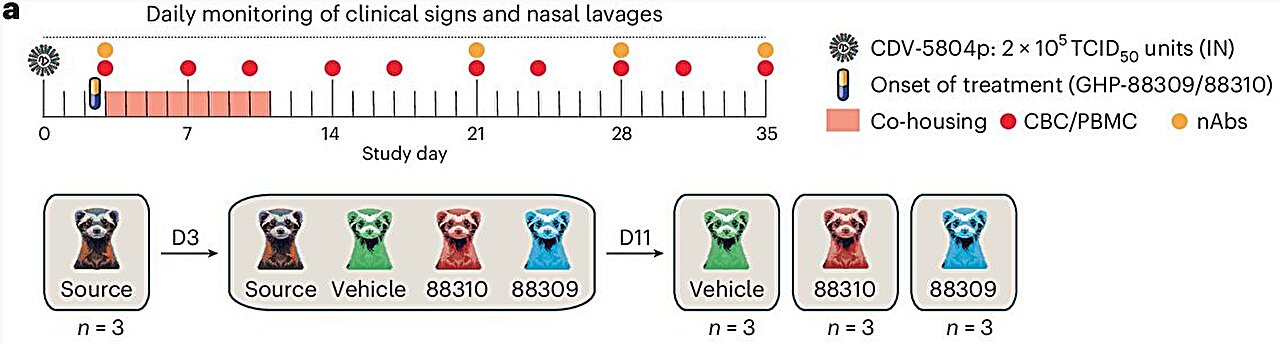
GHP-88310 measles transmission research has shown that an oral antiviral candidate stopped a measles-like virus from spreading between ferrets by contact and through shared air, according to a study in Nature Microbiology. Researchers at Georgia State University’s Center for Translational Antiviral Research said the drug also reduced clinical illness in the animal model.
The study used canine distemper virus, which causes measles-like disease in ferrets, as a model for measles transmission. The team tested whether GHP-88310 could work when given shortly before or after exposure, a use known as prophylactic administration.
According to Georgia State, the results showed that the drug candidate blocked spread after direct physical contact and after airborne exposure. The researchers also reported that treating already infected animals shortened the time during which they could pass on the virus.
What is GHP-88310?
GHP-88310 is an oral antiviral drug candidate designed to inhibit the viral polymerase, an enzyme viruses use to copy their genetic material, according to the Georgia State team. Earlier work describing the candidate appeared in Science Advances.
The Nature Microbiology study focused on whether the compound could limit transmission as well as illness. That distinction is central for measles-like viruses because stopping onward spread can help contain outbreaks while vaccination campaigns take effect.
How did researchers test airborne spread?
The investigators built an experimental setup that paired infected and uninfected ferrets either in direct contact or in a shared airspace under controlled conditions, according to Georgia State. The design was meant to model both close household-type exposure and indoor settings where people share air without direct interaction.
In that system, GHP-88310 prevented airborne transmission when given by mouth, according to first author Carolin Lieber, a senior postdoctoral fellow in Richard Plemper’s laboratory. The team said the finding showed strong activity for a drug that targets viral polymerase.
Senior author Richard Plemper, a Regents’ Professor and director of the Center for Translational Antiviral Research, said the work supports testing GHP-88310 as a supplement to ring vaccination strategies for measles outbreaks. Ring vaccination targets people around a known case to cut off further spread.
Why are researchers focused on measles now?
Georgia State said measles has reemerged in the United States since 2025, with thousands of cases across multiple states, hundreds of hospitalizations and three confirmed deaths. The university also cited large outbreaks in Canada and Mexico with multiple deaths, saying they have put North America’s measles elimination status under pressure.
The study did not report human trial results. Plemper’s group said the candidate is being prepared for formal clinical testing, which would be needed to assess safety and effectiveness in people.
Additional authors named by Georgia State include Josef Wolf, Claire Ruckel and Lauren Harrison of the Center for Translational Antiviral Research in the Institute for Biomedical Sciences at Georgia State.
This story draws on original reporting from Medical Xpress.