
AI model reads mouse movement patterns to flag autism-linked behavior
KAIST researchers say BehaVERT treats animal motion as language, helping identify social behavior differences in autism-model mice.
By Priya Raghavan · Science Reporter
3 min read
Researchers at the Korea Advanced Institute of Science and Technology say they have built an AI system that analyzes animal movement as if it were language. The work could give neuroscientists a more interpretable way to study behavior linked to psychiatric disorders, drug testing and genetics.
The model, called BehaVERT, was developed by a team led by Dae-Soo Kim, a professor in KAIST’s Department of Brain and Cognitive Sciences. The study was published in the International Journal of Computer Vision.
According to KAIST, the researchers converted mouse skeletal motion into “tokens,” comparable to words in a sentence. Those tokens represented body points including the nose, ears, spine, limbs and tail, allowing a transformer-based system to learn patterns across time.
Movement treated as behavioral language
KAIST said the system uses a BERT-based architecture, a type of model commonly associated with language processing. Instead of training it only to sort clips into behavior categories, the team designed BehaVERT to learn how movements gain meaning from surrounding movements.
The university said BehaVERT performed at state-of-the-art levels on five international benchmark datasets. Those datasets covered social interaction, multi-animal behavior, three-dimensional movement analysis and autism-related behavioral assessment, according to KAIST.
The researchers also emphasized interpretability. KAIST said the model can show which behavioral signals contributed to its decisions, a feature meant to make its output more useful for scientists studying animal behavior.
Autism-model mice showed a social cue
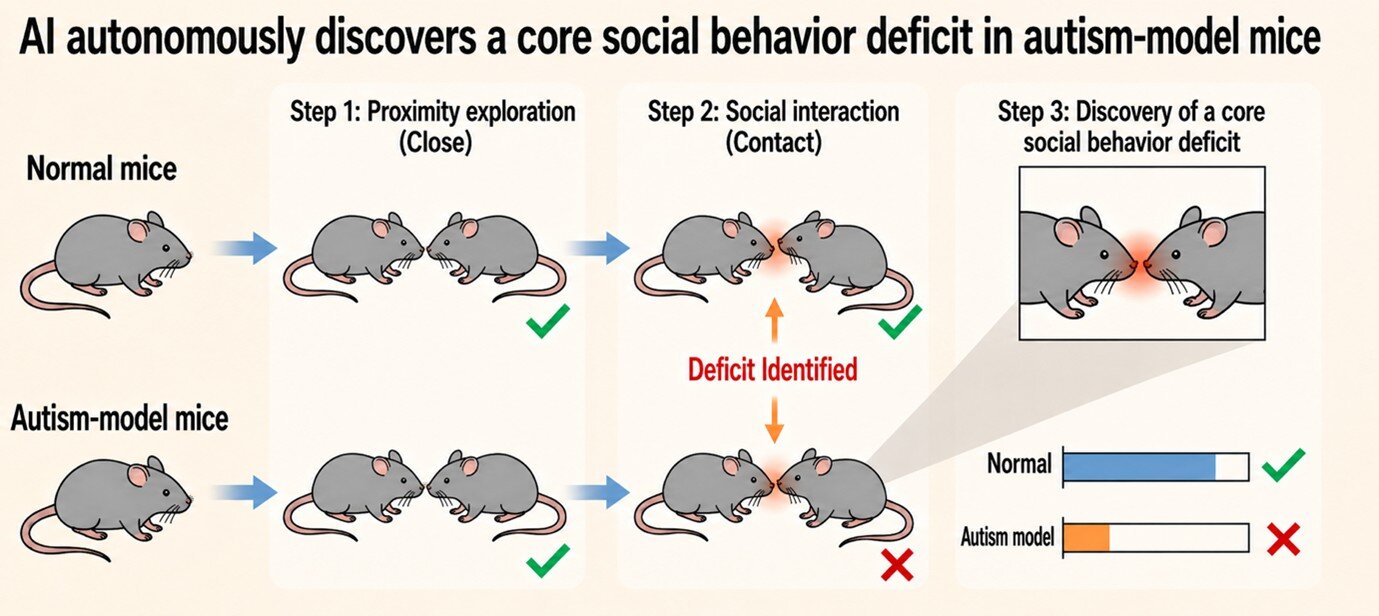
In tests involving Shank3B knockout mice, an autism model, BehaVERT separated the model mice from healthy controls by repeatedly focusing on oral-oral contact behavior, according to KAIST. The university said that result matches earlier biological findings that autism-model mice can retain normal approach behavior while showing social interaction deficits.
KAIST described the result as evidence that the system found a known autism-related behavioral feature using behavioral observations alone, without being given biological rules in advance. The finding does not mean the AI diagnosed autism; it identified a pattern in a mouse model used for research.
The team also reported that BehaVERT’s internal representations arranged behavior-related features such as mobility, attention and social engagement into organized patterns. KAIST said that supports the idea that animal behavior may have an underlying structure that can be modeled in a way similar to language.
Training without manual labels
The researchers used self-supervised learning, allowing the system to learn from behavioral data without hand-labeled annotations, according to KAIST. The university said a model trained on rat behavior was also able to transfer to mouse behavior analysis, suggesting the approach could support broader “behavioral foundation models” across species.
First author Seungjae Shin said the project started with the question of whether animal movements might contain a language-like structure. KAIST said Shin and other team members came mainly from biology backgrounds and learned transformer and deep-learning methods to build tools tailored to behavioral analysis.
Kim’s laboratory has previously worked on AI-based animal behavior tools, including AVATAR, a technology for reconstructing rodent behavior in virtual environments. KAIST said that work contributed to the founding of Actnova Inc.
Kim said BehaVERT is intended to go beyond classifying behavior and help researchers interpret behavioral meaning. He said the team expects it to be useful in drug development, psychiatric disorder research, behavioral genetics and other life-science fields.
This story draws on original reporting from Medical Xpress.