
SK Hynix Nasdaq debut raises $26.5 billion as AI memory demand surges
The South Korean chipmaker’s U.S. listing gives investors a direct bet on high-bandwidth memory, a core component in AI processors.
By Daniel Okafor · Business Editor
3 min read
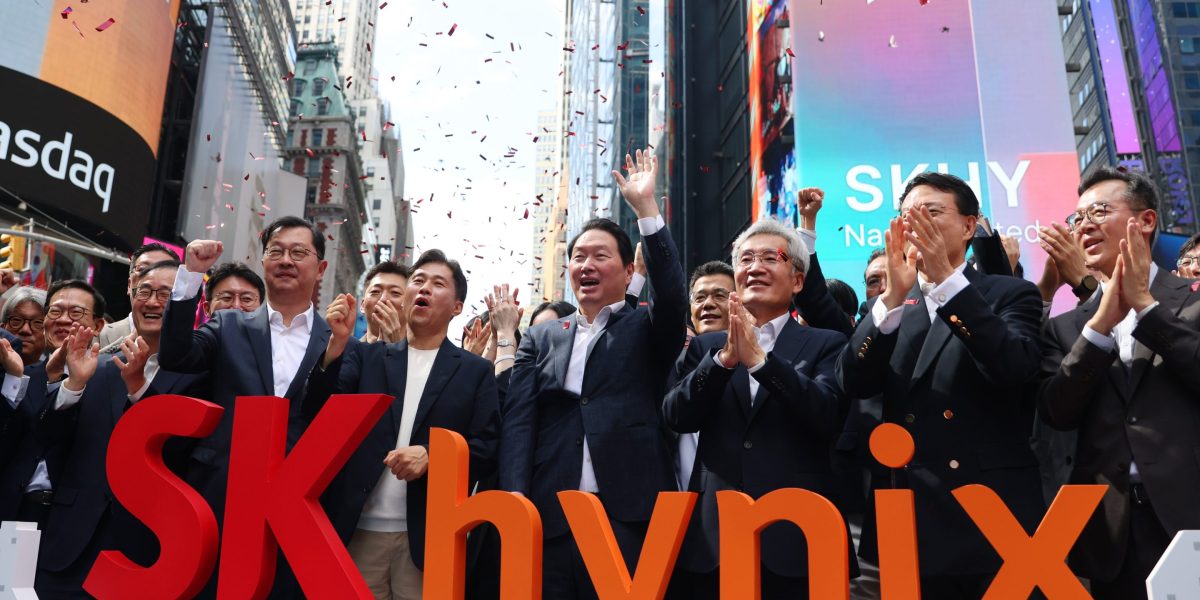
SK Hynix began trading on the Nasdaq after raising $26.5 billion, Fortune reported, giving U.S. investors direct exposure to one of the main suppliers behind the AI chip buildout. Fortune said the sale was the largest U.S. listing by a foreign company and the second-largest share sale in U.S. history, behind SpaceX’s $86 billion IPO last month.
The South Korean company’s shares rose 12.8% in their first session, according to Fortune. The debut reflects investor demand for high-bandwidth memory, or HBM, the specialized chips used alongside AI processors from companies including Nvidia.
SK Group Chair Chey Tae-won told CNBC on the listing day that the company plans to double production capacity within five years, while customers are still asking for more supply. SK Hynix’s Korea-listed shares have climbed more than 630% over the past 12 months, Fortune reported, lifting its market value above $1 trillion.
Why investors are paying attention
Fortune reported that SK Hynix makes memory chips used in almost every Nvidia processor and that supply shortages have pushed prices higher. Counterpoint Research estimates SK Hynix controls about 60% of the global HBM market by revenue.
HSBC analysts estimate the company’s American depositary receipts could raise SK Hynix’s valuation by as much as 20%, according to Fortune. The listing also gives global investors easier access to a company whose shares have traded in South Korea, where analysts often cite the “Korea Discount” as a drag on valuations.
Fortune reported that Korean companies can trade below global peers partly because of concerns over governance at chaebols, the family-controlled conglomerates that dominate South Korea’s economy. Micron Technology has a $1.1 trillion valuation even though SK Hynix is more profitable, according to Fortune.
From troubled memory maker to AI supplier
SK Hynix began in 1983 as Hyundai Electronics, a unit of Hyundai Group, Fortune reported. After the 1997 Asian financial crisis, South Korea pushed the chip sector to consolidate, and Hyundai absorbed LG Semiconductor before the business was renamed Hynix.
The combined company struggled with debt, needed support from creditors and the government, and was spun out of Hyundai in 2003, according to Fortune. SK Group acquired Hynix in 2012.
Fortune reported that SK Hynix and AMD co-developed the first HBM chip in 2013. The product was initially a niche technology, but the company kept investing in it, giving SK Hynix an edge when AI companies needed faster memory to train large language models.
SK Hynix reported 97.1 trillion won, or $64.1 billion, in 2025 revenue and 42.9 trillion won, or $28.3 billion, in net income, according to the company figures cited by Fortune. Intel last month appointed former SK Hynix CEO Lee Seok-hee to lead its foundry business, Fortune reported.
South Korea weighs gains and risks
The rally has reshaped South Korea’s stock market. Fortune reported that the KOSPI has risen 135% over the past 12 months and that SK Hynix and Samsung Electronics together account for more than half of the index’s market value.
The boom has also brought volatility. Fortune reported that South Korea’s exchange has triggered circuit breakers six times this year after KOSPI drops of more than 8%, and regulators have voiced concern about leveraged single-stock ETFs tied to Samsung and SK Hynix.
Reuters reported that SK Hynix CEO Kwak Noh-jung expects next year to be the worst year in the memory industry’s history from a supply standpoint. Fortune reported that Samsung and SK Hynix have announced plans with suppliers to invest 800 trillion won, or $517 billion, in two new semiconductor fabrication complexes in southwestern South Korea.
Morningstar analyst Jing Jie Yu warned that new chip capacity can arrive after demand has started to slow, according to Fortune. That risk leaves investors weighing today’s shortage against the memory industry’s long history of boom-and-bust cycles.
This story draws on original reporting from Fortune.