
Robot servicing mission launches to extend aging satellites
Northrop Grumman’s MRV will spend about a year reaching geosynchronous orbit before attaching propulsion packs to three communications satellites.
By Maya Lindqvist · Senior Technology Correspondent
3 min read
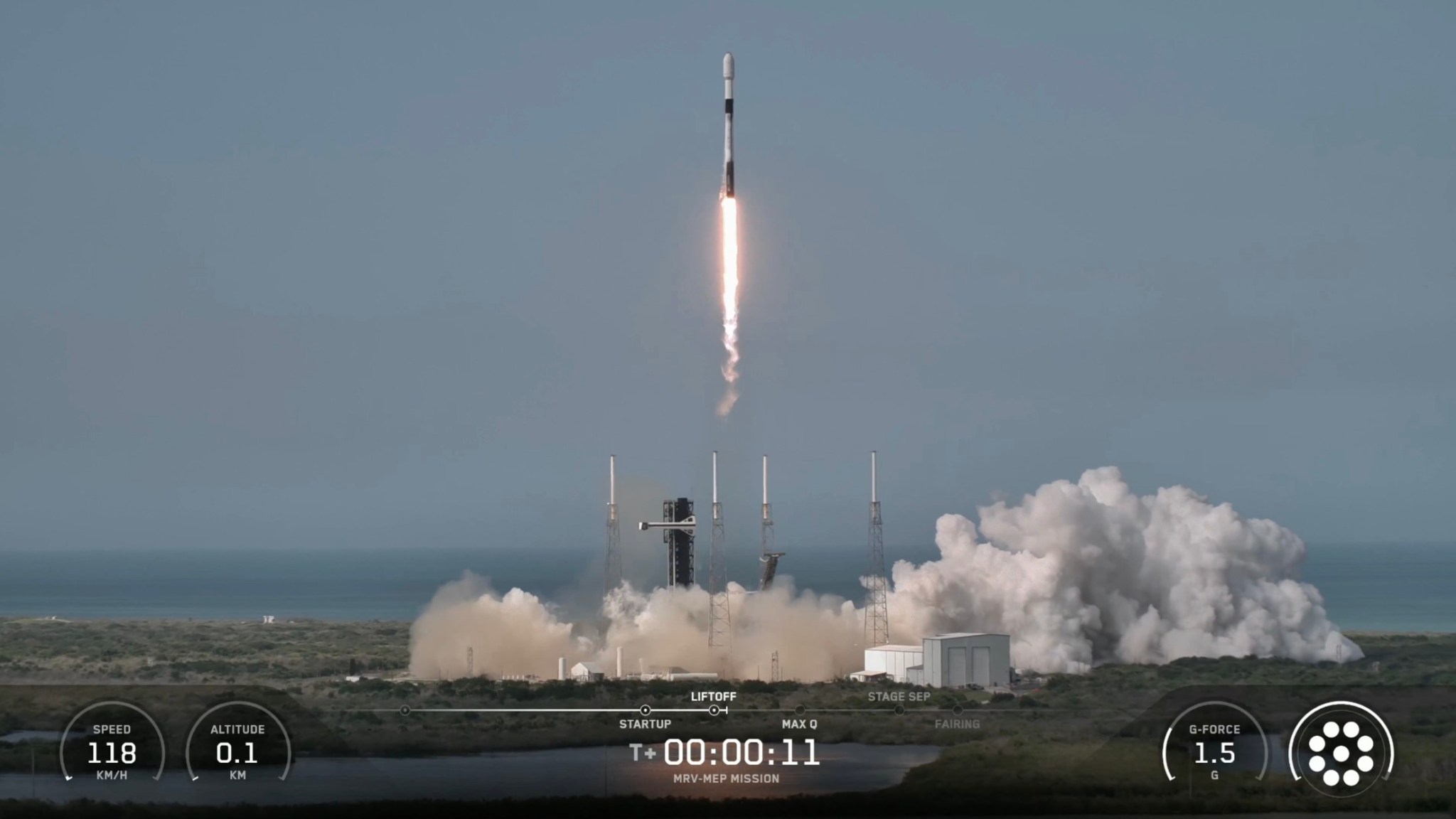
Northrop Grumman has launched a private robotic servicing mission aimed at keeping older satellites in operation after their fuel runs low. The Associated Press reported that the mission is part of a growing effort to save satellite operators the cost and disruption of replacing spacecraft already in orbit.
The spacecraft, called MRV, lifted off Tuesday aboard a SpaceX rocket with three separate propulsion packs. According to the AP, the mission follows another satellite-rescue launch earlier this month by Katalyst Space Technologies, whose spacecraft is intended to raise NASA’s Swift Observatory before it reenters the atmosphere.
Northrop Grumman’s vehicle is headed for geosynchronous orbit, about 22,300 miles above Earth. Satellites in that orbit move in step with Earth’s rotation, allowing them to remain over the same region and provide continuous communications and other coverage.
The AP reported that MRV will spend about the next year adjusting its path to reach the right orbit. Once it is in position by mid-2027, the minivan-sized spacecraft is expected to use its two robotic arms to attach one of the propulsion packs to an aging communications satellite, then repeat the work at two other satellites.
Propulsion packs will wait in orbit
The three packs separated after launch and will use xenon gas thrusters to travel to their assigned orbital region, the AP reported. Once there, each unit will wait for MRV to capture it and connect it to a customer satellite.
Each pack is roughly the size of a washing machine and is designed to give an aging satellite enough thrust to keep working for several more years. The AP identified the satellite operators as SES of Luxembourg and Optus of Australia, and reported that the service could save them millions of dollars in replacement expenses if it works as planned.
The launch expands Northrop Grumman’s work in satellite servicing. The company previously launched spacecraft in 2019 and 2020 that attached to struggling communications satellites and took over steering duties, giving them additional operating life, according to the AP.
Northrop Grumman designed the newer robotic system for broader work. The AP reported that the company sees future versions repairing and moving active satellites, as well as attaching to dead satellites to remove them from crowded orbits. The company is working with the U.S. Naval Research Laboratory and the Defense Advanced Research Projects Agency.
Another mission targets NASA observatory
Katalyst Space Technologies is testing its Link spacecraft in orbit before attempting to raise NASA’s Swift Observatory, the AP reported. Flight controllers have dealt with early communications and pointing issues by sending software fixes to the spacecraft.
Swift launched in 2004 to study gamma-ray bursts and other high-energy events. According to the AP, recent solar activity has caused the telescope to lose altitude faster than usual, raising the risk that it could fall back to Earth this fall without a boost.
NASA is paying Katalyst $30 million to return Swift to its original altitude of 373 miles, the AP reported. Northrop Grumman provided Link’s launch to orbit using a Pegasus rocket released from an aircraft.
This story draws on original reporting from Fortune.