
KPMG and OpenAI expand alliance around AI-native enterprise work
KPMG was named an OpenAI Elite Partner after building an internal supply chain and fulfillment platform for the AI company.
By Maya Lindqvist · Senior Technology Correspondent
3 min read
KPMG and OpenAI have expanded their partnership after KPMG built an internal AI-native supply chain and fulfillment orchestration system for OpenAI, Fortune reported. The companies are now using that work as the basis for a broader enterprise offering aimed at changing how employees use business software.
OpenAI has named KPMG an Elite Partner, the top level in its partner network, according to Fortune. Colleen Kapase, OpenAI’s vice president of strategic global partnerships and ecosystems, told Fortune the designation is for a small group of global partners with the scale and delivery capacity to support AI adoption across large organizations.
Chad Seiler, KPMG’s U.S. industry leader for technology, media and telecommunications, told Fortune the effort has moved past pilot projects and is focused on broad enterprise deployment. KPMG describes the OpenAI work as a “client-zero” deployment because it tested the model inside OpenAI before selling it to other clients.
What KPMG means by headless software
KPMG’s pitch centers on what Seiler calls “headless” enterprise software. He told Fortune the idea is to separate the employee’s work experience from the screens and modules of existing business systems while leaving those systems in place as records of truth.
Under that model, employees would describe the outcome they want, and AI agents would interpret the request, work across back-end systems and either complete the task or send it to a person when judgment is needed, according to Fortune. Seiler said voice could become a larger part of work, with employees speaking to systems rather than typing into conventional enterprise software interfaces.
A July 20 KPMG blog post by Swami Chandrasekaran and Matteo Colombo made a similar point, saying established software-as-a-service tools are not disappearing but that their user interface is changing. KPMG’s argument is that databases and enterprise applications become less visible to users as agent layers handle more of the translation between human intent and system action.
Limits of automation
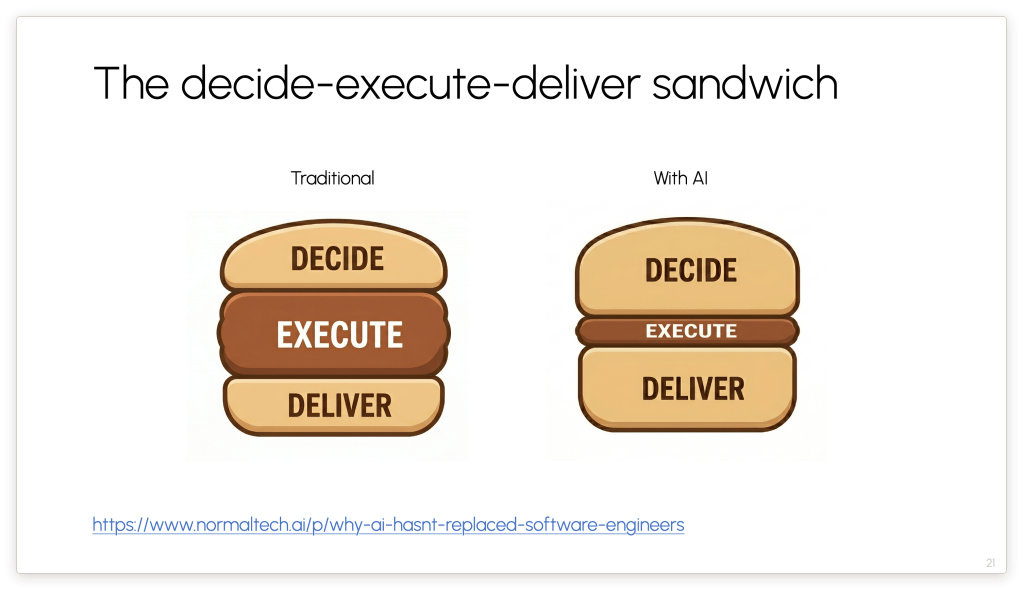
Fortune compared KPMG’s view with Princeton professor Arvind Narayanan’s “decide, execute, deliver” framework, which divides work into judgment, execution and delivery. Narayanan has argued that AI compresses the execution layer more than the layers involving accountability and decision-making.
Seiler told Fortune that KPMG’s deployments fit much of that framework, but he said faster work also creates more need to verify results and coordinate outcomes. Narayanan told Fortune that AI is raising the ambition and complexity of projects, which can increase the need for judgment even as tools make parts of execution easier.
Narayanan also pointed Fortune to concerns he has raised about AI-related lock-in. In a LinkedIn post cited by Fortune, he warned that agents could become repositories of tacit organizational knowledge, making companies dependent on them for workflows and know-how.
Why the deal is not exclusive
Kapase told Fortune that KPMG is not getting exclusive access to unreleased OpenAI capabilities. She said KPMG brings enterprise transformation experience, including work in regulated industries, the public sector and cybersecurity, and pointed to public-sector modernization and KPMG’s Daybreak Cyber product as parts of the partnership.
Seiler told Fortune the OpenAI alliance adds to KPMG’s existing AI partnerships rather than replacing them. He said KPMG also works with other frontier labs, including Anthropic, and does not expect large clients to rely on only one model provider.
According to Fortune, Seiler said some clients are already using lower-cost alternatives, including open-source models from China, for narrower tasks as a cost and resilience measure. Kapase said OpenAI is focused on helping customers get more value from OpenAI’s own models.
KPMG’s broader message, as described in its blog post, is that agentic AI adoption should be treated as a set of business decisions rather than a standard technology migration. The partnership gives KPMG a case study inside OpenAI as it tries to sell that approach to other large organizations.
This story draws on original reporting from Fortune.