
Hormuz fertilizer disruption revives guano’s role in U.S. expansion
An Amherst historian says fertilizer scarcity shaped guano mining, forced labor and a 1856 U.S. law on overseas territory.
By Maya Lindqvist · Senior Technology Correspondent
3 min read
The Hormuz fertilizer disruption has put crop nutrients back at the center of global food concerns, with the Strait of Hormuz normally carrying roughly one-third of the world’s fertilizer, according to The Conversation. Edward D. Melillo, a history and environmental studies professor at Amherst College, says the episode fits a longer pattern in which fertilizer has been treated as a strategic resource.
Melillo wrote that pressure on fertilizer supplies did not begin with the Iran war. Russia’s invasion of Ukraine disrupted natural gas markets and nitrogen fertilizer trade, sanctions on Belarus unsettled potash markets, and China limited phosphate exports to steady domestic prices, according to research and market accounts cited by The Conversation.
Why does the Strait of Hormuz matter for fertilizer?
The Strait of Hormuz is a key shipping corridor for fertilizer, a basic input for growing food. If shipments are delayed or blocked, farmers can face higher costs or shortages, which can feed into food prices and food-security risks, according to The Conversation and the Food and Agriculture Organization.
Melillo argues that the modern concern has a 19th-century precedent: seabird guano. Before synthetic fertilizers changed farming in the 20th century, dried bird waste from Pacific and Caribbean islands became a major global commodity because it contained nitrogen and phosphorus needed by depleted soils.
For centuries, farms had relied on nearby nutrient sources such as animal manure, crop residues and human waste. Industrial cities broke that cycle by drawing food from distant farms while returning few nutrients to rural soils, Melillo wrote.
How guano became a global fertilizer trade
South America’s arid Pacific coast held unusually rich guano deposits because little rain washed away seabird droppings. Indigenous farmers along Peru’s coast had used the resource for centuries, while European interest grew after Alexander von Humboldt brought samples of Peruvian guano to Europe in 1804, according to Melillo.
Commercial demand accelerated in the 1840s as agricultural chemists, including Justus von Liebig, showed that crops required nutrients taken from the soil to be replaced. Fertilizer companies later moved millions of tons of guano to farms in Europe and North America.
The trade also carried severe human costs. On Peru’s Chincha Islands, Chinese indentured laborers worked in harsh conditions breaking hardened guano with hand tools and breathing ammonia-heavy dust, Melillo wrote. In 1854, the British foreign secretary, the Earl of Clarendon, said he read reports of their treatment with “horror and disgust.”
What was the Guano Islands Act?
The Guano Islands Act of 1856 allowed U.S. citizens to claim unoccupied islands with guano deposits on behalf of the United States. Congress passed the law after American policymakers worried about relying on Peru for fertilizer, according to Melillo.
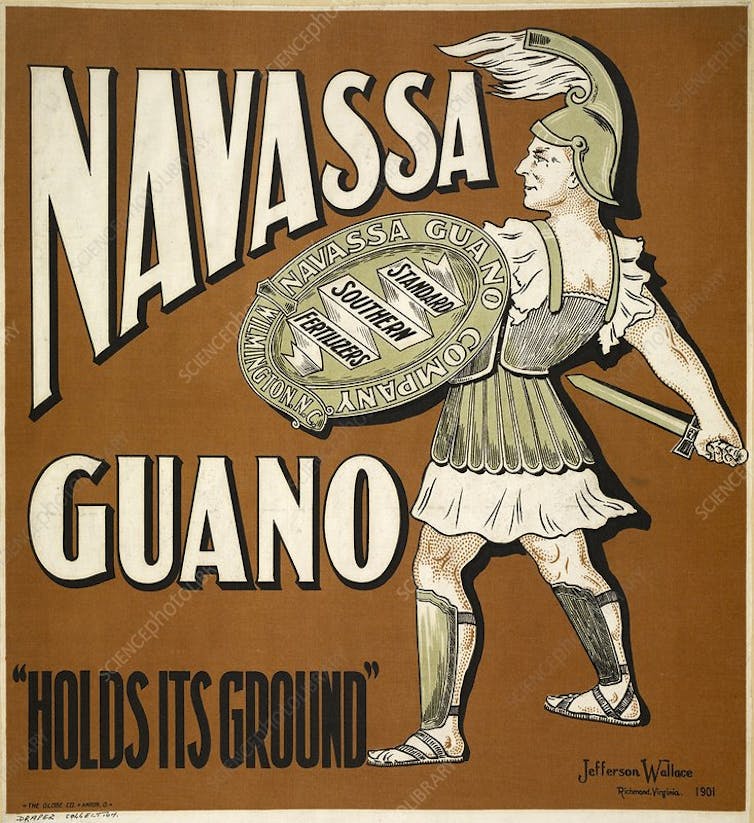
The law helped bring dozens of Caribbean and Pacific islands into the reach of U.S. power. One example was Navassa Island, between Haiti and Jamaica, where U.S. companies built a guano mining operation that supplied farms in the eastern United States.
Melillo wrote that Black workers recruited largely from Baltimore mined guano on Navassa under severe heat, dust and isolation. On Sept. 14, 1889, 137 Black miners rebelled against 11 officers of the Navassa Phosphate Company; by the end of the day, five white supervisors were dead.
The U.S. Navy sent the USS Kearsarge, and 18 Black workers were taken to Baltimore for murder trials. In 1890, the Supreme Court’s decision in Jones v. United States upheld federal jurisdiction over Navassa, reasoning that legal authority could rest on “actual, continuous, and useful possession,” including for mining.
Several defendants received death sentences, but President Benjamin Harrison commuted them in 1891 after pressure from Black civic groups and other supporters. Melillo says the history of guano shows that agricultural abundance has long depended on distant resources, shipping routes and workers whose labor tied remote islands to global food production.
This story draws on original reporting from Fortune.