
Gen Z lonely weekends are tied to money stress, surveys find
Harris Poll and Ogilvy reports say many Gen Z adults want in-person time but are staying home to avoid the cost of going out.
By Maya Lindqvist · Senior Technology Correspondent
3 min read
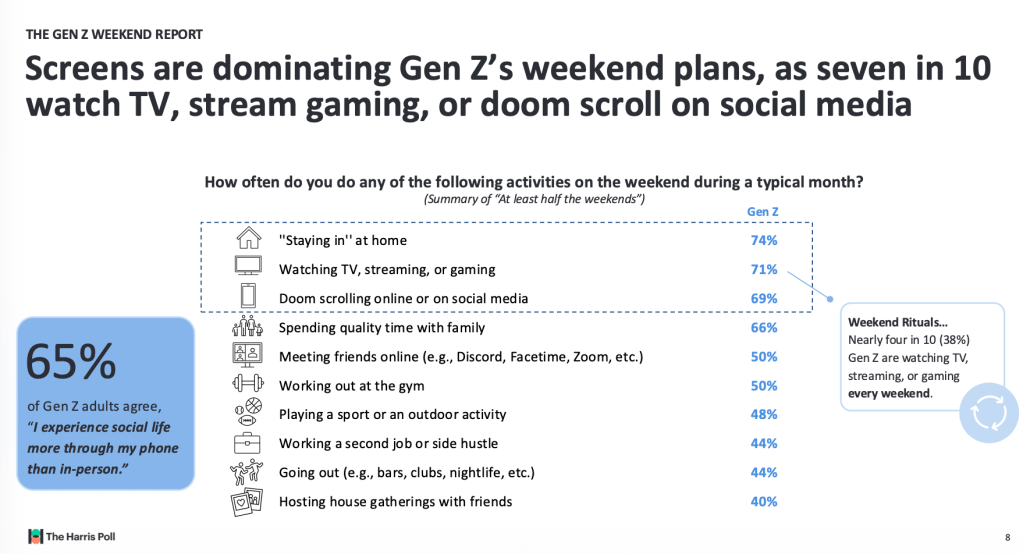
New reports from The Harris Poll and Ogilvy frame Gen Z lonely weekends as a money problem as much as a social one. The findings suggest many young adults want more in-person connection, yet pull back from plans because a night out can strain already tight budgets.
The Harris Poll surveyed 4,100 U.S. adults in late May and early June, including 603 Gen Z adults. It found that 51% of Gen Z respondents reported weekend loneliness, the highest share among generations in the survey and far above the 14% reported by Boomers.
Libby Rodney, chief strategy officer at The Harris Poll, told Fortune the pattern reflects a “spending hangover.” In this context, that means young adults are choosing financial caution over fear of missing out because they expect regret after paying for an expensive weekend.
Why are Gen Z weekends lonely?
Harris found that nearly three-quarters of Gen Z spend weekend time at home. It also found that 68% say going out is not worth the hit to their wallet, while 62% avoid making weekend plans to escape the regret that can follow spending.
Rodney pointed to drink prices of $15 to $25 as one reason a normal night out can become unaffordable. The survey also asked what respondents would do with an unexpected $100 for the weekend; 71% of Gen Z said they would save it or use it for bills, compared with 46% of Boomers.
Ogilvy’s Gen Z Pulse report, based on 2,100 respondents in the U.S., U.K. and Australia, also found that money and belonging are closely linked for young adults. The report cited Deloitte data showing that half of Gen Z feels financially insecure, up from less than one-third a year earlier.
Screens are filling a gap
Ogilvy found that more than 60% of Gen Z respondents are trying to cut their screen time, and 52% want more in-person social time. Only 6% said they are satisfied with their current level of in-person experience.
Majorities in each country surveyed by Ogilvy said digital contact helps, while in-person time remains necessary: 58% in the U.S., 63% in the U.K. and 55% in Australia. The report also found that only 17% of young Americans feel strongly connected to even one community, while 75% say belonging takes constant effort.
Rodney also linked loneliness to fewer free or low-cost places for young people to gather. She cited data showing that 75% of children ages 8 to 12 are allowed to play on Roblox, while 25% are allowed to play unsupervised in their own front yards.
Lower-cost social life is growing
The reports also show Gen Z experimenting with cheaper ways to meet people. Harris found that 85% have tried lower-cost social workarounds in the past year, including hosting friends at home, looking for happy-hour deals and using free fitness-class trials as outings.
Harris also found that 73% want more social settings where alcohol is not the focus, and 65% feel more connected in wellness-focused settings than in traditional nightlife. Ogilvy found that 42% of Gen Z finds consistent belonging through hobby groups, interest communities and fandoms, close to the shares citing friends at 44% and family at 48%.
Run clubs are one example of that shift. Ogilvy cited Strava data showing the number of run clubs on its platform nearly quadrupled in 2025, while organized events rose 50% year over year.
Rodney told Fortune that Gen Z has “high intent” but “low budget,” and said businesses should not dismiss the group because of current spending limits. Ogilvy projected Gen Z will lead all generations in spending growth, adding an estimated $9 trillion by 2034.
This story draws on original reporting from Fortune.