
Europe heat workplace safety becomes a business risk as temperatures rise
European employers are adding heat stress to safety plans as rising temperatures threaten workers, output and infrastructure.
By Maya Lindqvist · Senior Technology Correspondent
4 min read
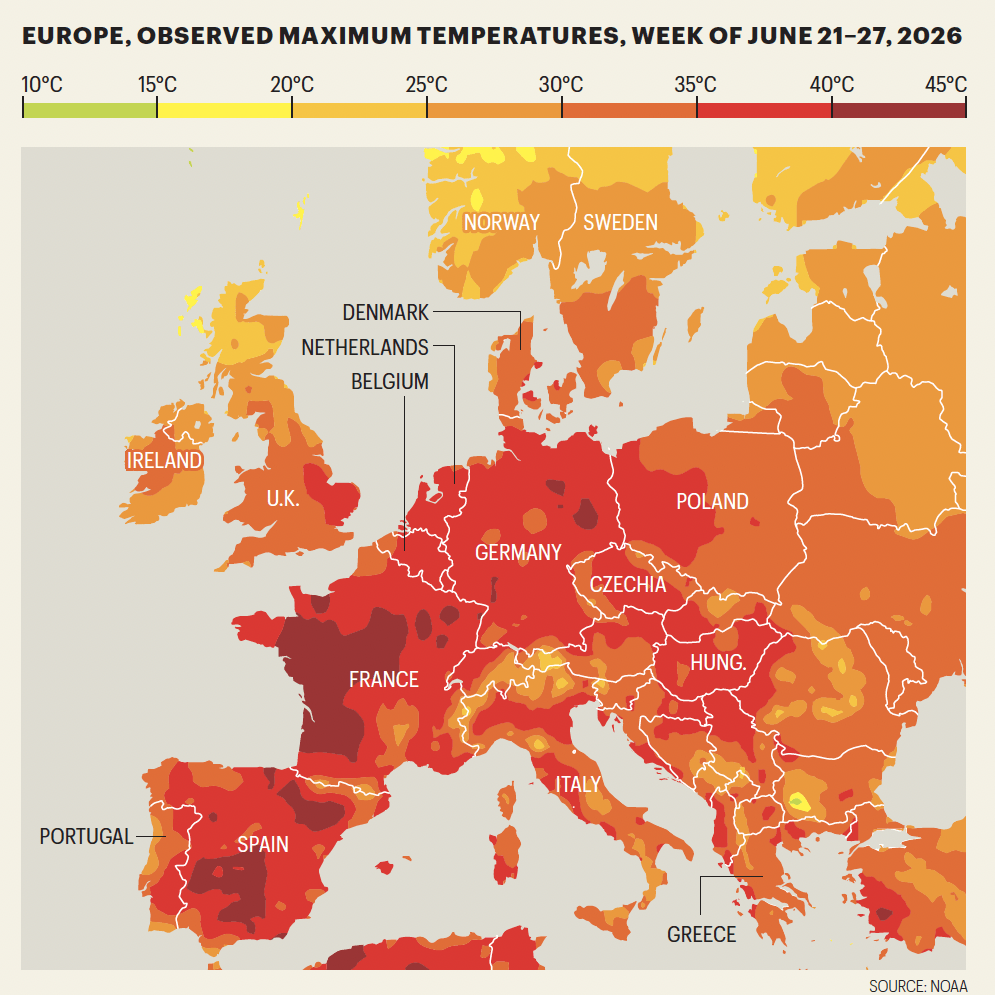
Europe heat workplace safety is moving from a seasonal concern to a core business risk as the continent warms faster than almost anywhere else. Copernicus, the European Union’s Earth observation service, says Europe has warmed at twice the global average since the 1990s, trailing only the Arctic.
The health stakes are already high. Scientists cited by Copernicus have warned that a very strong El Niño, driven by warming in the Pacific Ocean, could push temperatures to record levels, while Europe’s worst June heat wave is estimated to have killed up to 25,000 people, with older and vulnerable residents most at risk.
How does heat affect workplace safety in Europe?
Heat stress can cause illness, fatigue and more mistakes, making it a workplace safety issue as well as a productivity problem. The World Health Organization estimates that worker output falls by 2% to 3% for every degree Celsius above 20 degrees.
The International Labour Organization says employers should not treat heat stress only as a heat-wave problem. Manal Azzi, an occupational health and safety expert at the ILO, has pointed to the agency’s figures showing that 90% of excessive-heat exposure happens outside official heat-wave periods.
Some countries already force work stoppages in extreme conditions. In Italy and Greece, health and safety rules require workers to stop during the hottest midday periods, according to the report.
Allianz has described extreme heat as a structural economic risk for Europe. In a stress test titled Too Hot to Grow, the financial services company projected heat-related losses by 2030 of $240 billion in France, $147 billion in Italy, $131 billion in Germany and $120 billion in Spain, with cumulative GDP losses reaching as much as 7% in the most-exposed economies.
Allianz also warned that much of the damage falls outside conventional insurance coverage because it comes through deaths, lost hours, pressure on health systems and stressed infrastructure rather than claims that standard indemnity contracts are built to cover.
Which workers face the greatest heat risks?
Maurizio Curtarelli, a senior researcher at the European Agency for Safety and Health at Work, said the highest-risk sectors include outdoor jobs such as farming, construction, waste collection and logistics. He also cited manufacturing, mining and metallurgy, where heat-producing equipment or heavy protective clothing can raise danger.
EU-OSHA’s survey suggests the issue is spreading beyond the most obvious industries. One in five European workers reported unhealthy exposure to extreme temperatures, and about one in eight reported exposure to intense sun.
The agency’s Heat at Work guidance, published last year, has become its most downloaded document, according to EU-OSHA. It advises employers to assess heat risks, consult workers, train staff and monitor employees for heat-related illness.
How are companies responding?
IBM has set up internal safety committees led by employee-based work councils to track heat-related problems alongside other health issues. A health and safety spokesperson for IBM in Spain said extreme heat has not yet emerged as a risk in its accident data, but the company reviews trends and investigates causes.
Schneider Electric has added air-conditioned rest areas in many of its roughly 70 factories and distribution centers in Europe, according to human resources director Dominique Laurent. The company also uses measures including reversible heat pumps, AI-enabled air conditioning, insulated roofing and software to manage cooling and ventilation.
DHL has adjusted support for delivery staff. In Germany, the company gives couriers hot-weather cool boxes containing items such as a reusable cooling towel, a water-activated wrist cooler and a neck protector, according to spokesperson Sarah Preuß.
Air conditioning can protect workers, but it can also raise energy bills and emissions if powered by fossil fuels. The report notes high fossil-fuel reliance in electricity grids in Italy, Greece, Cyprus and Malta, some of the EU’s hotter countries.
Employers are also looking at natural cooling measures. Mark Shayler, head of ESG at Idverde, pointed to Ikea’s use of pocket parks and rain gardens at stores and city-center sites as examples of vegetation-based cooling that can reduce heat without electricity.
This story draws on original reporting from Fortune.