
Air Force One history frames new dispute over Trump’s Qatar jet
A historian says the fight over a Qatar-provided 747 reflects how presidential aircraft reshaped the modern presidency.
By Maya Lindqvist · Senior Technology Correspondent
3 min read
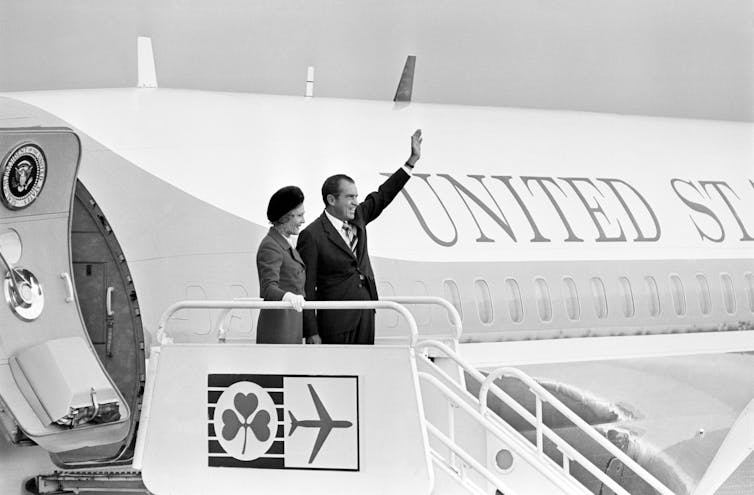
The latest Air Force One history debate began with a security question about a Boeing 747 provided by Qatar to President Donald Trump. The New York Times reported on July 8, 2026, that the aircraft lacked advanced defensive systems already available on the presidential 747s in service since 1990, reviving criticism that the arrangement was improper.
Trump later said the plane would be sent for extensive upgrades, according to The New York Times. Peter Kastor, a professor of history and American Culture Studies at Washington University in St. Louis, wrote in The Conversation that the dispute is part of a longer story: presidential aircraft have changed what presidents can do, how they campaign and how they project U.S. power.
The current Boeing 747s used as Air Force One function as transportation, command post, press area, medical space and living quarters, according to CNBC and the White House. Kastor argued that the plane has become “an essential arm” of the presidency, citing Smithsonian National Air and Space Museum curator Von Hardesty.
Why is Air Force One important?
Air Force One matters because it lets a president keep working while away from Washington, including during crises and foreign trips. Kastor wrote that the modern presidency would look very different without aircraft that allow rapid travel, secure communications and a highly visible presidential presence.
For much of U.S. history, presidents traveled rarely while in office because leaving Washington meant losing close contact with government offices. Theodore Roosevelt became the first sitting president to leave the United States when he visited the Panama Canal construction site in 1906, according to the State Department’s historical records. Woodrow Wilson crossed the Atlantic in 1918 to join post-World War I negotiations in Versailles.
The first aircraft designated for presidential use arrived in 1933, but Franklin Roosevelt did not fly on it, according to Kastor. Roosevelt’s first presidential flight came in 1943, when American Airlines supplied the Dixie Clipper for his trip to meet Allied leaders in Casablanca. In 1945, he traveled to Yalta aboard the Sacred Cow, a Douglas VC-54C built for presidential travel.
Jet travel changed the office more dramatically. President John F. Kennedy received a Boeing 707 in 1962, the first jet-powered Air Force One, according to the National Museum of the U.S. Air Force. Kastor wrote that faster, higher-flying and quieter jets made it possible for presidents to appear more often around the country and abroad.
That visibility became part of Cold War diplomacy. Kastor pointed to Richard Nixon’s 1972 trip to China and Ronald Reagan’s 1986 trip to Iceland for talks with Soviet leader Mikhail Gorbachev as examples of presidents using travel to put themselves at the center of world events. After the Cold War, Bill Clinton, George W. Bush and Barack Obama each made more than twice as many international trips as Reagan, according to Kastor.
Air Force One also changed domestic politics. As state primaries became central to presidential nominations in the 1970s, aircraft made it possible for incumbents to govern and campaign across the country. Kastor noted that Clinton visited 37 states over 73 days in his first year as president.
The aircraft’s crisis role was tested on Sept. 11, 2001. The 9/11 Commission report said President George W. Bush was flown from Florida to military sites in Louisiana and Nebraska before returning to Washington that night. Kastor wrote that the day showed both the plane’s value as secure transport and the limits of its communications systems during an emergency.
This story draws on original reporting from Fortune.