
Pakistan crypto pact brought access but no stablecoin rollout
A World Liberty Financial-linked deal has produced no Pakistani stablecoin pilot, while analysts told Al Jazeera it helped Islamabad reach Trump’s circle.
By Sofia Marchetti · World Affairs Correspondent
4 min read
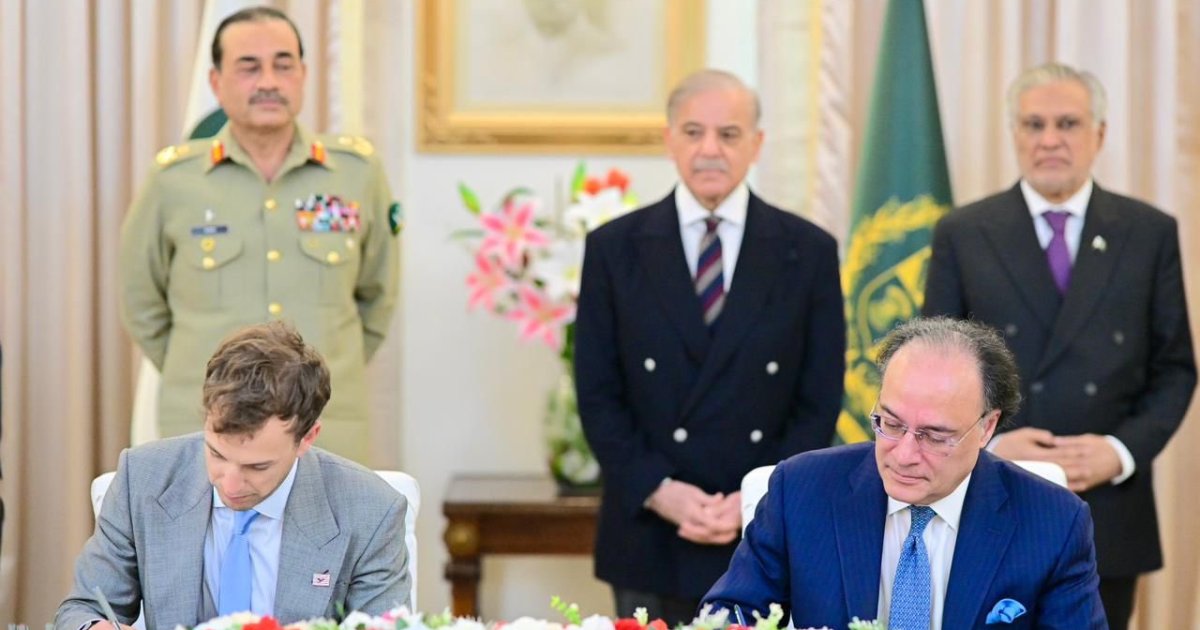
Pakistan’s agreement with a company linked to World Liberty Financial has not led to a stablecoin pilot, licences or known transactions, Al Jazeera reported. Analysts told the outlet the deal’s clearer payoff was political: access to US President Donald Trump’s administration.
Trump’s financial earnings released this week showed that World Liberty Financial, his family’s crypto venture, generated more than $500 million for him from token sales in 2025, according to Al Jazeera. Pakistan was one of the early governments to engage with the firm.
In January, Pakistan’s Ministry of Finance signed a memorandum of understanding with SC Financial Technologies, an affiliate of World Liberty Financial, to examine possible use of the USD1 stablecoin for cross-border payments, Al Jazeera reported. USD1 is pegged to the US dollar and is issued by World Liberty Financial.
The signing in Islamabad included Finance Minister Muhammad Aurangzeb and Zach Witkoff, the son of Trump adviser Steve Witkoff, according to Al Jazeera. Prime Minister Shehbaz Sharif and army chief Field Marshal Asim Munir attended the ceremony.
No rollout yet
Nearly six months after the signing, Pakistani officials confirmed there had been no USD1 pilot, no licences issued and no known transactions involving the stablecoin, Al Jazeera reported. A senior Pakistani banking executive, speaking anonymously to the outlet, described the memorandum as an exploratory technical discussion and knowledge-sharing effort, with no commitment to deploy a specific token.
Pakistan already ranks among the world’s largest crypto markets. Al Jazeera cited the Chainalysis crypto adoption index, which placed Pakistan third globally last year, behind India and the United States.
Much informal crypto activity in Pakistan is believed to use Tether’s USDT, the world’s largest stablecoin, Al Jazeera reported. The banking executive said no reliable measurement exists for the volume of money moving through such channels, and that available figures are inferred from formal inflows.
Formal remittances are at record levels. The State Bank of Pakistan said the country received $38.3 billion in remittances in the last financial year, up 27 percent from the prior year, according to Al Jazeera. In May, inflows reached $4.25 billion, and the central bank expects remittances to exceed $42 billion this year.
Ibrahim Khalil, a Canada-based banking and finance professional, told Al Jazeera that USD1 would not address the reasons some users avoid banks if banking channels still remain part of the process. He also said Pakistan’s central bank would need to convert USD1 back into dollars unless trading partners accepted the token directly.
Regulation still pending
Pakistan has moved to create rules for digital assets. The Virtual Assets Act, passed in March, established the Pakistan Virtual Assets Regulatory Authority, or PVARA, with authority to license firms and penalize unapproved operators, Al Jazeera reported.
In April, the State Bank allowed banks to open accounts for licensed crypto firms, according to Al Jazeera. But PVARA is still taking preliminary applications, and full licensing rules have not been published. Binance and HTX have received no-objection certificates and are registered, but they are not yet authorised to operate.
Access to Washington
Al Jazeera reported that the World Liberty Financial delegation first came to Islamabad in April 2025, shortly after an attack in Indian-administered Kashmir’s Pahalgam raised tensions between India and Pakistan. In June 2025, Pakistan nominated Trump for the Nobel Peace Prize, crediting him with helping reduce the India-Pakistan standoff.
Trump hosted Munir at the White House for lunch in June 2025, which Al Jazeera described as the first time a US president had received a Pakistani army chief who was not also head of state. During the US-Israeli war on Iran, Pakistan later presented itself as a mediator between Washington and Tehran.
Khurram Husain, a Karachi-based economist and commentator, told Al Jazeera the memorandum had “no real policy basis” and functioned as an instrument of access. Khalil gave a similar assessment, telling the outlet the exercise amounted to “pay for access.”
The White House has said there were no conflicts of interest, according to Al Jazeera. Bilal Bin Saqib, who chairs PVARA and previously served as an adviser to World Liberty Financial before joining the Pakistani government, PVARA and the Finance Ministry did not respond to the outlet’s requests for comment.
This story draws on original reporting from Al Jazeera.