
Analyst says Iran’s president faces blame as US-Iran MoU falters
Kayhan Valadbaygi argues that Tehran is steering anger over the troubled US-Iran framework toward Masoud Pezeshkian.
By Lucas Ferreira · Science & Environment Writer
3 min read
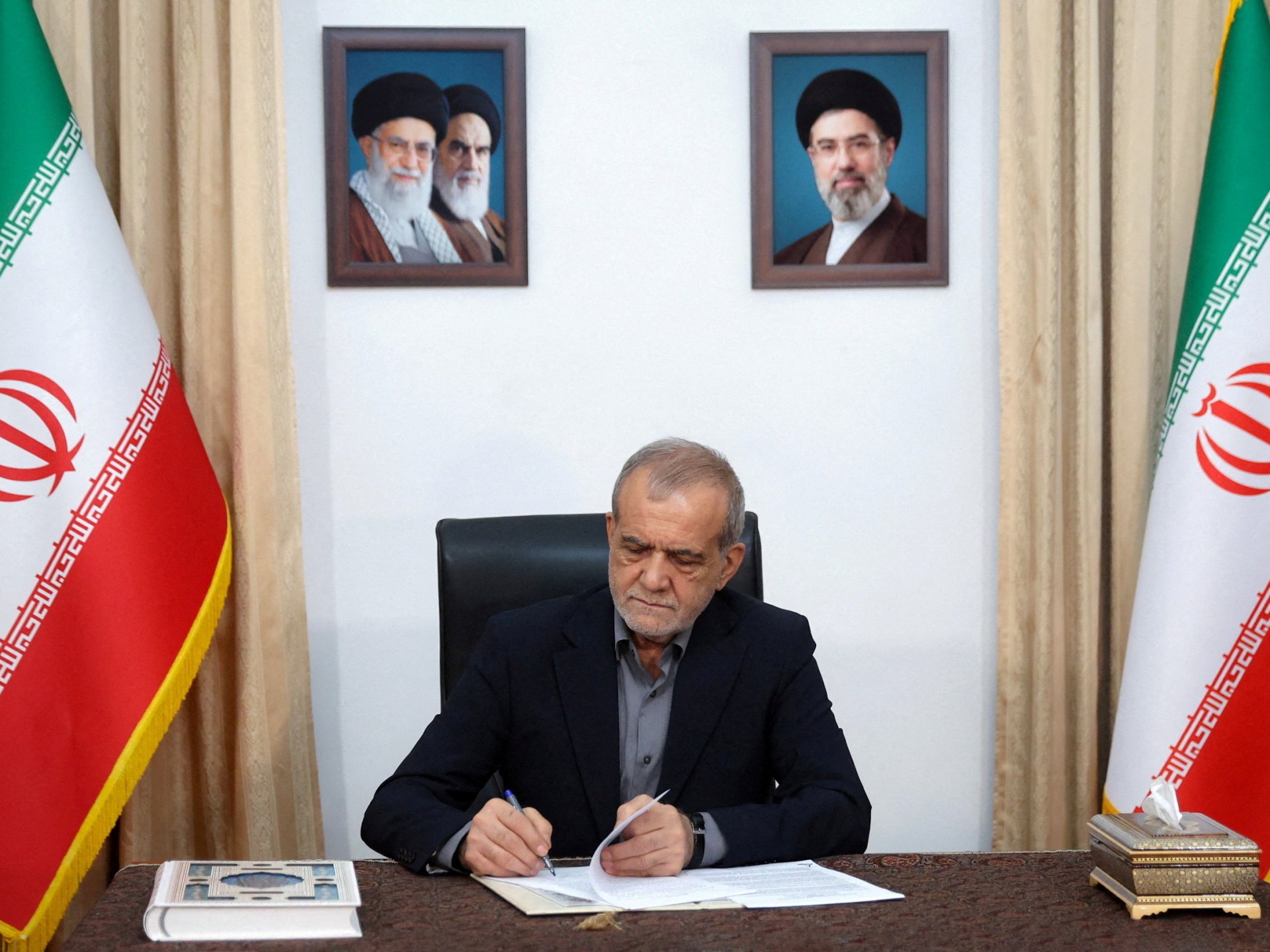
Renewed US strikes on Iran have put a recently signed US-Iran memorandum of understanding under new strain, raising doubts about the framework for peace talks. Kayhan Valadbaygi, a research fellow at the International Institute of Social History, wrote in an Al Jazeera opinion essay that Iranian President Masoud Pezeshkian is being positioned to absorb blame if the deal fails.
Valadbaygi wrote that US attacks on Iran have killed at least 18 people and wounded dozens in recent days. He argued that anger within the Iranian government’s support base has increased as the MoU’s future has become less certain.
Khamenei statement put responsibility on Pezeshkian
According to Valadbaygi, Supreme Leader Mojtaba Khamenei’s first public statement after the MoU was signed said he held “a different view” of the agreement. Valadbaygi wrote that Khamenei said he allowed the deal because Pezeshkian, as head of the Supreme National Security Council, had accepted responsibility for protecting Iran’s rights and the “Resistance Front.”
Valadbaygi noted that Khamenei’s statement did not name Mohammad Bagher Ghalibaf, the parliament speaker whom Foreign Minister Abbas Araghchi had identified as the official entrusted by the system with responsibility for the negotiations. Valadbaygi argued that the omission showed a political division of risk: Ghalibaf would gain if the MoU succeeded, while Pezeshkian would be blamed if it collapsed.
The MoU was signed in Tehran on June 18, according to the caption of a Reuters-distributed handout photo from Iran’s presidential website and WANA. Valadbaygi described the agreement as one of the most consequential in the Islamic Republic’s recent history.
Analyst points to split inside ruling bloc
Valadbaygi said the dispute reflects a deeper split inside what he calls Iran’s “military-bonyad complex,” a network linking the Islamic Revolutionary Guard Corps, security forces and major revolutionary-religious foundations. He wrote that the network grew through asset transfers in the 2000s and sanctions-era financial channels, and that its leaders are appointed by the supreme leader.
In Valadbaygi’s account, one side of the bloc is represented by Ghalibaf and favors economic recovery through controlled engagement with global capital. The other side, organized around the Paydari Front, treats engagement with the United States and Western investment as a threat to regime survival.
Valadbaygi identified a proposed $300bn private Reconstruction and Development Fund as a key fault line. He wrote that Ghalibaf’s camp sees the fund as needed for reconstruction and stability, while Paydari figures see it as giving Washington and regional partners influence over Iran’s rebuilding priorities.
Valadbaygi argued that Pezeshkian’s political weakness made him useful to Iran’s ruling bloc after his 2024 elevation to the presidency. Unlike previous presidents, Valadbaygi wrote, Pezeshkian lacks an independent political base, security network or factional leverage, making him a convenient official to sign off on risks driven by others.
The analyst wrote that media linked to the IRGC and close to Ghalibaf have offered Pezeshkian limited protection from Paydari attacks because the government still needs a working presidency while the MoU remains alive. He concluded that blaming Pezeshkian may delay, but will not settle, the internal struggle over Iran’s direction.
This story draws on original reporting from Al Jazeera.