
Fakir death puts Italy police accountability rules under scrutiny
A Bologna restraint death has triggered inquiries, protests and a new fight over Italy’s rules for investigating police conduct.
By Sofia Marchetti · World Affairs Correspondent
4 min read
The death of Abderrahim Fakir during a police restraint in Bologna has triggered official inquiries and renewed scrutiny of Italy’s system for holding officers accountable. The case has also become an early test of a new procedure that changes how alleged police offences are handled.
Fakir, a 42-year-old Moroccan-born man who had lived in Bologna for more than 30 years, died on Sunday after two Italian police officers and a civilian held him on the ground, Al Jazeera reported. A video filmed from a nearby balcony shortly after 12:30pm local time shows four Italian Red Cross volunteers standing close by after arriving with an ambulance.
According to Al Jazeera, the footage lasts six minutes and 56 seconds. Fakir can be heard calling for help for more than four minutes before he becomes silent, while his ankles are bound with a black plastic zip tie.
Bologna police said officers had been responding to reports of a person acting violently. Police said emergency services were called immediately and that Fakir died after restraint procedures were used in the presence of medical staff.
Prosecutors ordered a post-mortem examination, and Bologna’s local health authority opened an internal inquiry, Al Jazeera reported.
Family lawyer cites earlier custody death cases
Fabio Anselmo, the lawyer representing Fakir’s family, said at a July 21 news conference in the Italian Senate that the video raised serious questions about the response after Fakir stopped moving. “When the officers stand up, Fakir may still be alive,” Anselmo said, according to Al Jazeera. “Yet no one attempts to help him. No one removes the restraints.”
The news conference was hosted by Senator Ilaria Cucchi, whose brother Stefano Cucchi died in police custody in 2009. Anselmo represented the Cucchi family in the case, which led to the conviction of several officers and became a major reference point in Italy’s debate over police violence and accountability.
Anselmo also pointed to a January 2026 ruling by the European Court of Human Rights in the case of Riccardo Magherini, who died in Florence in 2014 after being held face down by police. The court found that Italy violated Article 2 of the European Convention on Human Rights because authorities had not shown that keeping him in that position was “absolutely necessary,” Al Jazeera reported.
Vigils give way to clashes
After the video spread online, people gathered at the place where Fakir died. At a vigil, Fakir’s sister held up his photograph and told reporters the family wanted justice, not revenge, Al Jazeera reported.
Barbara Spinelli, a lawyer who had represented Fakir in immigration matters, told Al Jazeera that Fakir had faced severe financial pressure after a small removals and logistics business ran into debt. She said he had also become worried about Italy’s harder debate over migration and the European Union’s Pact on Migration and Asylum, though she said there were no legal grounds for his expulsion from Italy at the time.
On July 20, Bologna Mayor Matteo Lepore called a solidarity rally in Piazza Maggiore for Fakir’s family. Al Jazeera reported that thousands attended, including students, union members and civil rights groups.
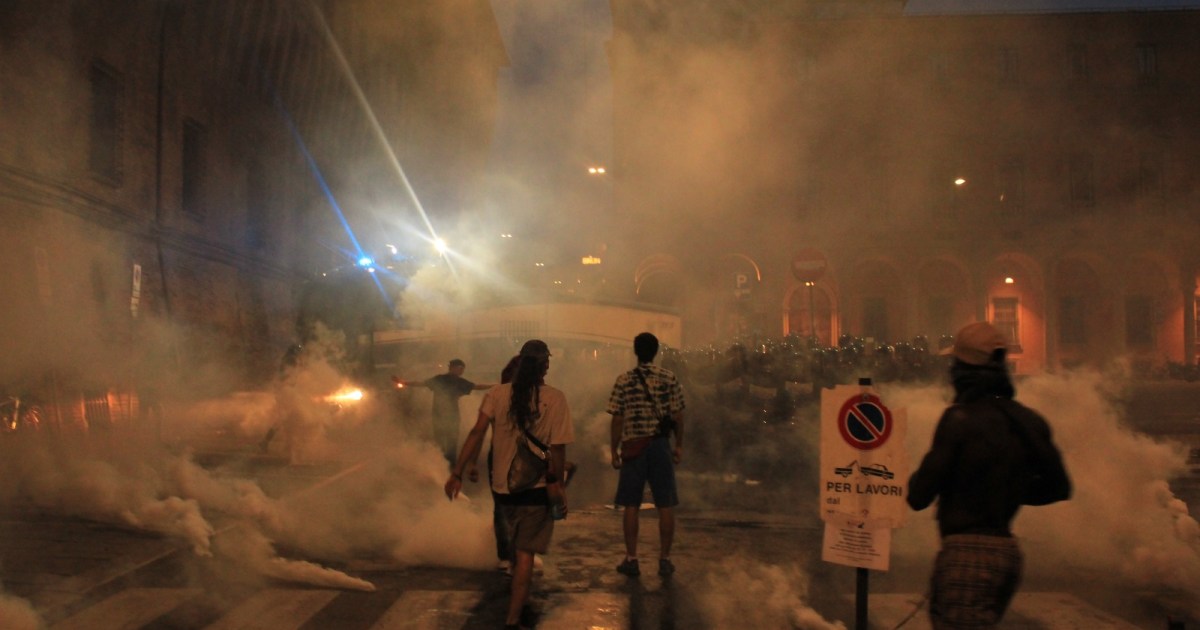
The event later turned violent after some demonstrators marched toward the Prefecture and police headquarters. Protesters threw bottles and fireworks, broke shop windows and cash machines, and set two cars on fire, while police used batons, water cannon and tear gas, according to Al Jazeera.
Police said 64 officers were injured and that Bologna’s historic centre sustained extensive damage. Several demonstrators accused officers of excessive force, and a freelance journalist working for L’Espresso told Al Jazeera he was beaten by police while retreating from the clashes.
New law faces its first test
Prime Minister Giorgia Meloni condemned the unrest as “unacceptable” and said Fakir’s death must be fully established “without prejudice and without discounts for anyone,” while adding that violence against police could not be justified.
Opposition parties called on Interior Minister Matteo Piantedosi to brief parliament and release any body-camera footage from the officers involved, Al Jazeera reported.
The investigation is expected to be the first conducted under Article 45-bis, a procedure introduced by the Meloni government’s Security Decree, which took effect in February 2026. Under that rule, officers are not immediately listed as criminal suspects when alleged offences occur during duty; opposition parties, legal scholars and rights groups say the change could weaken accountability.
This story draws on original reporting from Al Jazeera.