
Webb data point to a strange past for planet orbiting dead star
Astronomers studying WD 1856 b say the Jupiter-size planet is unexpectedly warm, hinting it moved inward long after its star became a white dwarf.
By Maya Lindqvist · Senior Technology Correspondent
4 min read
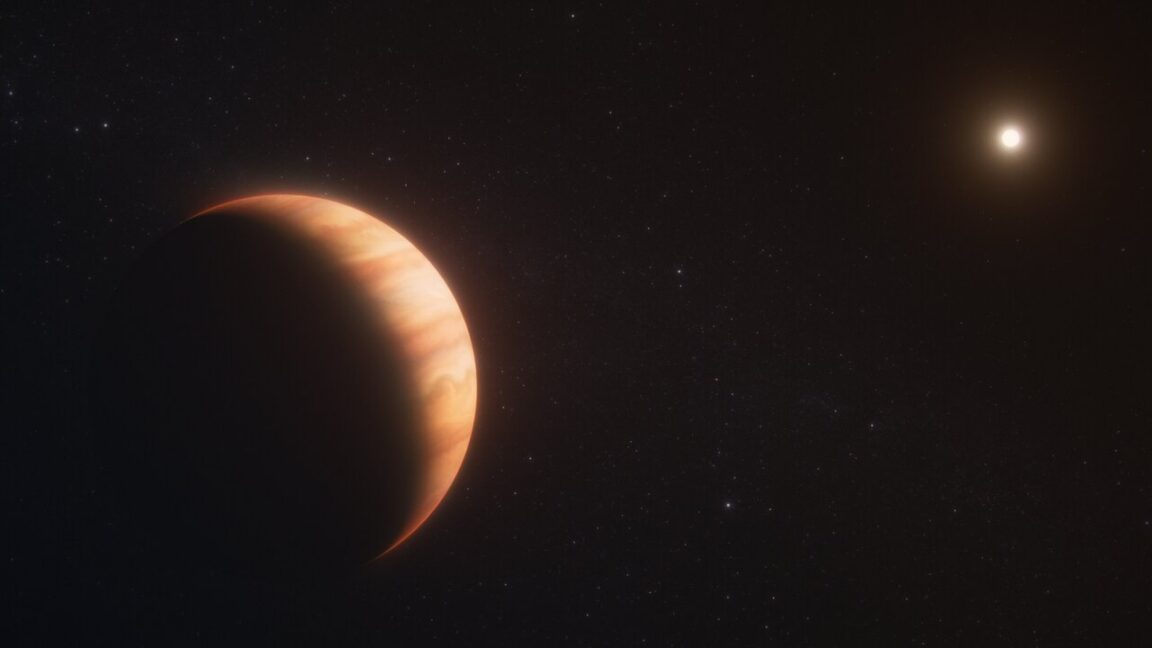
A Jupiter-size planet circling the remnant of a dead Sun-like star appears to have moved into its tight orbit billions of years after the star’s violent final phase. A Nature study using the James Webb Space Telescope adds new evidence that WD 1856 b survived an extreme history unlike anything confirmed in another planetary system.
WD 1856 b is the only confirmed planet known to have lived through the death of a Sun-like star, according to the astronomers behind the work. It orbits a white dwarf, the dense leftover core of a star that expanded into a red giant and then shed much of its mass.
The planet was first spotted in 2020 during a TESS survey of about 2,000 white dwarfs. Researchers had been looking for small bodies such as comets or asteroids crossing in front of the stars, but instead found a gas giant.
Christopher O’Connor, a theoretical astrophysicist at Cornell University and co-author of the Nature paper, said the system immediately stood out as unusual. The white dwarf is about seven times smaller than the planet, yet the star’s light falls by only about half during a transit. O’Connor said the best explanation is that the planet only skims the star’s face from Earth’s point of view.
A planet in the wrong place
The planet’s orbit is also difficult to explain. WD 1856 b circles the white dwarf at about 0.02 astronomical units, far closer than expected for a gas giant around a stellar remnant.
O’Connor said a star’s red-giant phase should destroy inner planets. As the star later contracts into a white dwarf and loses roughly half its mass, outer planets should shift farther away because the star’s gravity weakens. WD 1856 b instead ended up close to the white dwarf.
To study the planet in more detail, the team used JWST to observe one transit on April 27, 2023. The event lasted about eight minutes.
The geometry made the analysis difficult. Standard methods for reading exoplanet atmospheres assume a small planet passing fully across a much larger star. The team instead built equations for a changing overlap between the planet and the star, and modified the POSEIDON atmospheric-retrieval software developed by lead author Ryan MacDonald.
The results showed an atmosphere with aerosol hazes and methane. They also showed the planet is much warmer than expected.
Heat points to late migration
According to the study, WD 1856 b emits about 25 times more energy than it receives from its fading host star. O’Connor said the white dwarf has been dead for about 6 billion years, meaning the planet should have cooled to roughly 150 to 200 Kelvin, similar to Jupiter’s cloud tops. Instead, the team found a temperature near 400 Kelvin.
O’Connor said the extra heat must come from inside the planet rather than from starlight. The researchers argue it cannot be leftover heat from the planet’s formation, so another event must have warmed it.
The team tested two main explanations. In one, the planet was already close in and survived being swallowed during the star’s red-giant stage. In the other, the planet began farther out, was disturbed by gravitational interactions with companion objects, and moved inward over time on a highly stretched orbit.
The timing favored the second scenario, according to the study. Models run backward from the current temperature suggested the heating happened 3 billion to 5.5 billion years after the red-giant phase ended, too late for the close-in survival model. O’Connor said the team interprets the heat as a remnant of the migration process, most likely tied to gravitational interactions with WD 1856’s two distant stellar companions.
The authors note a limitation. The cooling models used for the estimate were designed for Jupiter-like atmospheres with methane making up about 0.3 percent, while WD 1856 b’s methane level is about 7 percent. O’Connor said models better matched to this planet’s atmosphere may be needed.
WD 1856 lies about 75 light-years from Earth. O’Connor said its proximity suggests more planets that survived stellar death may remain undiscovered, and the team has already taken additional JWST observations of the system.
This story draws on original reporting from Ars Technica.