
Viking arm that opened Air and Space Museum remains unidentified
A NASA sampler arm cut the museum’s 1976 opening ribbon via a Mars relay, but its whereabouts are still unclear 50 years later.
By Hana Yoshida · Markets Reporter
3 min read
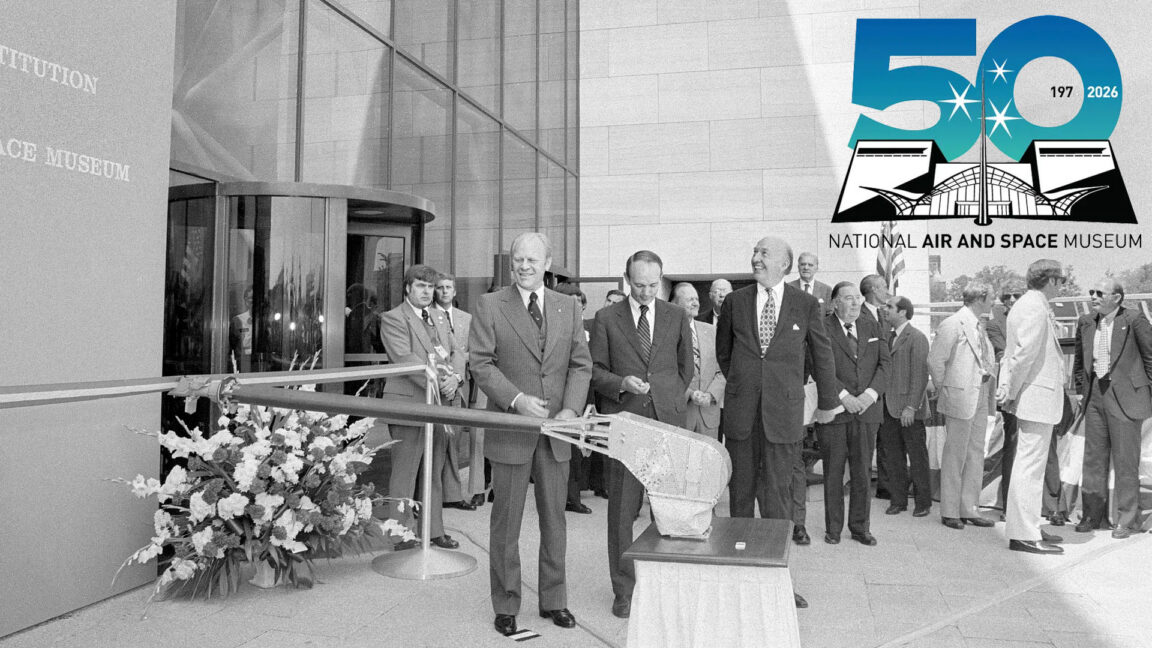
A piece of Viking Mars lander hardware helped open the National Air and Space Museum in 1976, but the specific arm used in the ceremony has not been identified. The question has resurfaced as the Smithsonian museum marks 50 years since its public debut on the National Mall.
According to Ars Technica and space historian Robert Pearlman, the museum’s July 1, 1976, opening depended on a timed stunt involving NASA’s Viking 1 spacecraft, then en route to its Mars landing. A command sent to Viking 1 was relayed back to Earth and used to trigger an engineering-model surface sampler arm placed outside the new museum.
The ceremony brought President Gerald Ford, Vice President Nelson Rockefeller, Smithsonian leaders and museum director Michael Collins, the Apollo 11 astronaut, to a bunting-lined stage. Ford spoke shortly before the ribbon cutting, calling the museum a bicentennial gift from Americans to themselves, according to the Smithsonian record cited by Ars Technica.
After the remarks, officials moved to the museum entrance, where a red, white and blue ribbon had been placed through the sampler end of the Viking arm. Traffic-style lights on a temporary backdrop indicated whether the signal had arrived.
The timing was tight because radio communications between Earth and Viking 1 took about 18 minutes each way at the planets’ separation that day, Ars Technica reported. NASA had started the sequence roughly 36 minutes before the arm was expected to cut the ribbon.
Collins later recalled the tension in an interview cited by collectSPACE. He said he worried that the command might fail while dignitaries stood waiting, but the signal arrived, the green lights came on and the arm cut the ribbon.
The museum had a fallback plan if the space-linked command did not work. Don Lopez, an original staff member who later became deputy director, said before his death in 2008 that someone was stationed behind the scenes with a button to trigger the mechanism if needed, according to collectSPACE.
The successful cut opened the museum to visitors, who saw major aviation and space artifacts including the Wright brothers’ 1903 Flyer, Charles Lindbergh’s Spirit of St. Louis and NASA spacecraft, among them the Apollo 11 command module Columbia, which Collins had flown to the Moon.
The unresolved issue is what happened next to the Viking arm. Contemporary accounts cited by Ars Technica indicate NASA packed up the assembly after the event and took it away.
The Viking lander now familiar to many museum visitors was not donated by NASA until 1979, according to the National Air and Space Museum. That artifact is a proof test article used on Earth during the Viking 1 and Viking 2 missions to check lander behavior and test responses to radio commands.
Ars Technica reported that the proof test article had also been used to confirm that the landers could withstand launch and landing stresses, making it unlikely, though not ruled out, that NASA removed its arm for the 1976 ceremony.
Other Viking sampler arms or related test articles have been displayed elsewhere, according to Ars Technica. Engineering models are associated with the Virginia Air and Space Science Center in Hampton, the California Science Center in Los Angeles and a unit once exhibited at the Kennedy Space Center Visitor Complex before its return to NASA in 2019.
Photographs and film from the 1976 opening do not clearly show serial or part numbers on the arm assembly, Ars Technica reported. Museum staff have not identified which model supplied the arm used to open the building.
The National Air and Space Museum planned a private 50th anniversary ceremony before opening five renovated galleries, with remarks by NASA Administrator Jared Isaacman and Amanda Wright Lane, a descendant of the Wright family, according to Ars Technica. Unlike the 1976 event, the anniversary will not depend on a command routed through space.
This story draws on original reporting from Ars Technica.