
Ukrainian drone maker says autonomous test killed Russian soldiers
Aero Center's CEO said quadcopters ran a one-off AI attack mission, raising fresh questions about autonomy and human control in Ukraine's drone war.
By Hana Yoshida · Markets Reporter
3 min read
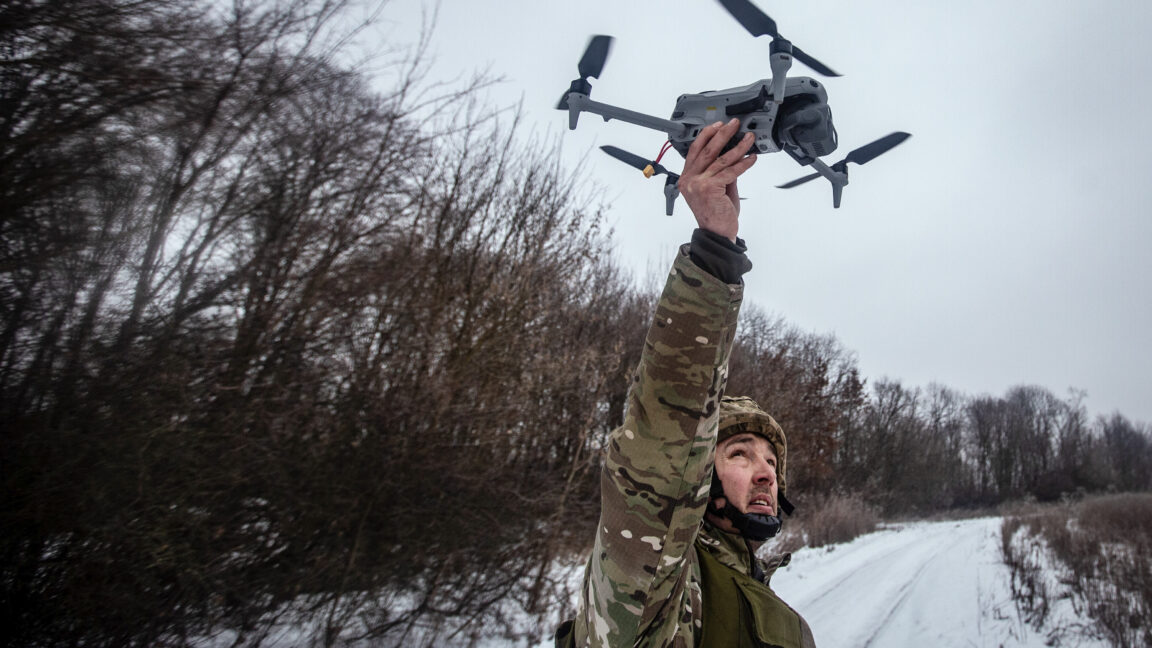
A Ukrainian drone manufacturer’s chief executive said fully autonomous quadcopters killed Russian soldiers during a one-time battlefield trial two years ago. The account, given to New Scientist, points to the growing role of AI-enabled weapons in a war already reshaping drone combat.
Alexander Kokhanovskyy, CEO of Ukrainian company Aero Center, described the test during an interview at a London event hosted by Ukraine’s embassy, New Scientist reported. He said the drones were programmed to fly to a front-line zone, then switch on an AI-enabled “Terminator mode” designed to find and attack targets inside that area.
Kokhanovskyy told New Scientist there was no video feed or other direct record showing what the drones struck. He said human-operated drones later inspected the site and found “a couple” of dead Russian soldiers, leading Aero Center to conclude that the autonomous drones had killed them.
A Ukrainian military commander gave New Scientist a more cautious account of current practice. The commander said Ukrainian drone teams use semi-autonomous systems in which people still make key control decisions, and said the military acts with “great care” to avoid civilian casualties while observing “international humanitarian law.”
The reported test highlights the practical and legal risks around weapons that can choose and attack targets without a person approving each strike. A drone sent to attack anything inside a defined area could hit friendly forces or civilians if planning, identification or boundaries fail.
Autonomy remains hard to define
The United Nations Office for Disarmament Affairs says there is no shared global definition of a lethal autonomous weapon system. Common descriptions refer to weapons able to operate without human direction or input, according to the UN office.
U.S. Defense Department policy has defined lethal autonomous weapons as systems that, after activation, can select and engage targets without further human intervention, according to a Congressional Research Service summary. That definition closely tracks the type of trial Kokhanovskyy described, though the reported evidence is indirect.
Kateryna Bondar, a former Ukrainian government adviser, wrote in a Center for Strategic and International Studies report that fully autonomous weapons able to complete goals with little or no supervision in complex conditions are not yet a regular battlefield reality in Ukraine. Bondar said both sides are adding autonomous features for flight, target recognition and other functions while humans often retain broader control.
Ukraine and Russia rely heavily on first-person-view drones for reconnaissance and attacks on vehicles and soldiers. These drones are commonly flown by operators wearing goggles that show the drone’s camera view, while larger multirotor drones can carry supplies or drop explosives near the front.
Longer-range strike drones can require more automated flight systems because Russian electronic warfare can disrupt control links and jam GPS, according to Bondar’s CSIS report. She wrote that AI-assisted systems have raised Ukrainian strike success rates from about 10 to 20 percent to 70 to 80 percent.
Russia’s Shahed-type attack drones are usually preprogrammed to fly toward targets with limited decision-making, but some variants have added onboard computing, according to Ukraine’s military intelligence service. The agency has said modernized Shahed-136 systems include Nvidia Jetson Orin microcomputers used for video processing and autonomous target recognition and retargeting.
Ukraine is also using interceptor drones against Shahed attacks. United24, a Ukrainian government platform, says some interceptors can fly autonomously to an interception point and lock onto a target, while a human operator still selects the initial target, authorizes the strike and can cancel it.
Ukraine’s Ministry of Defense has said the country can carry out more than 5,000 drone strikes each month against Russian targets at distances beyond 20 kilometers. Bondar wrote that Ukraine’s defense industry has focused on small AI models that can run on inexpensive chips, allowing autonomy modules to be fitted to FPV drones, long-range strike drones and uncrewed ground systems.
This story draws on original reporting from Ars Technica.