
Study questions medieval monk’s claim to Halley’s comet fame
James Aitcheson argues Eilmer of Malmesbury may have confused Halley’s comet with another comet seen in 1018.
By James Whitfield · Staff Writer
3 min read
A medieval monk long tied to an early story of flight may have a weaker claim to comet-spotting fame than some historians have suggested. In a paper in Notes and Queries, University of Leicester scholar James Aitcheson argues that Eilmer of Malmesbury may not have seen Halley’s comet twice.
The question matters because Eilmer’s reported words after seeing Halley’s comet in 1066 have been read by some historians as evidence that he remembered the comet from an earlier appearance in 989. Aitcheson says another explanation fits the record: Eilmer may have been recalling a different comet visible in 1018.
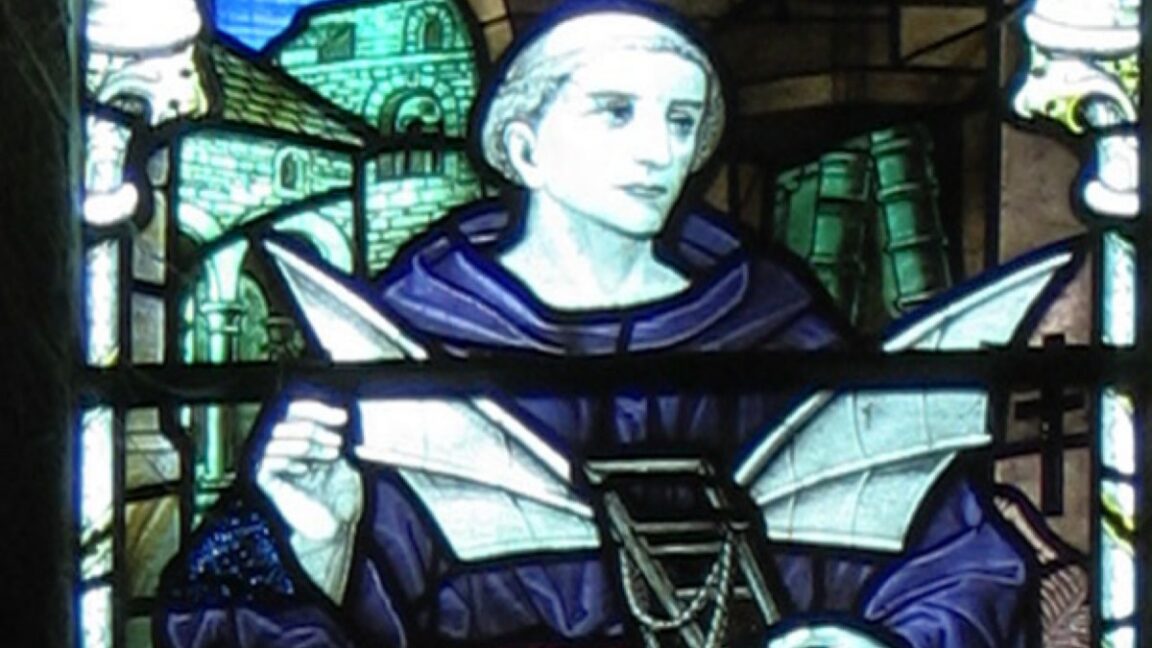
Eilmer is known from the writing of the 12th-century historian William of Malmesbury, who wrote about him around 1125. According to William, Eilmer was a Benedictine monk at Malmesbury Abbey in England who, as a young man, fastened wings made from willow and cloth and launched himself from the abbey tower.
William’s account says Eilmer glided about 600 feet, crossed the town wall and crashed in a valley near the River Avon. The landing broke both of his legs and left him disabled, according to William. Malmesbury Abbey later commemorated Eilmer with a stained-glass window.
William did not give a date for the attempted flight. He did, however, describe Eilmer as “advanced in years” when the monk saw Halley’s comet in 1066 and said, “It is long since I saw you.”
That sentence has carried much of the historical weight. If Eilmer remembered Halley’s comet from its 989 return, and if he was at least about five years old then, he would have been born no later than 984. On that timeline, his flight as a young man would likely fall between 1000 and 1010, and he would have been in his 80s in 1066.
Aitcheson argues that the calculation rests on uncertain assumptions. His paper says the comet of 1018 was visible in the British Isles for roughly two weeks in the fall, giving Eilmer another possible childhood or youth sighting to remember when Halley appeared in 1066.
Under that scenario, Aitcheson says Eilmer could have been born in the early 1010s. That would make him older than 50 in 1066, a description Aitcheson considers compatible with William’s phrase “advanced in years.” It would also place Eilmer’s flying attempt later, possibly between the 1020s and 1040s.
The revised chronology would undercut speculation that Eilmer recognized the recurring cycle of Halley’s comet centuries before Edmund Halley. Aitcheson acknowledges that Eilmer could have had access to earlier British and European records of comet sightings and might have noticed a pattern among them.
But Aitcheson says the surviving evidence does not show that Eilmer studied astronomy. William’s account is the only known record of him, and it does not describe Eilmer as a sky-watcher. Aitcheson writes that it is also unclear whether early medieval observers could reliably distinguish one comet from another.
A later birth date would leave one other possibility open, according to Aitcheson: Eilmer may have lived into his 90s and met William of Malmesbury himself. If so, the monk could have personally passed along the story of his flight.
This story draws on original reporting from Ars Technica.