
Stoke advances Nova tests as SpaceX prepares Friday IPO
Stoke Space finished key first-stage checks for Nova, while SpaceX’s public listing and Falcon 9 reuse milestone led a busy launch week.
By Hana Yoshida · Markets Reporter
4 min read
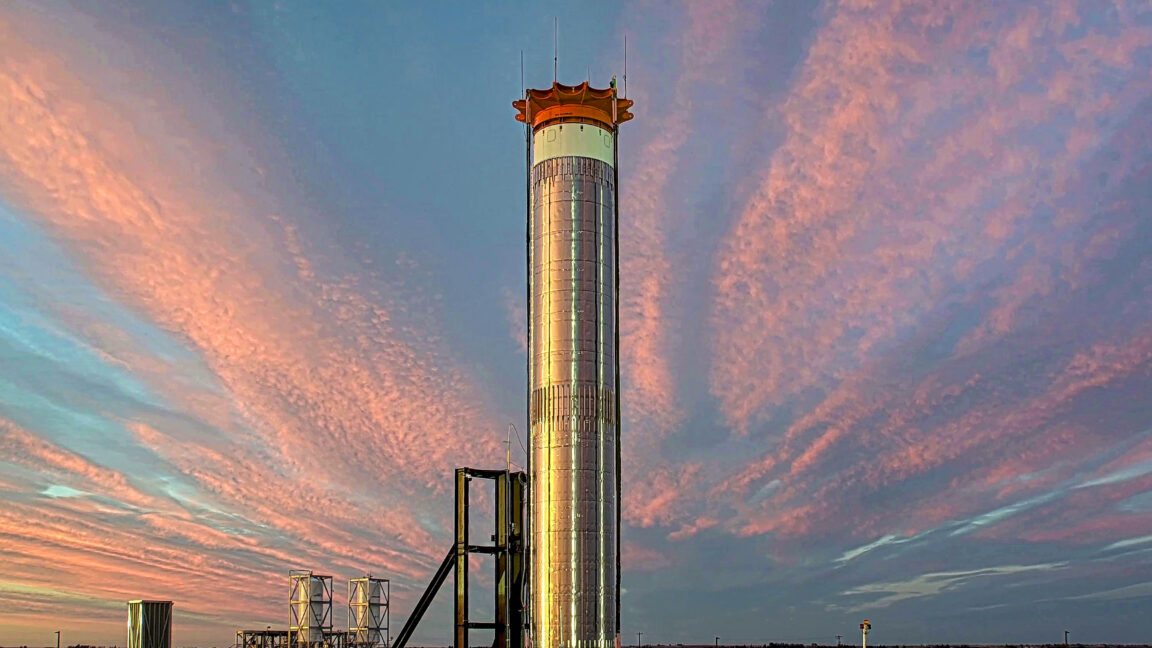
Stoke Space has completed a major round of first-stage testing for its Nova rocket, keeping the company on course for a planned debut late in 2026, NASASpaceflight.com reported. The update comes as SpaceX prepares to enter public markets Friday, a listing that could reward current and former employees after years of growth in launch and satellite services, according to Ars Technica.
NASASpaceflight.com reported that Stoke finished proto-qualification work on Nova’s first stage in early June at its Moses Lake, Washington, test site. The three-week campaign included 46 structural verification tests of the flight article, along with checks of fluid systems, avionics and ground equipment.
Nova is designed as a medium-lift vehicle with a reusable 27.1-meter first stage, according to NASASpaceflight.com. Stoke plans to recover the booster either by returning it to the launch site or landing it on a droneship. The rocket’s engines have already gone through vertical hot-fire testing at Moses Lake, and the company expects to install engines in the coming months before more verification work and shipment to Cape Canaveral.
SpaceX listing and Falcon 9 reuse
Ars Technica reported that former SpaceX employees planned to gather in New York City for the company’s market debut Friday. The report said current and former employees are expected to be able to sell some shares in the coming months.
Payload Space reported that analysts have debated SpaceX’s valuation ahead of the IPO, while Ars Technica said the company would initially trade at a valuation of $1.75 billion. The New York Times’ DealBook newsletter, cited by Ars Technica, described SpaceX as increasingly tied to artificial intelligence because of its plans for space-based data centers and the spending needed to compete with firms such as Anthropic and OpenAI.
SpaceX also extended the life record for a Falcon 9 booster this week. Ars Technica reported that first stage B1067 launched 29 Starlink satellites from Florida on Monday and landed on the droneship A Shortfall of Gravitas, completing its 35th flight. The company has said it wants to qualify Falcon 9 boosters for as many as 40 missions each, according to Ars Technica.
European launchers and new spaceport options
European Spaceflight reported that Isar Aerospace raised 270 million euros in Series D funding and set a June 15-21 window for the second launch attempt of its Spectrum rocket. Isar says Spectrum is built to carry up to 1,000 kilograms to low Earth orbit. Its first launch in March 2025 failed less than a minute after liftoff, according to European Spaceflight.
Space News reported that HyImpulse, a German launch company, signed a letter of intent with Oman’s Etlaq Spaceport to study possible launch activity and an operational presence there. The agreement covers HyImpulse’s SR75 suborbital rocket and SL1 orbital vehicle, according to Space News.
The Globe and Mail reported that T-Minus Engineering BV of the Netherlands launched a Barracuda hypersonic suborbital rocket from Maritime Launch Services’ site in Nova Scotia. The rocket can reach 100 kilometers, but this flight fell short after an anomaly later in the mission, with engineers studying whether stabilizing fins played a role, according to the newspaper.
Artemis, Ariane 6 and Amazon satellites
NASA named Randy Bresnik, Luca Parmitano, Andre Douglas and Frank Rubio to the Artemis III crew, Ars Technica reported. NASA Administrator Jared Isaacman said the mission could fly as early as summer 2027, though Ars Technica reported that the plan still depends on several major elements, including lander prototypes from Blue Origin and SpaceX.
Ars Technica reported that NASA still plans, for now, to launch Blue Origin’s test lander on New Glenn, despite the recent loss of New Glenn and damage at its Florida pad. Artemis program manager Jeremy Parsons said NASA is also studying what it would take to use another rocket, with Vulcan and Falcon Heavy listed as options.
Arianespace plans to launch the first Ariane 64 using upgraded P160C solid boosters on June 17 with 36 Amazon satellites, European Spaceflight reported. Ars Technica also reported that the Federal Communications Commission waived Amazon’s July deadline to deploy half of its broadband constellation, while keeping the July 2029 deadline for the full system.
This story draws on original reporting from Ars Technica.