
Starship is pushing satellite makers toward flat-packed designs
SpaceX’s giant rocket is prompting some satellite companies to rethink spacecraft shapes, deployment systems and launch economics.
By Maya Lindqvist · Senior Technology Correspondent
4 min read
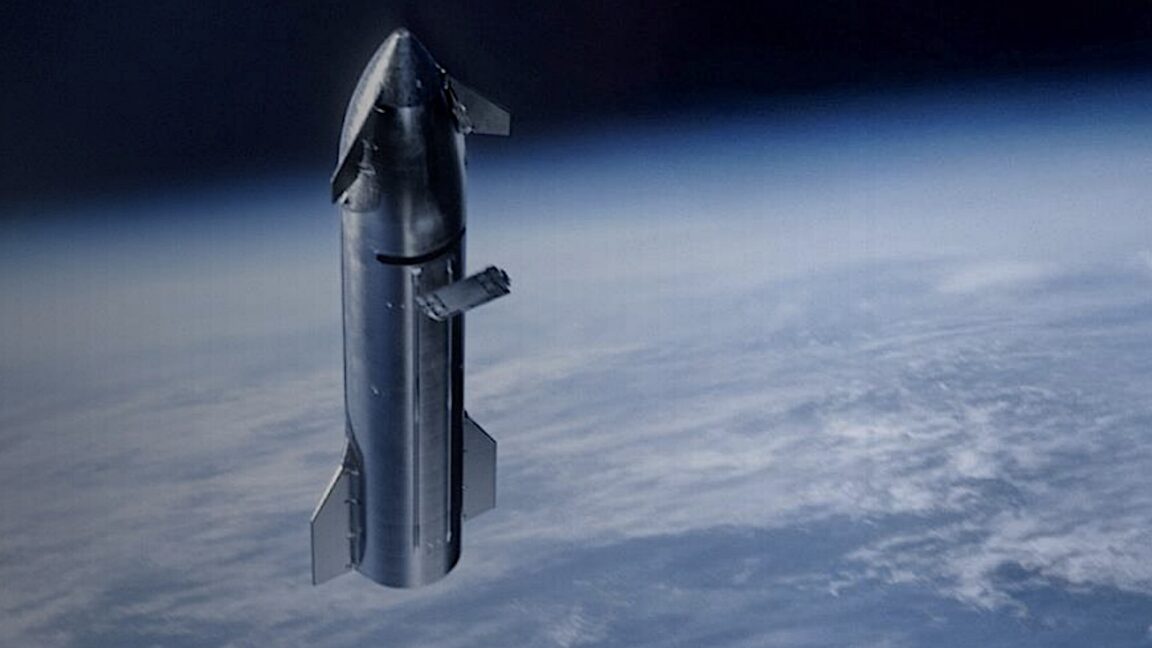
Satellite builders are starting to design spacecraft around SpaceX’s Starship rather than waiting for rocket makers to fit existing payloads, Ars Technica reported. The shift could reshape broadband constellations, sensing missions and other commercial spacecraft if Starship reaches its promised lift capacity and reuse goals.
Starship is designed to carry more than 100 metric tons to low-Earth orbit, according to Ars Technica. SpaceX has not yet proved the rocket can meet Elon Musk’s most ambitious claims, but NASA, the U.S. military, scientists and rival space programs are already studying uses for a vehicle with far more volume and mass capacity than today’s workhorse launchers.
That reverses a long pattern in the launch business. Ars Technica reported that rocket developers have traditionally sized vehicles and fairings around the spacecraft customers wanted to fly: small rockets for small satellites, larger rockets for heavier payloads, and payloads enclosed under a protective shroud at the top of the launcher.
Flat satellites gain attention
SpaceX’s first operational Starship payloads are expected to be its own Starlink V3 broadband satellites, Ars Technica reported. Starship can carry up to 60 of them on one flight, using a flat, stackable design that deploys through a side opening rather than from a conventional nose fairing.
That deployment concept is influencing some satellite manufacturers. Muon Space said this month that it is developing Condor-Ultra, a high-power satellite platform built for stackable deployment from Starship, with potential uses in communications, sensing and orbital data-center missions, according to Ars Technica.
Greg Smirin, Muon Space’s president, told Ars Technica the satellite is being designed for deployment through Starship’s opening without requiring a full fairing system. The company expects the design to weigh about 1.5 metric tons at launch and also fit on medium-lift rockets such as Falcon 9 and Rocket Lab’s Neutron.
Other companies are moving in the same direction, though not uniformly. Ars Technica reported that China’s Qianfan broadband satellites use a flat, stackable format, while Amazon’s Amazon LEO satellites use a more traditional shape. Apex has announced a flat satellite chassis called Comet and has described a larger Comet XL as suited for Starship and future super-heavy launchers; Terran Orbital markets a flat-packed Enterprise design; and Vast has announced a flat-panel satellite effort for dense batch launches.
John Rood, chief executive of Momentus, told Ars Technica that SpaceX deserves credit for thinking more closely about how rockets and satellites fit together. He also said flat-panel spacecraft are unlikely to take over the entire market, because some missions need different shapes or orbital-transfer spacecraft.
Launch costs drive the redesign
A new Aerospace Corporation report helps explain why companies are preparing for Starship. Karen Jones, a space economist and lead author of the report, modeled scenarios in which a reusable Starship and Super Heavy system could lower launch costs by about an order of magnitude from Falcon 9 levels, according to Ars Technica.
Jones’ scenarios included Starship launches with initial costs of $100 million and marginal costs of 20% or 35%, producing costs of $133 to $233 per kilogram after 10 reuse cycles when fully loaded. A more optimistic case, using a $50 million initial cost and 20% marginal cost, reached $67 per kilogram after nine reuse cycles, Ars Technica reported.
Jones told Ars Technica those results depend on major assumptions, including manufacturing gains, operating improvements, high payload utilization and repeated reuse. SpaceX has demonstrated repeated reuse with Falcon 9, including a booster flown for a 35th time, but Ars Technica noted that Falcon 9 took years to reach nine flights on a single booster.
The first clear market for Starship is likely to be broadband megaconstellations, starting with SpaceX’s own system, according to Jones. She told Ars Technica that Starship could launch 60 larger Starlink V3 satellites at once, compared with 27 V2 satellites on Falcon 9, greatly increasing the bandwidth SpaceX can place in orbit per launch.
Prices for customers remain uncertain. Ars Technica reported that SpaceX charges commercial customers $74 million for a dedicated Falcon 9 launch, far above its internal cost for Starlink missions, and Starship pricing will depend partly on competition from companies such as Blue Origin.
This story draws on original reporting from Ars Technica.