
OpenAI launches ChatGPT Work for longer-running office tasks
The new agent-style tool connects to workplace apps, can run scheduled jobs and may consume more paid usage than standard ChatGPT requests.
By James Whitfield · Staff Writer
3 min read
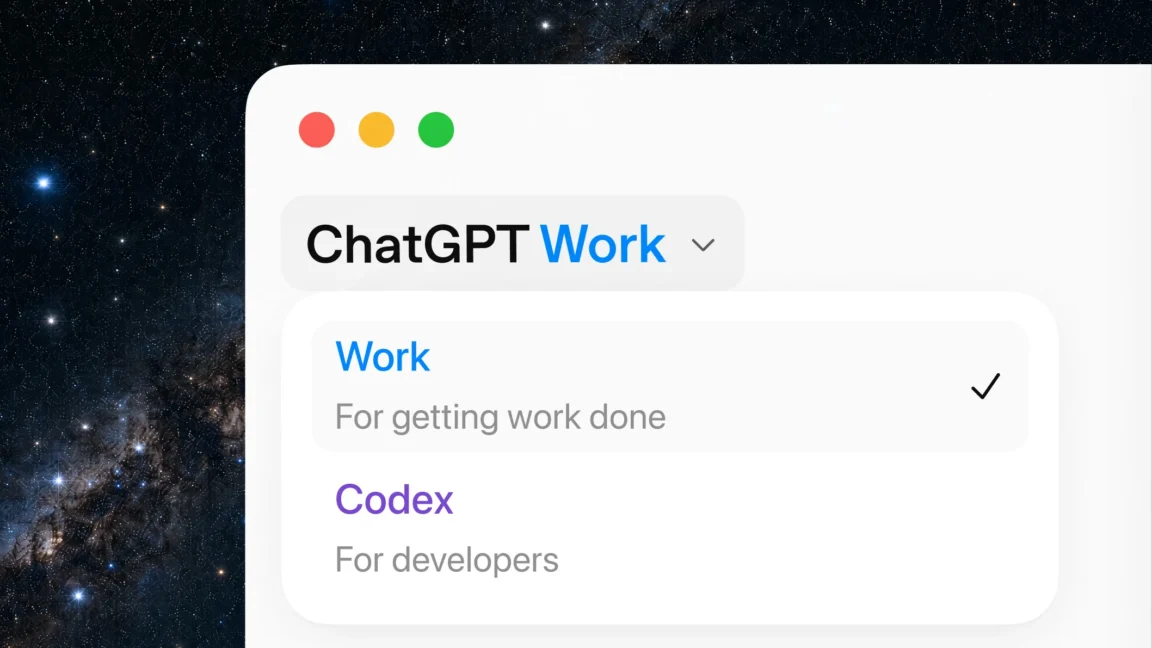
OpenAI has introduced ChatGPT Work, a new version of ChatGPT designed to carry out longer office tasks across documents, browsers and workplace apps. The launch matters for businesses because OpenAI says the tool can keep working on complex projects for hours, while also raising questions about access controls and usage costs.
OpenAI described ChatGPT Work as a system that can take a user’s objective and produce completed work, rather than only answering short prompts. The company suggested users test it on tasks they already understand, including budget analysis or preparation for a sales meeting.
OpenAI said the tool can also string together multi-step work, such as researching customers, drafting a campaign brief and creating marketing materials adapted for local markets. The company said ChatGPT Work will pause for user approval before taking important actions.
Workplace apps and scheduled tasks
ChatGPT Work connects to services including Slack, Microsoft Teams, Google Drive and SharePoint through custom plugins, according to OpenAI. The desktop version can also work with local files and includes a browser for using online resources.
OpenAI said an updated ChatGPT Chrome extension will let users complete browser-based tasks without leaving Chrome. The company also said it is retiring Atlas, its own browser, less than nine months after that product launched.
Ars Technica reported that its earlier tests of Atlas’ Agent Mode found automated tasks often stopped after only a few minutes. OpenAI is now positioning ChatGPT Work as an answer to that limitation, saying the new tool can remain active on a project for much longer when needed.
The product also includes Scheduled Tasks, which OpenAI described as a way to run recurring work on a timetable or in response to a monitored event. OpenAI said those tasks can continue while a user is away from the computer and can be checked from a phone.
OpenAI said ChatGPT Work can decide on its own when to use connected apps and files to complete a request. Users can also direct it to a specific outside app by using the “@” symbol, according to the company.
OpenAI said organizations can restrict access to files and outside apps through its Compliance API and through enterprise or administrator controls. Those controls are likely to be central for companies deciding how much authority to give an AI tool inside internal systems.
Codex, plans and usage limits
OpenAI is also combining parts of Codex, its coding-focused app, with ChatGPT Work. The company said Codex technology is built into ChatGPT Work, while Codex remains available as a separate view inside the new ChatGPT app.
The existing ChatGPT desktop app is being renamed ChatGPT Classic, according to OpenAI. Basic chat will be available through a “quick chat” button on desktop or a dropdown on mobile, while Codex will not be available on mobile.
OpenAI warned that ChatGPT Work is intended for more involved tasks than ordinary chat requests and may use more of a subscriber’s included usage. The company said billing follows the Codex structure, with plans running up to $100 a month and usage governed by a credit system.
For ChatGPT Enterprise and Edu customers, OpenAI said administrators can set overall spending caps as well as limits for groups or individual users. OpenAI said those controls are meant to support selected work without giving every user the same spending ceiling.
The rollout arrives with GPT-5.6, a new model OpenAI said offers better performance for the cost on difficult work. OpenAI said the model has three operating tiers, with the highest-performance tier priced at $5 per million input tokens and $30 per million output tokens.
This story draws on original reporting from Ars Technica.