
Study finds possible brain removal in Iron Age Scottish burial
Researchers say remains from Loch Borralie show rare evidence of postmortem processing, though other archaeologists urge caution.
By James Whitfield · Staff Writer
4 min read
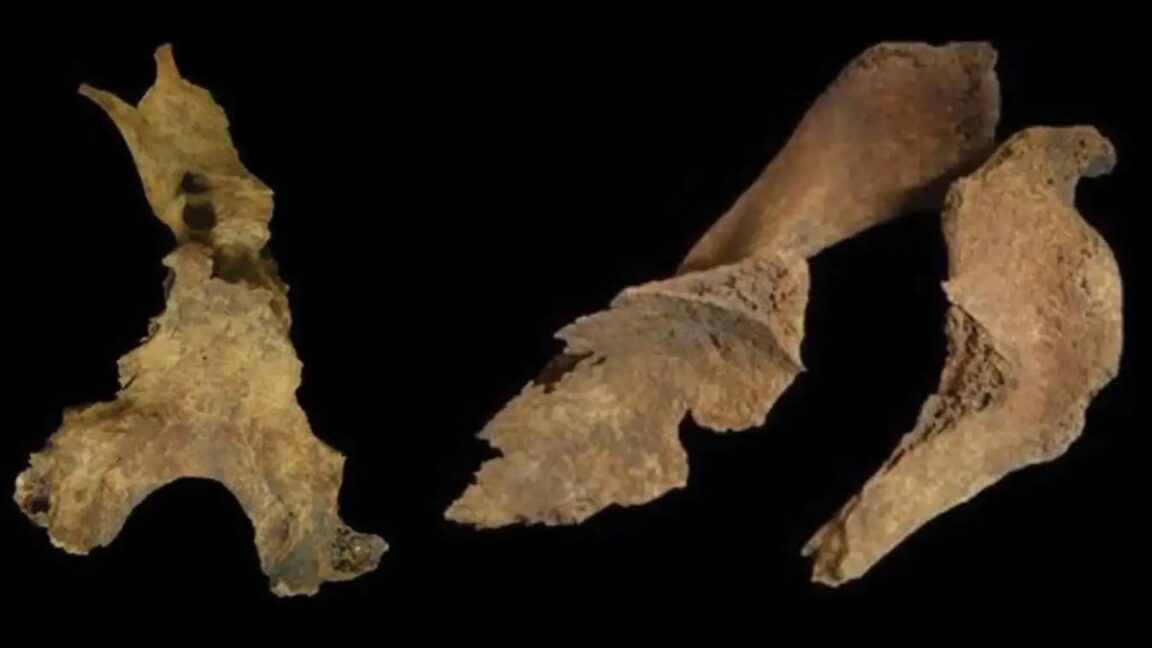
Researchers studying Iron Age remains from northwest Scotland say they have found possible evidence that a woman’s brain was removed after death. The finding matters because human remains from Iron Age Britain are scarce, leaving archaeologists with limited evidence for how communities treated the dead.
The analysis, published in the journal Antiquity, examined bones excavated in 2000 from a burial cairn at Loch Borralie, near the northwestern tip of the Scottish mainland. The site was investigated after erosion exposed a human cranium, and excavators recovered remains belonging to two people: an adult woman and a juvenile whose sex was not initially known.
The researchers used osteoarchaeological study, isotope testing and ancient DNA analysis. Radiocarbon dating of molar teeth from both individuals placed their deaths between 50 BCE and 70 CE, according to the Antiquity paper.
Marks inside the skull
The team reported an unusual fracture at the base of the woman’s skull that likely occurred around the time of death. They said the injury resembles damage caused by high-velocity impacts, but does not neatly match known forensic patterns from vehicle collisions, sports accidents, falls, assaults or long-drop hanging.
Because of that mismatch, the authors concluded the fracture most likely came from a targeted blow. They also identified fractures on both shoulder blades that occurred around the time of death.
The paper’s most striking claim concerns several straight, parallel marks on the inside of the woman’s skull. The researchers interpreted those striations as evidence that brain tissue had been scraped out with a sharp tool soon after death.
If that interpretation is correct, the authors said it would be the first known example of such a practice in the region. The paper notes that other parts of Europe, including southern France and Bulgaria, have produced evidence of postmortem cutting of skull bone and the reshaping of bone into amulets.
The researchers also reassessed marks on four of the woman’s long bones: both upper arm bones, the left ulna and the left femur. Earlier work had identified the marks as possible rodent gnawing, but the Antiquity authors said they are more consistent with whittling by a sharp implement.
According to the study, three of those bones had been sharpened along an edge. The fourth appeared to have been shaped into a point and then worn through use as a tool. Despite that treatment, the authors said all four bones were placed back in the grave in their correct anatomical positions.
Outside caution
Not all archaeologists accept the interpretation. Richard Madgwick of Cardiff University, who was not involved in the research, told New Scientist that the marks do suggest some handling of the skull, but he was unsure whether they prove brain removal.
Madgwick also told New Scientist that the long bones may have been broken before being reused as tools. He described it as remarkable that bones used in that way would then have been returned to the ground in anatomical order.
The juvenile’s remains were also reexamined. Ancient DNA showed the young person was male, and the researchers estimated he was between 14.5 and 15.5 years old at death. His bones showed signs of disrupted growth and vitamin C deficiency, according to the study.
The paper said both individuals were genetically typical of Iron Age populations in Scotland. Isotope evidence suggested each spent early life in a coastal setting, most likely the east coast of Sutherland, before moving to the Loch Borralie area after childhood.
The researchers found that the woman and the adolescent were close biological relatives, possibly maternal second cousins. Layers in the cairn indicated they were not buried at the same time, and the authors said the two bodies did not undergo the same treatment after death.
The Antiquity authors said the genetic and isotope findings point to lasting connections among maritime communities around Scotland’s north coast and the Northern Isles. They argued that movement by individuals and small groups may have helped cultural practices spread across wide areas.
This story draws on original reporting from Ars Technica.