
Why Formula 1 teams pay millions for ultra-fast simulators
F1 simulator builders and drivers say latency, motion fidelity and tire feedback separate professional systems from high-end consumer rigs.
By James Whitfield · Staff Writer
3 min read
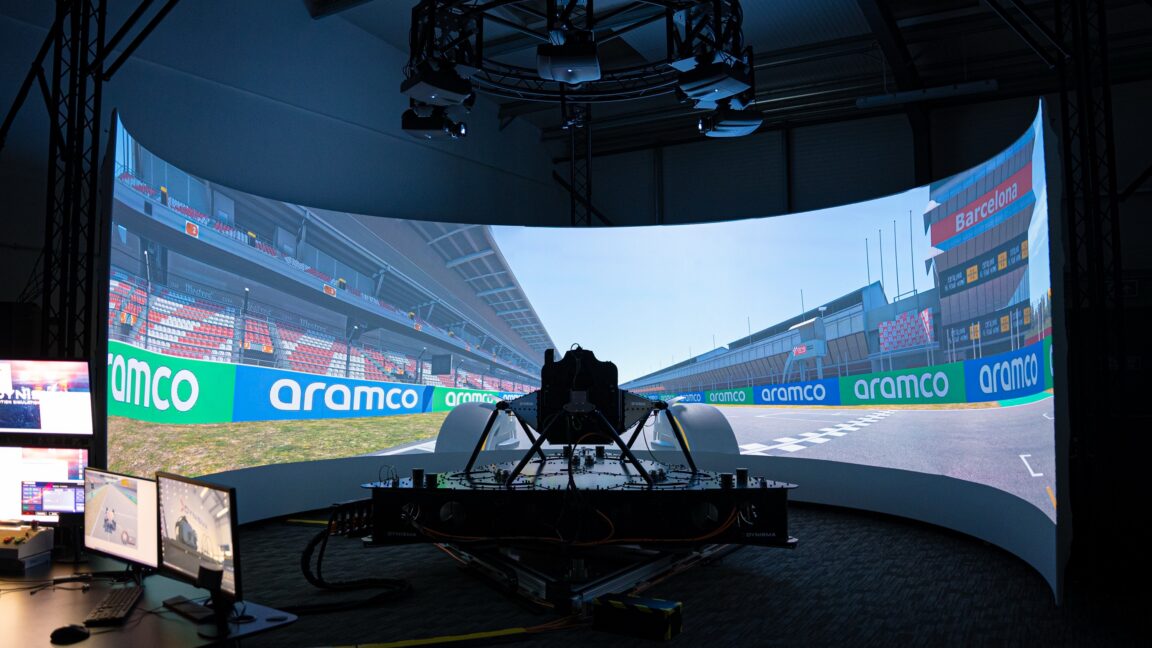
Formula 1 teams are spending millions on driver-in-the-loop simulators because tiny delays and poor motion cues can make the data useless. Engineers and simulator drivers say the systems matter because they help teams test setup changes, manage tires and prepare race cars without turning laps on track.
Ars Technica reported that F1 began adopting these simulators in the early 2000s, with McLaren, Toyota and Ferrari among the teams believed to have been early movers. The exact history is hard to pin down because teams closely guard tools that may provide a performance edge.
Ash Warne, founder and chief technology officer of UK simulator company Dynisma Motion Generators, told Ars Technica that the key technical demand is latency. Dynisma supplies systems to Ferrari and Alpine, and is due to supply Cadillac; Warne said its simulators can cost as much as $10 million.
Milliseconds matter
Warne said a racing driver constantly acts in a feedback loop: steering, braking or accelerating, sensing the car’s response, then correcting again. In a simulator, he said, the machine must replace the real car closely enough that an elite driver does not immediately feel that something is wrong.
According to Warne, Dynisma targets a response delay of roughly 3 to 5 milliseconds between a change in the physics model and measurable movement in the simulator chassis. Ars Technica reported that this is about ten times quicker than leading commercial flight simulators or the National Advanced Driving Simulator in Iowa.
Warne said he founded Dynisma after working at McLaren and Ferrari, where he concluded that a far faster simulator was technically possible. He said the company’s first proof-of-concept used consumer electronics, including Arduino and Raspberry Pi hardware, before Dynisma moved to industrial-grade control systems.
Warne also pointed to bandwidth as a major difference from aviation simulators. Flight systems must often reproduce slower, sustained movement, while a racing simulator must transmit road texture, engine vibration, tire behavior and suspension movement through the driver’s seat and cockpit.
The tire problem
Simon Pagenaud, Cadillac F1’s simulator driver, told Ars Technica that reproducing tire feel remains one of the hardest jobs. He said drivers need to sense suspension displacement and the way a tire moves under the wheel rim, even though no actual tires are involved.
Pagenaud has watched the technology improve since his first simulator work around 2008 with Wirth Research during the De Ferran Motorsport program. The 2019 Indianapolis 500 winner said visuals, motion platforms and computing power have all improved, but he described latency as central to giving a driver useful feedback.
Pagenaud said much of his current F1 simulator work focuses on tire energy and avoiding overheating. He said the aim is to help the race drivers and engineers find ways to make tires last longer, work better with the car and produce more grip.
During the Monaco Grand Prix weekend, Ars Technica reported, Pagenaud worked from GM’s motorsports headquarters outside Charlotte, North Carolina, while Sergio Perez and Valtteri Bottas prepared Cadillac’s cars for first practice. Pagenaud was connected to the same communications network as engineers at the circuit and at the Charlotte control center.
Cadillac’s new Dynisma simulator is planned for the team’s new Indianapolis base, according to Ars Technica. Until then, Pagenaud’s work involves comparing simulator data with track data after practice sessions, then running performance items requested by engineers.
Pagenaud said a session may require repeated five-lap runs, and a crash means starting again. He said consistency is critical, with lap times expected to stay within about two-tenths of a second so engineers can trust the results.
This story draws on original reporting from Ars Technica.