
Close-in exoplanet appears magnetically linked to its star
Researchers report that GJ 436 brightens on a cycle tied to its planet, pointing to magnetic field loops between the two bodies.
By Hana Yoshida · Markets Reporter
3 min read
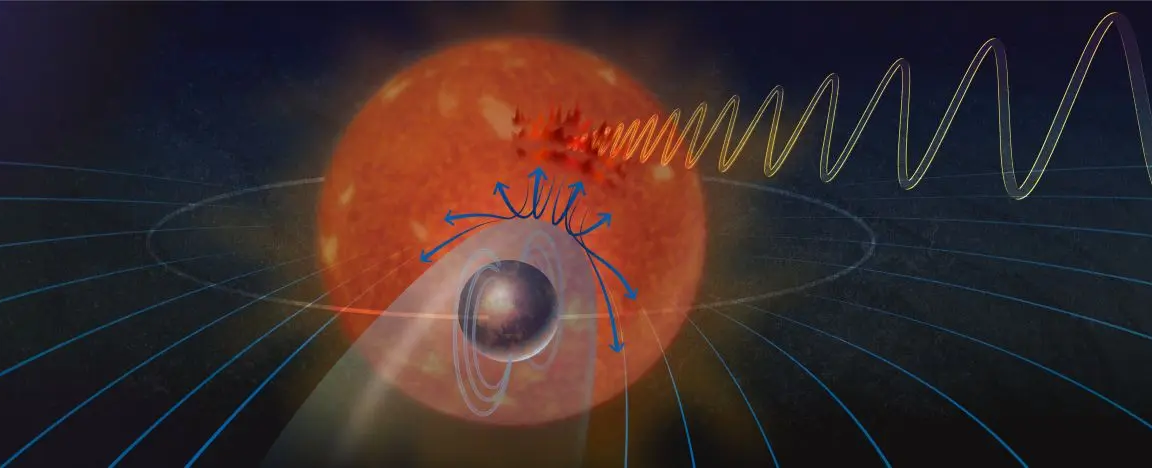
Researchers have reported evidence that a planet orbiting close to the red dwarf GJ 436 may be magnetically connected to its star. The finding matters because it offers a way to measure magnetic fields around planets outside the Solar System, a property that is hard to observe directly.
In a study published in Science, an international team examined years of observations of GJ 436, a star about 30 light-years from Earth and roughly half the mass of the Sun. The system has one known planet, about four times Earth’s mass, that circles the star every 2.6 days, according to the researchers.
A repeating signal in starlight
The team focused on the star’s chromosphere, a thin outer layer whose emissions can reflect magnetic activity. The researchers used light from hydrogen and calcium ions as indicators of activity in that layer.
By searching archival observations, the team found periodic changes in those emissions. The rhythm was close to the planet’s orbital period, which the researchers interpreted as a possible sign that the planet’s magnetic field affects the star most strongly at certain points in the orbit.
The timing did not match the orbit exactly. The researchers said their model can account for a lag of several hours by combining the star’s rotation, uneven activity on the stellar surface and the likely tilt of the planet’s spin axis and magnetic field relative to its orbit.
Why the signal appears only sometimes
The study also found that the brightening did not appear in all chromospheric tracers. The researchers said that may mean the signal comes from the lower chromosphere, rather than from all layers of the star’s outer atmosphere.
The team also found that the repeating signal appeared and disappeared over time. Using the volume of archived observations, the researchers linked those changes to the star’s own activity cycle, comparable in concept to the Sun’s solar cycle.
According to the researchers, the planet-driven signal may be hidden when the star is highly active. During low-activity phases, they said, the star may not provide enough background activity for the planet’s magnetic influence to strengthen, leaving intermediate activity levels as the best time to see the effect.
Magnetic loops offer the best fit
The researchers considered several models for how the planet could affect the star. They said the only model that supplied enough energy in the chromosphere involved magnetic loops linking the planet’s magnetic field with the star’s field.
From that model, the team estimated the planet’s magnetic field at a minimum of 6 gauss, more than 10 times Earth’s field strength. The researchers noted that the value is similar to Jupiter’s magnetic field, and they said Neptune’s magnetosphere reaches farther than the distance between GJ 436 and its planet.
The Science paper describes the work as the most detailed study so far of magnetically driven flaring in a star system with a close-in planet. The researchers said many other systems with tight planetary orbits remain available for similar searches, raising the possibility that exoplanet magnetic-field measurements could become more routine.
This story draws on original reporting from Ars Technica.