
Arturia MiniLab 37 review praises extra keys and portable design
The Verge gave Arturia’s $149 MiniLab 37 an 8, citing a roomier 37-key layout, strong controls and tradeoffs around its plastic build and small screen.
By Maya Lindqvist · Senior Technology Correspondent
3 min read
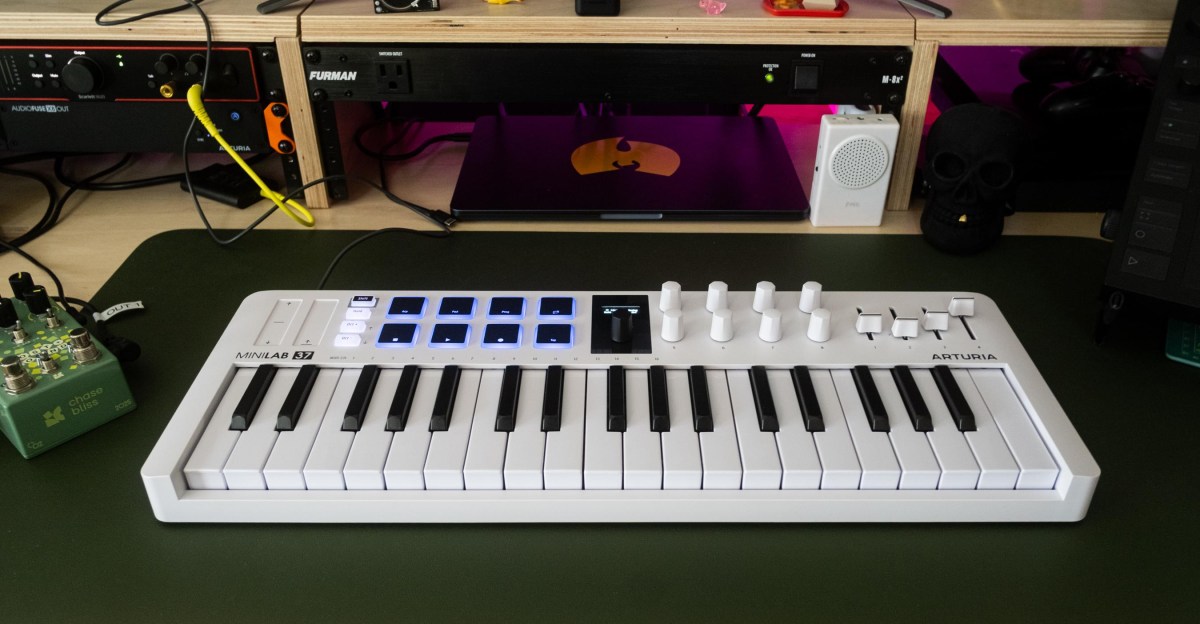
Arturia’s MiniLab 37 gives portable MIDI controller buyers more playing room without moving into a much larger device, according to a review by Terrence O’Brien at The Verge. The review says the 37-key design makes the $149 controller more practical than Arturia’s 25-key MiniLab MK3 for players who want portability and a less cramped keyboard.
O’Brien wrote that the added octave lets users play bass and lead parts together more comfortably, or use broader chords than the smaller MiniLab allows. The Verge gave the MiniLab 37 a score of 8, calling out its value, hands-on controls and integration with Arturia software, while faulting its plastic construction and small display.
More room without a major size penalty
The MiniLab 37 carries over much of the hardware from the smaller MiniLab MK3, according to The Verge. O’Brien said it includes eight pads, eight endless encoders, four faders, two touch strips, USB-C and a full-size five-pin MIDI DIN output on the back.
The review describes the keybed as solid but somewhat springy, and says the rounded plastic chassis feels inexpensive yet tough enough for backpack use. O’Brien said the controller is not a design showpiece, but found the build adequate for a portable device.
The wider frame also changes how the controls sit on the surface, according to The Verge. O’Brien said Arturia arranged the knobs, pads, touch strips, main encoder and small LCD in a more direct layout than on the 25-key model, reducing the reach across controls and making the device easier to use while playing.
Software strengths, screen limits
The MiniLab 37 ships with Arturia’s Analog Lab Intro and Ableton Live Lite, according to The Verge. O’Brien said that bundle helps buyers begin making music right away, especially if they already use Arturia’s software instruments.
The review says the MiniLab 37 also offers basic digital audio workstation controls, including starting and stopping recording and looping sections of a session. O’Brien said users can manually map controls for more detailed DAW work, but the device does not offer the depth or ready-made control of products such as Ableton’s Push or Serato’s Slab.
The small screen is the main usability weakness cited by The Verge. O’Brien said preset browsing still works better with a mouse or keyboard, and that advanced functions such as the built-in arpeggiator require repeated scrolling and clicking through settings including rate, mode and gate.
The Verge also noted that the MiniLab 37 can control external synthesizers through its rear MIDI port. O’Brien said a DAW-free setup with multiple instruments on separate MIDI channels is possible, though users may need a MIDI splitter if their instruments lack MIDI out or thru ports.
O’Brien’s verdict was that the MiniLab 37 is neither the smallest, most premium nor cheapest MIDI controller, but that it strikes a strong balance among comfort, portability and price. The review said that balance is strongest for musicians already working with Arturia’s soft synths.
This story draws on original reporting from The Verge.