
Artificial cell system feeds, grows and divides for five generations
University of Minnesota researchers built a membrane-bound genetic system that can import supplies and divide, though the work remains preliminary.
By Maya Lindqvist · Senior Technology Correspondent
3 min read
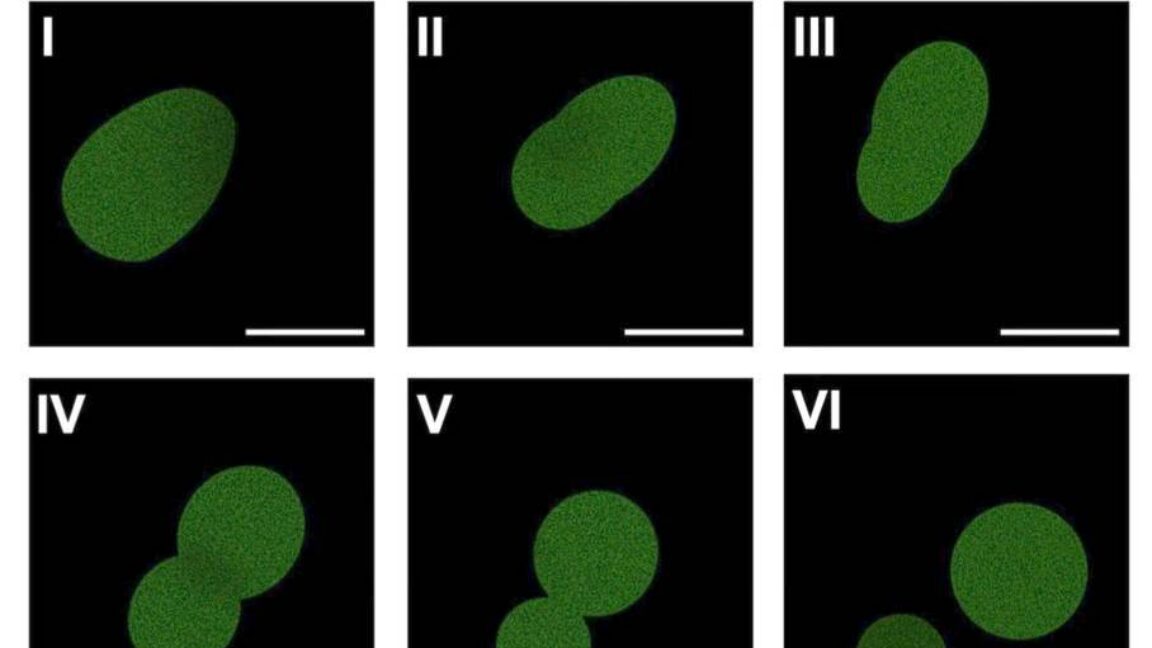
A University of Minnesota team has built a simplified artificial cell system that can take in supplies, grow and split through several rounds, according to a draft manuscript described by Ars Technica. The work matters because membrane growth and division remain major open questions in studies of how early life may have formed.
The system, led by Kate Adamala, has not yet been peer reviewed, according to Ars Technica. The researchers call the artificial units “SpudCells,” and the design combines biological parts developed in earlier work with a surrounding membrane.
Ars Technica reported that the SpudCells carry about 90,000 DNA bases spread across seven circular DNA molecules. Their DNA-copying system comes from Phi29, a virus that infects bacteria, and builds on prior research showing that Phi29-related machinery could replicate DNA inside a membrane.
How the artificial cells work
The SpudCells use another viral component, T7 RNA polymerase, to copy genetic instructions into RNA for protein production, according to Ars Technica. The gene for that polymerase was included in the artificial genome, allowing the SpudCells to make the enzyme themselves.
For protein production, however, the system still depends on researchers. Ars Technica reported that the Minnesota group purified translation machinery using a method developed by University of Tokyo researchers, who tagged the needed proteins so they could be isolated, and then supplied those proteins to the SpudCells.
The researchers also had to solve the problem of feeding a membrane-bound system. For small molecules and ions, Ars Technica reported, they encoded a pore protein in the SpudCell genome, letting those materials pass through the membrane when the artificial cells were placed in a suitable solution.
Larger protein complexes could not pass through that pore. According to Ars Technica, the team packaged those materials inside separate membrane-bound packets and engineered interactions between the packets and the SpudCells, allowing the membranes to fuse and deliver the contents.
That process supplied new raw materials for protein-making and added membrane material, causing the SpudCells to increase in size, Ars Technica reported. The team first split the enlarged membranes by forcing them through a wire grid, then developed a chemical trigger that caused pore proteins to clump and made portions of the membrane bud off.
Limits and possible uses
The division process remains crude and uneven. Ars Technica reported that the SpudCells lack a mechanism to guarantee that both offspring receive all seven DNA molecules, so the system relies on making many copies and distributing them by chance.
That chance-based inheritance breaks down over time. After five generations, most SpudCells were missing at least one genome piece, according to Ars Technica, and the researchers did not carry the system beyond that point.
Even so, the team reported signs that selection could act on the artificial cells. Ars Technica said the researchers altered the genome to change how much pore protein SpudCells produced; versions that made more pore protein grew faster, especially when food was limited, and became more common after five generations.
The work is not presented as a recreation of Earth’s first cells. Ars Technica noted that the system depends on evolved viral proteins, purified translation machinery and laboratory conditions set by researchers.
Its value may be as a test system for origin-of-life questions, according to Ars Technica. The setup could help researchers examine how membrane-bound genetic systems might improve inheritance, regulate pores or link growth more tightly to division.
This story draws on original reporting from Ars Technica.