
Anduril says satellite sensor can track spacecraft through orbital darkness
Anduril says its first satellite’s infrared sensor can follow spacecraft in eclipse, though its public evidence so far is a Moon image.
By James Whitfield · Staff Writer
2 min read
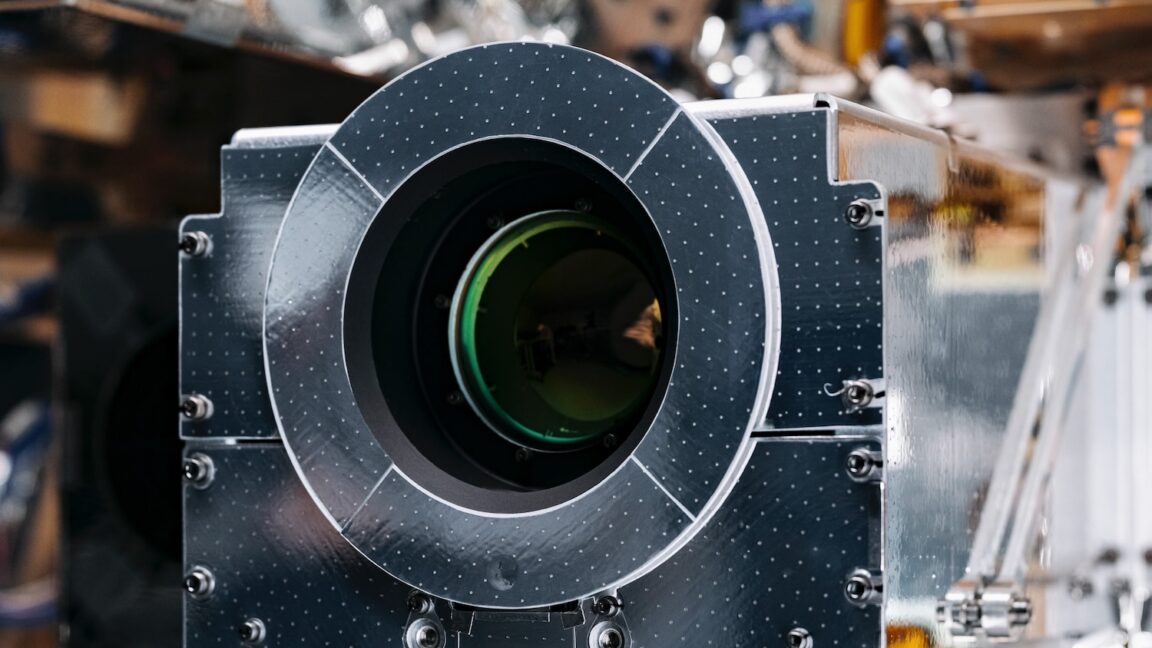
Anduril satellite night tracking is the aim of a new sensor demonstration aboard the company’s first spacecraft in orbit. Anduril says the long-wave infrared instrument on ANDURIL-216 can detect the heat signatures of spacecraft during eclipse, when visible-light systems can lose sight of objects that pass through Earth’s shadow.
The company announced the demonstration in November after launching the self-funded satellite on a SpaceX rideshare mission in July, according to Ars Technica and Via Satellite. The stated use is space-domain awareness: monitoring objects in orbit and maintaining a track on them when lighting conditions limit optical observations.
How does Anduril satellite night tracking work?
Long-wave infrared sensing detects thermal emissions rather than relying on sunlight reflected from an object. Anduril says that approach can help its satellite observe spacecraft in orbital darkness and is less often blocked by the Sun than conventional optical imaging.
ANDURIL-216 orbits about 590 kilometers above Earth and spends roughly one-third of each orbit in darkness, Ars Technica reported. Anduril executive Adam Thurn said eclipse periods leave trackers relying on visible sensors unable to observe satellites that are not lit by the Sun, and said the infrared sensor is intended to narrow that gap.
That is a company claim, not a publicly verified demonstration of tracking an adversary satellite or detecting a maneuver. The material made public describes one infrared image from the satellite: a view of the Moon over Earth’s horizon. Neither Ars Technica nor Via Satellite reported released tracking data for a spacecraft maneuver.
What is aboard ANDURIL-216?
Apex Space built the satellite platform, according to Ars Technica. The spacecraft carries Anduril’s infrared sensor, two third-party electro-optical sensors, a compute module and a power-management module, Via Satellite reported.
Anduril says the compute hardware can combine information from infrared and visible sensors and produce tracking results on the spacecraft without ground-based analysis. The company has described the flight as a demonstration intended to develop its role as a satellite mission integrator.
Anduril is currently seeking to collect space-domain-awareness data for sale to the US military rather than sell the satellite or sensor as a standalone commercial product, the company told Ars Technica. No government customer or government validation of the sensor’s performance was identified in the reporting.
The company acquired commercial satellite-tracking firm ExoAnalytic Solutions earlier in 2026, Ars Technica reported. ANDURIL-216 adds an on-orbit sensor demonstration to that broader tracking business, while the capability to follow spacecraft through eclipse remains based on Anduril’s disclosed claims and limited public imagery.
This story draws on original reporting from Ars Technica.