
Amazon’s satellite rollout waits on launch capacity as Ariane 6 advances
Amazon says hundreds of completed Leo satellites are in Florida awaiting launch as delays hit two other major rockets it booked for the constellation.
By Maya Lindqvist · Senior Technology Correspondent
3 min read
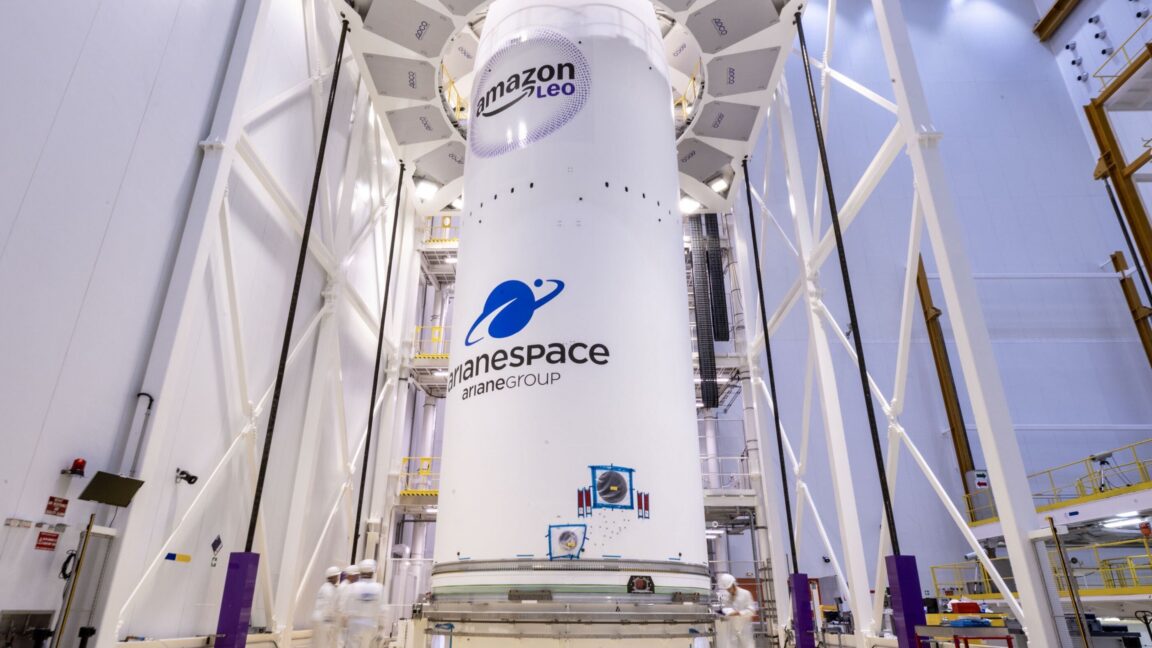
Amazon has a growing stockpile of completed broadband satellites on the ground because it does not yet have enough rocket capacity to launch them. Steve Metayer, vice president of Amazon Leo Production Operations, told reporters Tuesday that hundreds of flight-ready spacecraft are in a Florida payload facility awaiting rides to orbit.
Metayer said Amazon is producing several satellites each day for its low-Earth orbit internet network. The company is trying to build out a planned 3,236-satellite constellation, but Ars Technica reported that only 331 satellites have reached orbit so far.
Arianespace is scheduled to carry the next group of Amazon Leo satellites on an Ariane 64 rocket from French Guiana. Liftoff was targeted for 7:53 a.m. ET Wednesday, with 36 satellites aboard, according to Ars Technica.
Arianespace takes a central role
Amazon has so far relied mostly on United Launch Alliance’s Atlas V rocket for the satellites already in orbit, Ars Technica reported. That line is nearing retirement, and Amazon has only one more booked mission on the vehicle.
The company moved in 2022 to reserve capacity on three newer heavy-lift rockets: 18 Ariane 6 launches from Arianespace, 12 New Glenn flights from Blue Origin with options for 15 more, and 38 Vulcan launches from United Launch Alliance. Of those vehicles, only Ariane 6 has carried Amazon satellites, according to Ars Technica.
Metayer said Arianespace has been dependable on schedule and orbital delivery, and said Amazon expects the company to remain a long-term launch partner. After two Ariane 6 missions earlier this year and the scheduled Wednesday flight, Amazon still has 16 Ariane 6 launches remaining under its existing deal, he said.
New Glenn and Vulcan remain key questions
Amazon’s launch plan has been slowed by delays affecting Blue Origin’s New Glenn and ULA’s Vulcan. Ars Technica reported that Amazon had expected a much faster launch pace by the middle of the decade, while its satellite factories have continued producing spacecraft.
Blue Origin suffered a setback in late May when a New Glenn rocket exploded during a test firing at its Florida launch pad, destroying the vehicle and badly damaging Launch Complex 36A, according to Ars Technica. Jeff Bezos has said New Glenn will fly again this year, but Ars Technica reported that many independent industry observers expect the pad restoration to take 12 to 18 months.
Ars Technica also reported, citing multiple sources, that an issue involving the BE-4 engine has been identified as a likely cause of the accident. The same engine powers Vulcan’s first stage, which could affect that rocket’s return to flight while ULA also addresses strap-on booster issues.
Metayer told reporters that the first Vulcan mission carrying Amazon Leo satellites could still happen in the late third quarter of this year. He also said New Glenn accounts for less than a quarter of Amazon’s booked launches, while Ars Technica noted that New Glenn is expected to carry at least 50 Amazon satellites per flight, compared with 36 on Ariane 6.
Metayer said Amazon has booked launches across several vehicles and continues to seek additional opportunities. He said the company remains on schedule to begin commercial service for Amazon Leo later this year.
This story draws on original reporting from Ars Technica.