
Webb telescope detects salt clouds around distant pink companion
Astronomers say GJ 504 b’s faint spectrum points to salty clouds, unusual chemistry and possible metal enrichment 57 light-years away.
By Lucas Ferreira · Science & Environment Writer
3 min read
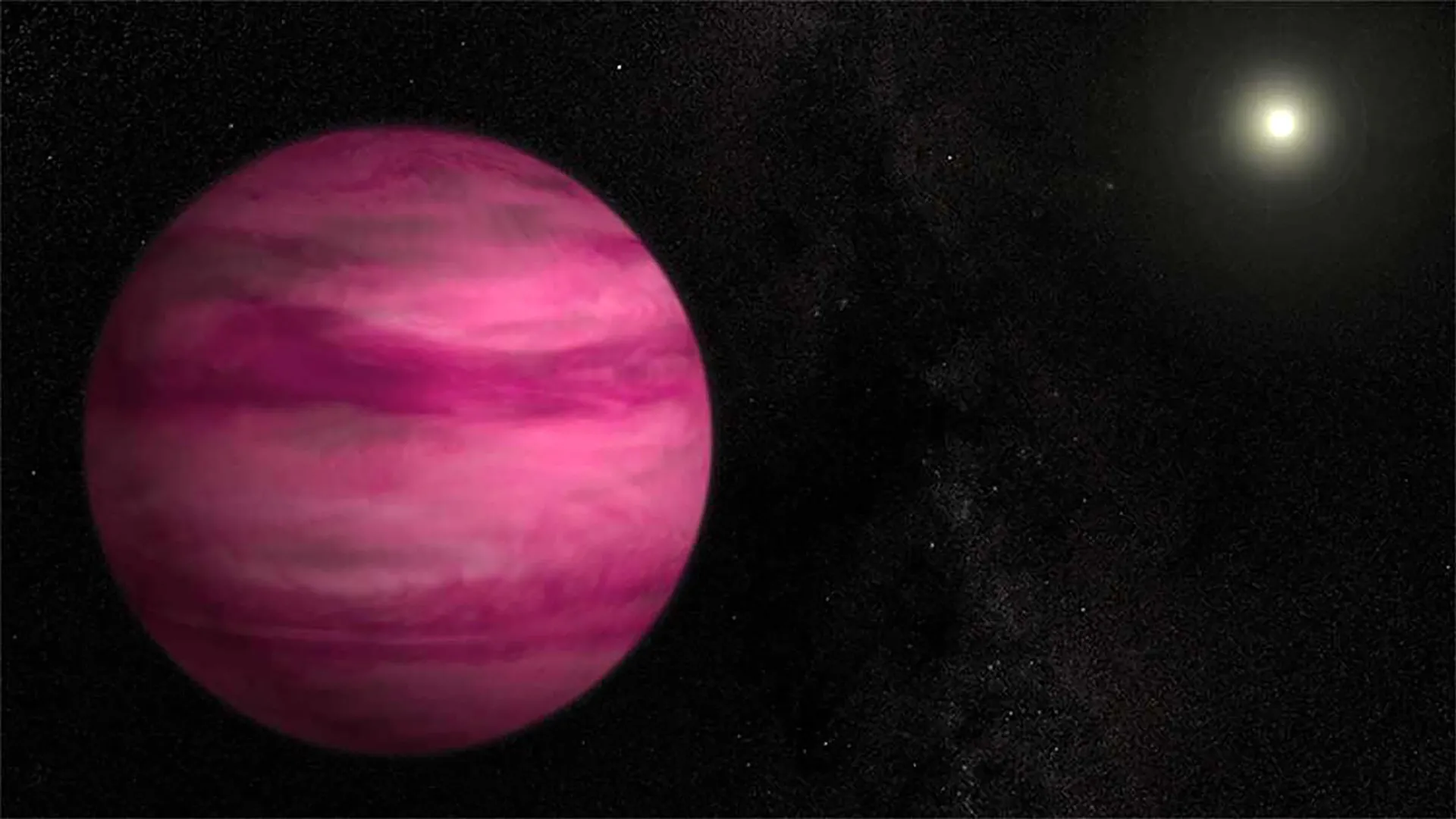
The James Webb Space Telescope has detected evidence of salt clouds around GJ 504 b, the cold, faint object widely nicknamed the Pink Planet, according to Northwestern University. Researchers say the finding helps explain a puzzling atmosphere on one of the coldest planetary-mass companions ever directly imaged.
The study, published June 18 in The Astronomical Journal, reports that Webb observations found water vapor, methane, carbon dioxide, ammonia and other molecules in the object’s atmosphere. Northwestern said the data also provide some of the first direct evidence that salt clouds can exist around a cold planetary object, a possibility scientists had predicted more than 15 years ago.
A cold object with a disputed label
GJ 504 b was discovered in 2013 and orbits a Sun-like star about 57 light-years from Earth, according to Northwestern. Researchers remain cautious about calling it a planet because its mass, about 25 times Jupiter’s, puts it near the dividing line between giant planets and brown dwarfs.
Astronomers therefore describe it as a planetary-mass companion: an object with a planet-like mass that travels around a star. Northwestern said GJ 504 b is also unusually cool for a directly imaged companion, with an estimated temperature of about 550 degrees Fahrenheit, or 290 degrees Celsius.
The research team estimates the object is between 2.5 billion and 4 billion years old. Aneesh Baburaj, the Northwestern postdoctoral researcher who led the study, said in the university’s account that giant planets form hot and cool over long periods, making the object’s age part of the explanation for its low temperature.
Webb separates a faint signal
Baburaj’s team used Webb to collect light from GJ 504 b and then processed the data to reduce interference from its much brighter host star, Northwestern said. The result was a spectrum, a breakdown of light that lets scientists identify chemical signatures in an atmosphere.
According to Northwestern, earlier attempts with large ground-based telescopes struggled because the object is so dim. Baburaj said the Webb observation took about two hours and produced a usable spectrum where previous overnight efforts had failed to clearly detect the companion.
The researchers then tested atmospheric models against Webb’s data. Northwestern said models without clouds required conditions that did not make physical sense, while models including clouds brought the results into line with expectations for cold planetary atmospheres.
The team compared three cloud types and found that salt clouds best matched the observed spectrum, according to Northwestern. The study says those clouds appear to mute the signals of molecules deeper in the atmosphere, changing the light Webb receives.
Clues to formation remain unsettled
The spectrum also suggests GJ 504 b may be enriched in heavy elements, which astronomers often call metals, according to the journal paper. Northwestern said that clue does not settle how the object formed, because the evidence remains consistent with either planet-forming processes or processes more like those that produce small stars.
The project included researchers from Northwestern, the Space Telescope Science Institute and other institutions. Marshall Perrin of the Space Telescope Science Institute designed the observing program, according to Northwestern, and the work was supported by NASA.
Baburaj said the analysis shows why cloud physics must be included when scientists interpret spectra from cold worlds. Northwestern said the same methods could help researchers study other faint planetary companions, including objects with cloud layers that current instruments cannot yet examine in comparable detail.
This story draws on original reporting from ScienceDaily.