
Lucy flyby finds a tumbling asteroid with traces of ancient water
NASA says asteroid Donaldjohanson is a bilobed relic shaped by impact, sunlight and a short-lived episode of liquid water.
By Priya Raghavan · Science Reporter
3 min read
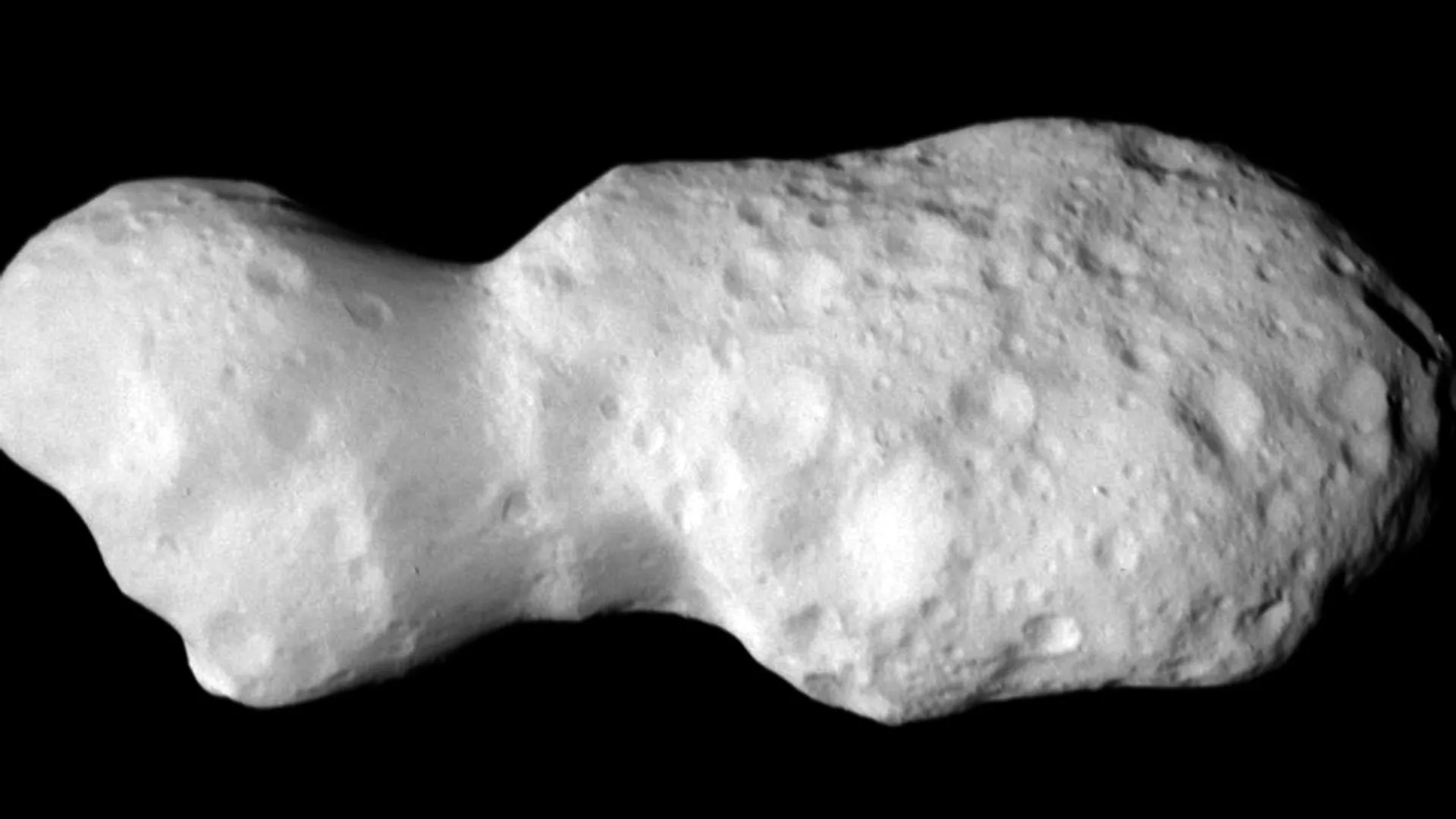
NASA’s Lucy spacecraft has found that asteroid Donaldjohanson is a two-lobed, tumbling object with minerals that point to ancient liquid water. The findings matter because the asteroid offers a fresh comparison point for scientists studying how small bodies recorded the solar system’s early history.
Researchers reported the results June 18 in the journal Science, based on Lucy’s April 20, 2025, flyby in the main asteroid belt. NASA said the spacecraft passed within 650 miles of Donaldjohanson while on its way to Jupiter’s Trojan asteroids.
The encounter gave scientists their first close views of Donaldjohanson and a test run for Lucy’s later Trojan flybys. NASA said Lucy’s cameras and instruments showed an object with a narrow neck joining two lobes, along with craters, ridges and other surface features.
A rotation more complex than expected
Before the flyby, Earth-based observations showed a brightness pattern that suggested Donaldjohanson was elongated and rotated once every 10.5 Earth days. The spacecraft data showed a more complicated motion, according to the research team.
Rather than spinning around one steady axis, Donaldjohanson tumbles. The team found that it turns end-over-end once every 10.5 days while also rocking around its long axis once every 26.5 days.
NASA said the asteroid likely formed about 155 million years ago after debris from a larger impact gradually reassembled. Researchers estimate Donaldjohanson spun at least 10 times faster soon after it formed, before slowing over the past 20 million to 60 million years.
The team attributes that slowdown to the YORP effect, a small force produced as sunlight heats an uneven asteroid and the surface later emits that energy as infrared radiation. Over long periods, NASA said, the tiny recoil can change an asteroid’s spin.
Water clues in the surface minerals
Lucy was moving about 30,000 mph during the pass, but its instruments still detected iron-rich clay minerals on Donaldjohanson’s surface, according to NASA. The research team said such minerals require liquid water to form.
The evidence points to a limited exposure to water rather than a long wet period. NASA said extended alteration tends to replace iron in clay minerals with elements such as magnesium, while Donaldjohanson’s clays remain rich in iron.
That sets Donaldjohanson apart from Bennu and Ryugu, two asteroids visited by sample-return missions. NASA said those objects contain magnesium-rich clays, evidence that they had longer contact with water, possibly over millions of years when they were still part of larger parent bodies.
The differences may reflect where or when the parent asteroids formed before their remains moved through the solar system, according to the research team. Donaldjohanson has stayed in the main asteroid belt since it formed, while Bennu and Ryugu later shifted into near-Earth orbits.
Lucy’s next targets
NASA said the Donaldjohanson flyby helped mission teams prepare for Lucy’s first Trojan asteroid encounter, a planned pass of Eurybates on Aug. 12, 2027. The mission is intended to make Lucy the first spacecraft to explore Jupiter’s Trojan asteroids.
Those objects are considered early solar system remnants, and NASA says studying them could help explain how the planets formed and migrated. The Lucy mission is led by the Southwest Research Institute, managed by NASA’s Goddard Space Flight Center, and built by Lockheed Martin Space.
This story draws on original reporting from ScienceDaily.