
Theory predicts checkerboard order for three-particle quantum clusters
Rice University physicists say trions should form orderly grids at the right particle density, offering experiments a new target.
By Tom Brennan · Health & Medicine Correspondent
3 min read
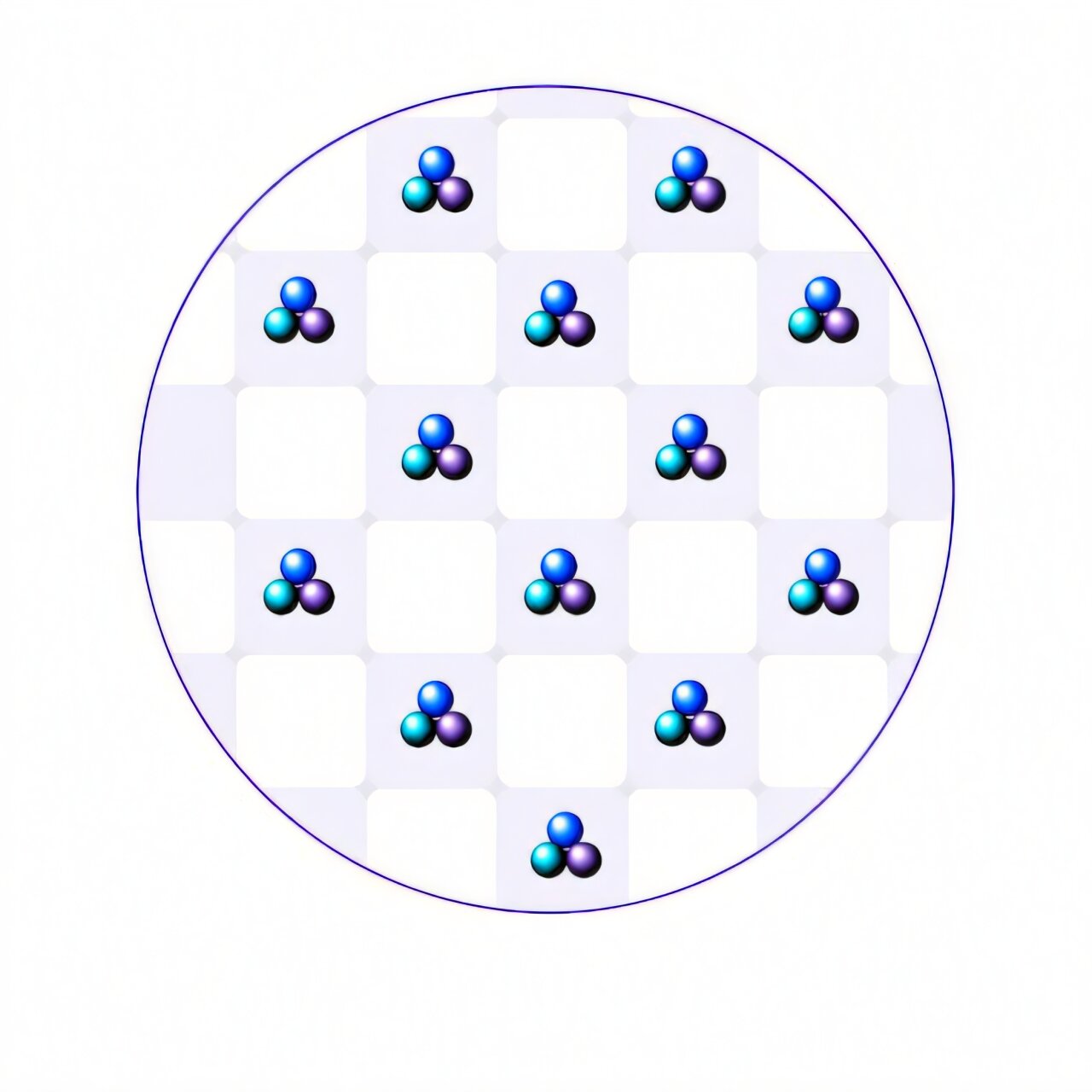
A Rice University physics team has proposed a theory for how trions, clusters made from three quantum particles, form and organize themselves. The work matters because trions appear in areas including nuclear physics, semiconductors and magnets, while their collective behavior remains difficult to predict, according to Rice University.
The study, published in Physical Review Letters, was led by Jonathan Stepp, a Rice graduate student, with Kaden Hazzard, an associate professor of physics and astronomy, as corresponding author. Rice said the team calculated the interaction strength needed for trions to appear and predicted that, under the right conditions, the clusters settle into a checkerboard arrangement.
Three particles, one cluster
Rice describes a trion as a bound group of three particles, comparable to one red, one blue and one yellow ball sticking together in a space filled with equal numbers of each color. Hazzard’s team asked what happens after those three-particle groups form and how the clusters position themselves relative to one another.
The researchers’ answer depends on density, according to Rice. At a particular particle density, the trions occupy alternating sites so that each cluster sits beside open space rather than directly beside another trion.
Stepp said that arrangement indicates the trions affect one another. Rice said the theory suggests nearby trions can block each other’s motion, while the checkerboard pattern leaves room for movement without close-neighbor interference.
Simulations built from ultracold-atom work
The Rice team drew on earlier experimental work with ultracold molecules, according to the university. In those systems, physicists place molecules in a box cooled to about a nanokelvin, a temperature just above absolute zero, where light can be used to manipulate the molecules.
Stepp said the group used equations and lessons from ultracold-molecule experiments to build simulations that tested how trions would behave. Rice said the team then worked back from the simulation results to identify simpler rules that could explain the observed patterns.
According to Rice, Stepp used a Monte Carlo program, a computational method that runs many simulations to approach a reliable result. He then examined the numerical output and compared possible descriptions, including whether the system behaved more like an ideal gas, a liquid, independent particles or bound trions.
Density sets the pattern
The simulations found that the checkerboard state appears only when the particle density is in the right range, according to Rice. If the number of particles is too high or too low for the available space, the system changes character, becoming more liquidlike in one direction and more gaslike in another, the university said.
Rice said the theory gives experimentalists a clearer target for tests of trion behavior. Experiments could check whether trions form at the predicted interaction strengths and whether they arrange in the alternating pattern described by the model.
The paper is titled “Trion Formation and Ordering in the Attractive SU(3) Fermi-Hubbard Model.” Rice said the findings could help physicists ask new questions about three-particle formations that occur across several branches of physics.
This story draws on original reporting from Phys.org.