
Study finds tire-derived chemical in Florida river after storms
FIU researchers detected 6PPD-quinone in Hillsborough River samples and found levels rose after rain, pointing to road runoff as a likely pathway.
By Priya Raghavan · Science Reporter
3 min read
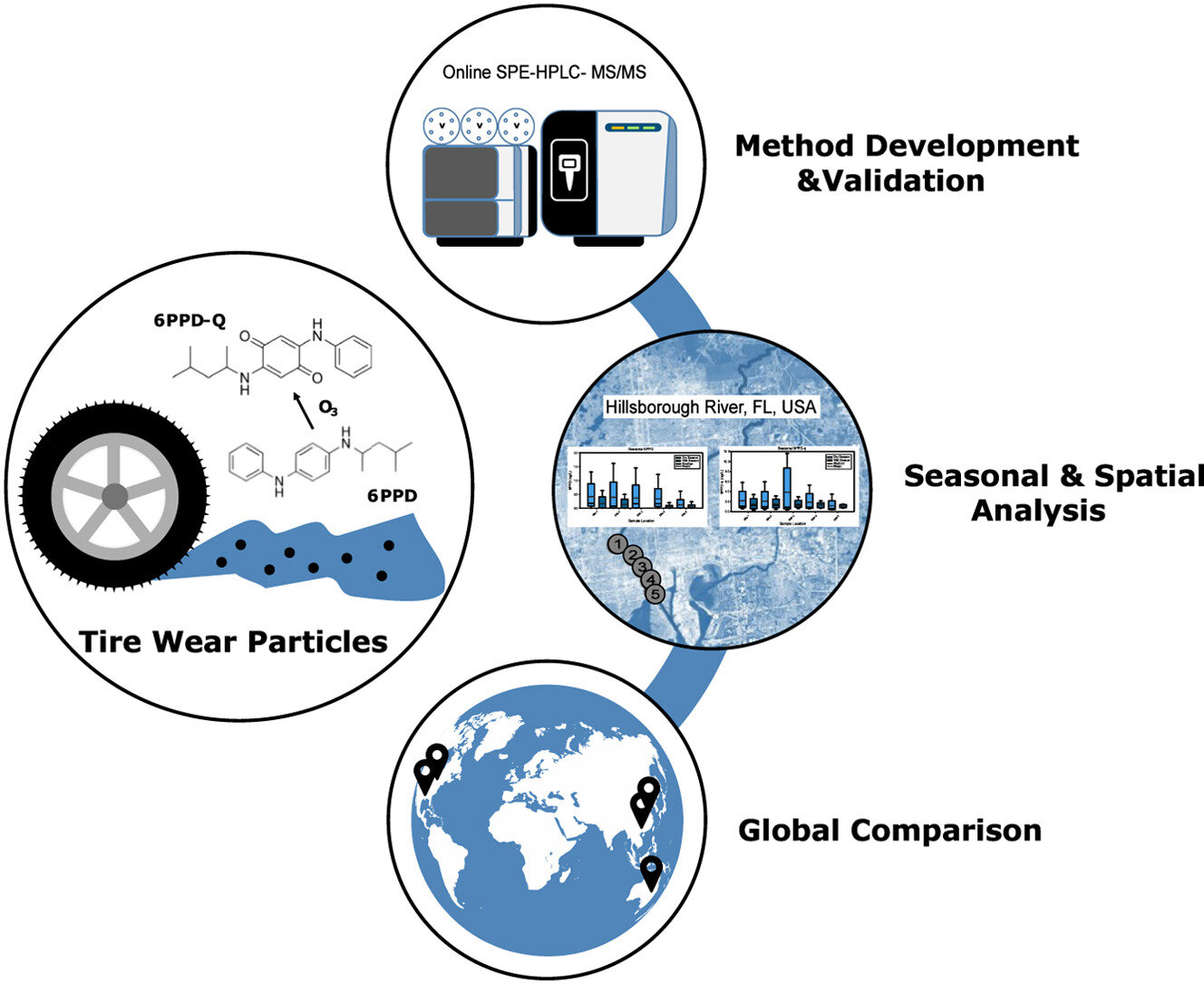
Researchers have detected a toxic tire-related chemical in Florida waterways for the first time, according to Florida International University. The finding matters because the pollutant, 6PPD-quinone, has been tied in other regions to fish deaths and may enter rivers and canals in bursts after storms.
The study, published in Environmental Pollution, focused on 6PPD-quinone, also known as 6PPD-Q. FIU said the compound forms when 6PPD, an additive used in vehicle tires, reacts with ozone in the air.
Kassidy Troxell, a research assistant professor at FIU's Institute of Environment, worked with researchers from FIU, Ocean Conservancy and the University of Florida on the study. The team also developed a more sensitive testing method to identify the compound at very low concentrations, according to FIU.
Rainfall linked to higher levels
The researchers sampled water in the Hillsborough River over 10 months, FIU said. They found 6PPD-Q in every sample analyzed.
According to the university, the highest levels appeared near urban stormwater outfalls in downtown Tampa. The study found concentrations increased after rain, especially after dry periods, a pattern researchers described as a first flush of pollutants into waterways.
Troxell said large rain events can send pulses of stormwater into rivers and canals, carrying higher amounts of these chemicals. The results point to runoff from roads and highways as a likely route for tire-derived pollutants to reach Florida waterways, according to the study.
The researchers compared their measurements with an Environmental Protection Agency freshwater screening benchmark of 11 nanograms per liter for short-term exposure in aquatic species. FIU said concentrations during some storm events came close to or slightly passed that level.
New method for monitoring
FIU said scientists could already test for 6PPD-Q, but existing approaches often require more sample preparation and analysis. The method developed by Troxell and her colleagues is designed to reduce manual handling, limit contamination risk and improve consistency.
The paper describes the technique as an online SPE-HPLC-MS/MS method for detecting 6PPD and 6PPD-Q. According to FIU, the approach could make routine monitoring faster and more reliable for researchers tracking tire-derived pollutants in the environment.
Separate research in the Pacific Northwest has linked 6PPD-Q to mass die-offs of coho salmon, according to FIU. Scientists are still studying how the chemical behaves in Florida's water systems and what repeated stormwater runoff could mean for local aquatic species and ecosystem health.
The study was authored by Troxell and collaborators and published under the title, “Development and validation of an online SPE-HPLC-MS/MS for tire-derived pollutants of environmental concern (6PPD and 6PPD-Q): Detection and rainfall-driven dynamics in an urban river-estuary continuum.” Its DOI is 10.1016/j.envpol.2026.127857.
This story draws on original reporting from Phys.org.