
Taiwan Biobank evolution study finds signs of natural selection
Researchers found rare disease-linked variants by comparing genetic data across age groups in more than 72,000 Han Taiwanese adults.
By Priya Raghavan · Science Reporter
3 min read
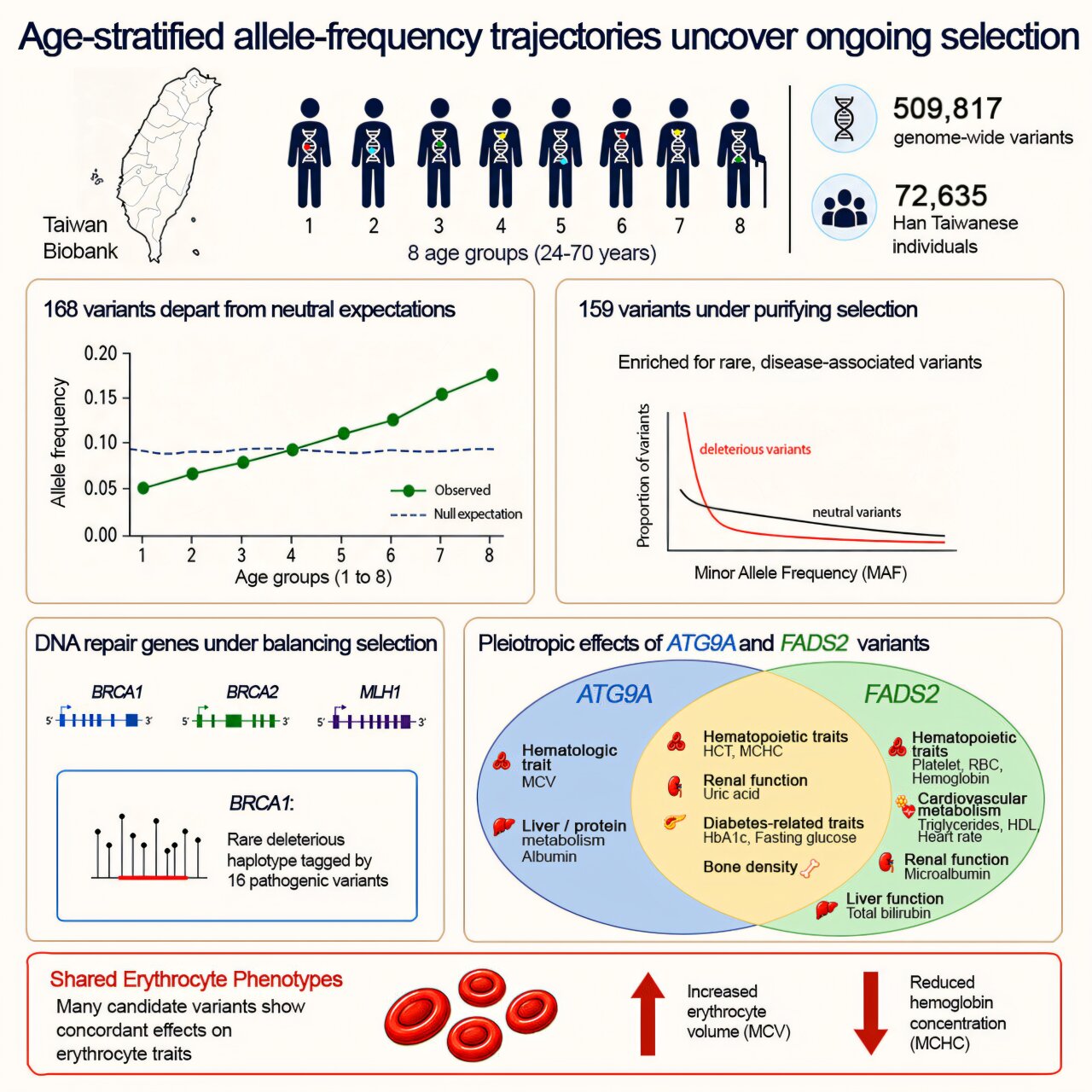
A Taiwan Biobank evolution study has used genetic data from more than 72,000 Han Taiwanese adults to search for signs that natural selection is still shaping living populations. The researchers said the approach could help identify rare disease-related variants that conventional genetic studies may overlook.
The work, led by researchers at National Yang Ming Chiao Tung University and published in The American Journal of Human Genetics, analyzed genomic data from 72,635 Han Taiwanese participants ages 24 to 70. The team compared how often inherited variants appeared across adult age groups rather than starting with genes already tied to specific diseases.
How can biobanks show human evolution?
Biobanks can reveal evolutionary signals because they contain genetic data from many people in the same population. In this study, researchers looked for allele-frequency patterns across age groups that differed from what would be expected if variants were changing only by chance.
The team examined 509,817 genome-wide variants and found 168 that departed from neutral expectations. According to the study, 159 showed evidence of purifying selection, an evolutionary process in which harmful variants tend to become less common over time.
About 90% of the flagged variants were extremely rare, the researchers reported. That is central to the finding because many past selection scans have focused mainly on common variants, leaving rare variants harder to detect.
Rare variants linked to disease
Many of the variants identified in the study had prior links to inherited disease. The researchers said 71 were classified in ClinVar as pathogenic or likely pathogenic, while others were associated with cancer, neurological conditions, cardiovascular problems, kidney disease and other serious health issues.
First author Jing-Lian Chen, formerly a master’s student in Wen-Ya Ko’s laboratory at National Yang Ming Chiao Tung University, said the age-based method helped reveal ongoing selection in a contemporary population and could expose disease-associated variants that remain hidden by other approaches.
Ko, the study’s corresponding author, said biobanks are often treated as disease-research tools, but the findings show they can also be used to study how natural selection affects disease-related genetic variation.
What did the study find in BRCA genes?
The researchers reported an unusual pattern involving BRCA1, a gene known for its role in cancer susceptibility. They identified a rare BRCA1 haplotype carrying 16 protein-altering variants, 15 of which are already classified as pathogenic, and said it appears to be under purifying selection.
At the same time, regions near BRCA1, BRCA2 and MLH1 showed evidence of positive selection, according to the study. Positive selection means variants become more common when they offer an advantage in a population, though the specific reasons may vary by time and environment.
Yoko Satta of SOKENDAI in Japan said the results show that evolution can act on different variants within the same genes in different ways. A variant tied to disease risk today may have carried an advantage under earlier environmental conditions, she said.
Red blood cell traits stood out
The study also found that many candidate variants converged on red blood cell traits. About 150 variants were associated with red blood cell measurements, especially higher mean corpuscular volume and lower mean corpuscular hemoglobin concentration, according to the researchers.
The team proposed that this pattern may reflect historical adaptation to infectious diseases such as malaria, which was once widespread in Taiwan. They said more research is needed to confirm the mechanism.
The researchers also highlighted ATG9A and FADS2, two genes with broad effects across human biology. Variants in those genes were linked to traits involving blood cells, liver and kidney function, lipid metabolism, diabetes-related measures, cardiovascular metrics and bone density.
The authors said the method could be applied to other national biobanks as more countries build large genomic datasets. Because many existing genetic reference datasets lean heavily toward people of European ancestry, they said population-specific analyses may help reveal medically relevant variants in groups that have been studied less often.
This story draws on original reporting from Phys.org.