
Study finds Southern California fault stress at 1,000-year high
Researchers say Cajon Pass may influence whether a future rupture stays on one fault or spreads across two major Southern California systems.
By Lucas Ferreira · Science & Environment Writer
3 min read
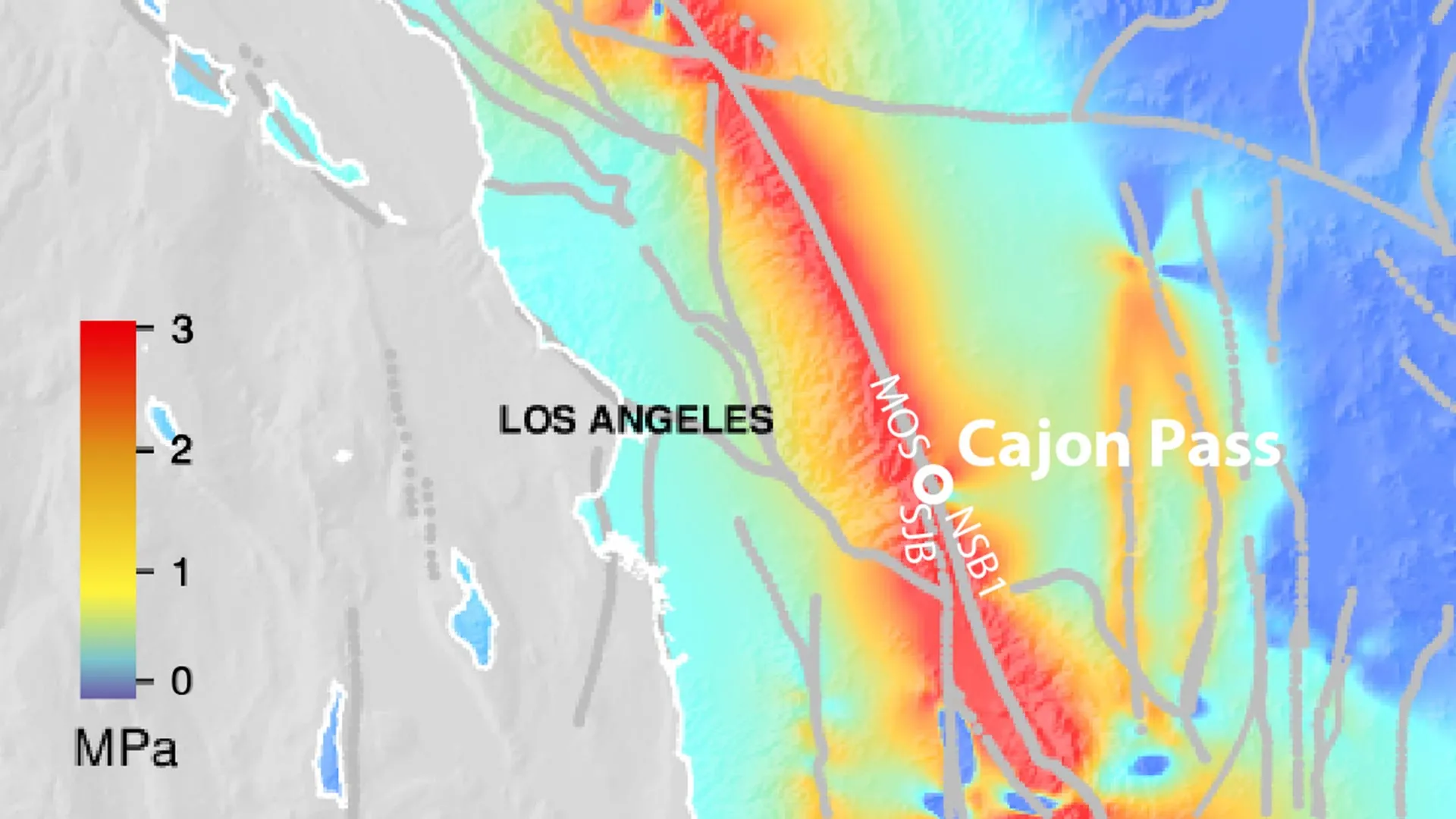
A new study says key Southern California faults are carrying their highest modeled stress levels in 1,000 years, raising concern about how a future major earthquake could rupture through the region. The research identifies Cajon Pass, where the San Andreas and San Jacinto fault systems come close together northeast of Los Angeles, as a possible “earthquake gate” that could affect whether a rupture crosses from one fault system to the other.
The study, led by Liliane M. L. Burkhard of the University of Bern, was published in the Journal of Geophysical Research: Solid Earth. The University of Bern said the research team also included scientists from the University of Hawaiʻi at Mānoa, the U.S. Geological Survey Earthquake Science Center in Pasadena and the Scripps Institution of Oceanography at UC San Diego.
Model reconstructs a millennium of fault stress
According to the University of Bern, the researchers built a physics-based four-dimensional earthquake cycle model to estimate how stress has changed along the southern San Andreas and San Jacinto systems. The model represents fault behavior in three dimensions and tracks changes over time.
The team fed the model with a 1,000-year earthquake record reconstructed from geological evidence, including radiocarbon dating, tree rings and historical observations of ground rupture, the university said. The model was designed to show how earthquakes shift stress to neighboring fault segments, how stress builds during quiet periods and how deeper crustal layers relax after large ruptures.
The researchers reported that stress across the region has reached or surpassed any level found in the 1,000-year model period. Since the magnitude 7.9 Fort Tejon earthquake in 1857, the University of Bern said, stress has continued to accumulate on nearby fault segments during a long quiet interval.
Cajon Pass could shape rupture path
The study describes Cajon Pass as a junction that may help determine whether a large earthquake stays on one fault or spreads across both the San Andreas and San Jacinto systems. The researchers call this role an “earthquake gate,” meaning the junction’s behavior depends on stress conditions that shift over centuries.
According to the University of Bern, past earthquakes show different outcomes at the same location. The 1857 Fort Tejon rupture stopped at Cajon Pass and did not continue onto the San Jacinto Fault, while the 1812 Wrightwood earthquake crossed the junction and moved through both fault systems as one event.
The study says the balance of stress between the two fault systems matters along with the stress on each fault. When both systems carry high and similar stress levels, the model indicates conditions are more favorable for a rupture to cross the junction; when their stress levels differ more, ruptures are more likely to stop there.
The researchers estimated present stress at 3.6 megapascals on the San Jacinto-Bernardino section, above any value in the 1,000-year simulation. They estimated 2.8 megapascals on the neighboring Mojave South section of the San Andreas Fault, a combination the study associates with past multi-fault rupture conditions.
Study is not an earthquake forecast
An earthquake that ruptured both fault systems through Cajon Pass would likely have greater regional consequences than one confined to a single system, according to the University of Bern. The areas cited by the researchers include greater Los Angeles, San Bernardino, Riverside and the Coachella Valley, while Cajon Pass contains major transportation, rail and energy infrastructure.
Burkhard said through the university that the findings should be used for hazard assessment, infrastructure planning and emergency preparedness. She also said the study does not predict when an earthquake will happen, but gives a physics-based picture of current stress conditions and possible rupture scenarios.
This story draws on original reporting from ScienceDaily.