
San Carlos Reservoir falls below 1% after dry winter
NASA Earth Observatory says scarce snow in the Gila River watershed left the Arizona reservoir nearly empty and caused a major fish kill.
By Priya Raghavan · Science Reporter
3 min read
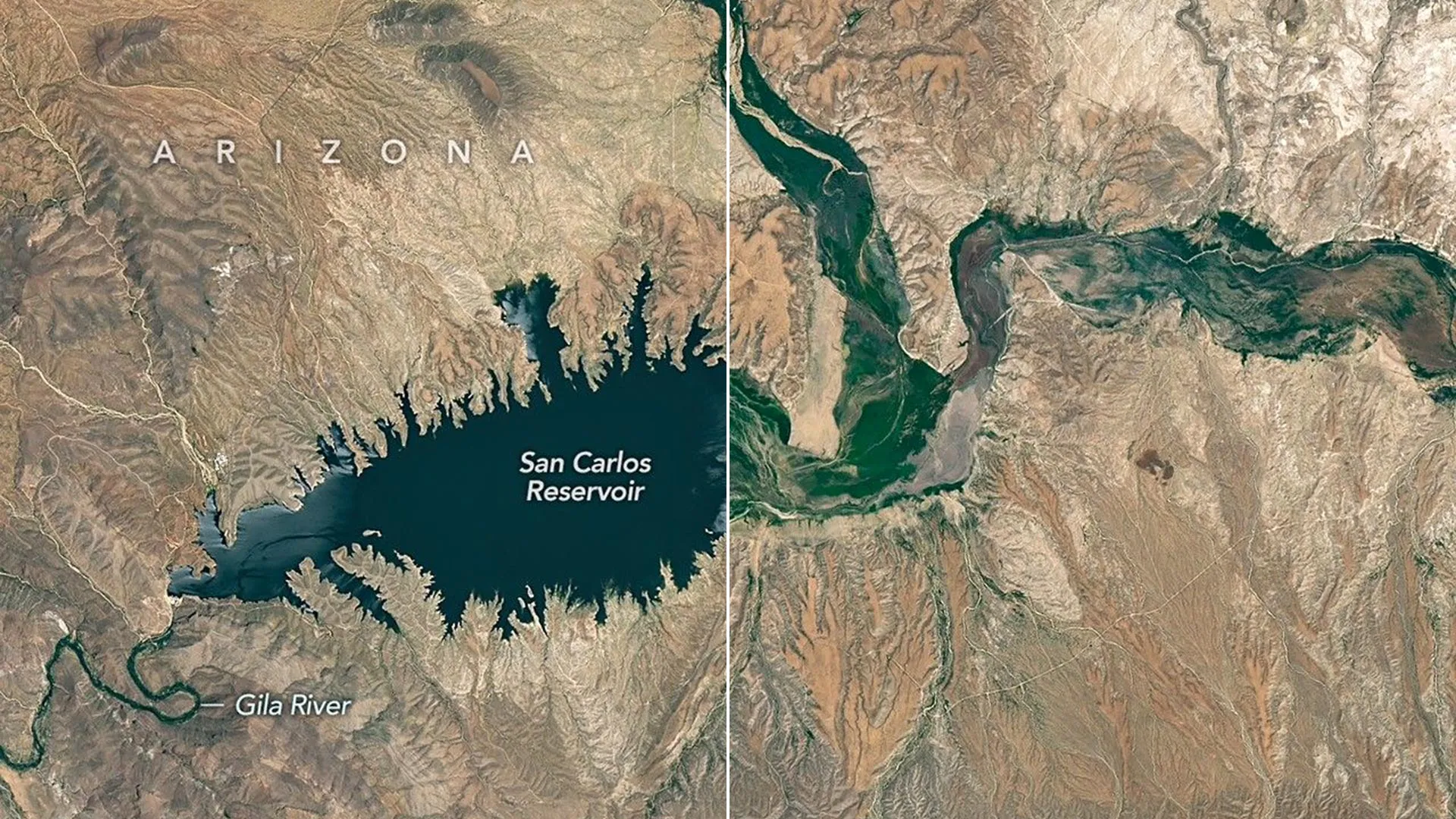
San Carlos Reservoir in eastern Arizona has dropped to less than 1% of capacity after a winter with very little mountain snow, according to NASA Earth Observatory. The decline has killed nearly all fish in the reservoir and led officials to close the site indefinitely.
The reservoir, formed by Coolidge Dam on the Gila River, depends in part on runoff from snow that falls in the Mogollon Mountains and Black Range of southwestern New Mexico, NASA Earth Observatory said. In wetter years, that runoff helps sustain one of Arizona’s larger lakes and supports water supplies for farms, communities and wildlife along the Gila River system.
Conditions shifted sharply in 2026. NASA Earth Observatory reported that snowpack in the Gila River watershed stood at only 2% of the 1991-2020 March median, and that April streamflow reached 39% of normal.
Required releases for downstream agricultural use further reduced storage by June, NASA Earth Observatory said. A Landsat satellite image taken May 22 showed San Carlos Reservoir holding 389 acre-feet of water, compared with an image from June 2023 when the reservoir was about 60% full.
As the water receded, oxygen levels fell. NASA Earth Observatory said the low-oxygen conditions, known as hypoxia, killed virtually all fish remaining in the reservoir.
The San Carlos Recreation and Wildlife Department closed the reservoir indefinitely on June 5, according to NASA Earth Observatory. Species affected included largemouth bass, black crappie, bluegill, channel catfish, flathead catfish, brown trout and rainbow trout.
The department also warned that decomposing fish could pose health risks to people who try to fish or boat in the area, NASA Earth Observatory said.
A reservoir with a history of extreme lows
The current drawdown is severe, but San Carlos Reservoir has seen repeated dry spells since it first filled in 1930. NASA Earth Observatory cited news reports saying the reservoir has gone completely dry at least 20 times.
Dry conditions were present even around the dam’s dedication, according to NASA Earth Observatory, when exposed lakebed had enough grass for humorist Will Rogers to joke to President Calvin Coolidge, “If that was my lake, I’d mow it.”
Large fish kills have happened there before. NASA Earth Observatory cited the Gila Herald as reporting that a 1976 fish kill destroyed more than 5 million fish and that the reservoir ecosystem took five years to recover. Another major fish kill occurred in 2018, according to NASA Earth Observatory.
Monsoon rain could help
The broader region remains dry. NASA Earth Observatory said U.S. Drought Monitor data show severe drought across much of the Gila River’s headwaters in New Mexico.
Rain later this year could improve conditions. NASA Earth Observatory said a NOAA seasonal monsoon outlook issued in May 2026 gave the region a 33% to 50% chance of above-average summer rainfall.
NASA Earth Observatory also reported that El Niño conditions in the central and eastern equatorial Pacific were strengthening in late spring 2026. That pattern can raise the odds of heavy rain in the U.S. Southwest, though the report did not say how much water would be needed for San Carlos Reservoir to recover.
This story draws on original reporting from ScienceDaily.