
Researchers make solid material that turns visible sunlight into UV
Kyushu University says the material could support solar-powered air cleaning, chemistry and low-light manufacturing uses.
By Lucas Ferreira · Science & Environment Writer
3 min read
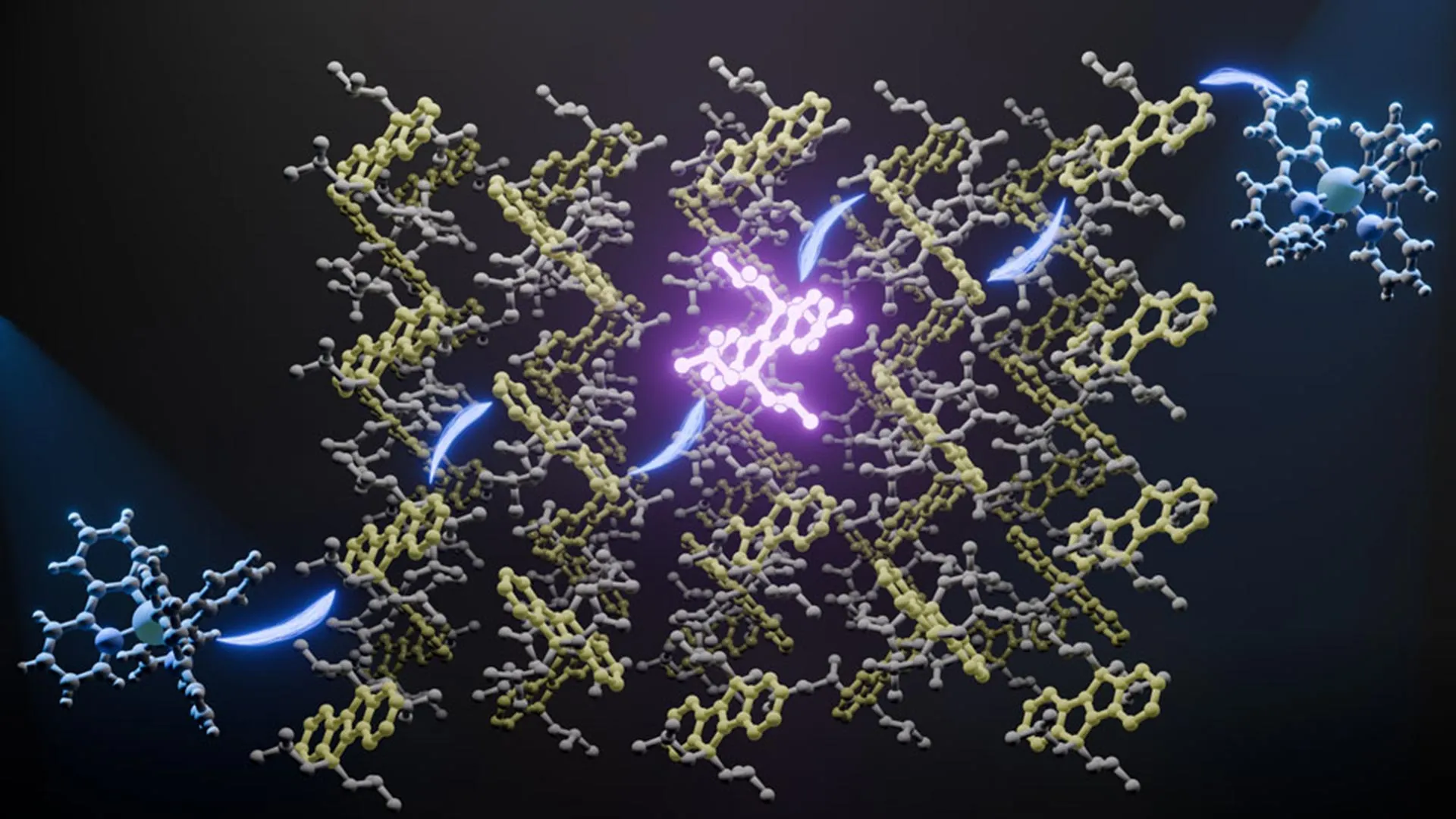
Researchers at Kyushu University have developed a solid molecular material that converts visible sunlight into ultraviolet light under normal outdoor light levels, according to the university. The work matters because usable UV light is limited in sunlight but is central to technologies including air purification, resin curing and photocatalysis.
The study, published June 23 in Nature Communications, reports a visible-to-UV photo upconversion efficiency of 1.9% when the material is combined with a donor molecule. Kyushu University said the system runs on natural sunlight alone, a condition that many solid-state upconversion materials have struggled to meet.
How the material raises light energy
The process is known as photo upconversion, in which energy from lower-energy visible photons is combined to produce a higher-energy ultraviolet photon, according to Kyushu University. Yoichi Sasaki, an associate professor at Kyushu University’s Faculty of Engineering and the study’s corresponding author, described the work as combining energy from two visible-light photons to make one ultraviolet photon.
The study uses a mechanism called triplet-triplet annihilation, Kyushu University said. In that process, a donor molecule absorbs visible light and enters a triplet excited state, passes energy to an acceptor molecule, and two triplet states can then combine to emit one UV photon.
Kyushu University said this approach has worked well in liquids because molecules can move and meet more easily. Liquid systems, however, can rely on toxic solvents and may evaporate, limiting practical use, the university said.
Solid materials pose a different problem, according to Sasaki. Molecules can pack so tightly that their electron clouds overlap, causing excited states to lose energy before they combine; the challenge is keeping molecules close enough to transfer energy while far enough apart to avoid quenching.
Controlled spacing in a solid
The team built the material around an organic semiconductor called dihydroindenoindenedene, or DHI, Kyushu University said. Researchers attached alkyl chains to sp³ carbon atoms in the molecule, creating controlled gaps between neighboring molecules.
According to the university, that spacing allowed efficient triplet energy transfer while limiting the electronic interactions that suppress performance. The material showed strong luminescence, long-lived excited states and a solid-state fluorescence quantum yield above 60%, the study reported.
When used with a donor molecule, the system produced the 1.9% upconversion efficiency reported in the paper. Sasaki said, according to Kyushu University, that this corresponds to roughly two UV photons generated for every 100 visible-light photons absorbed.
Potential uses and next steps
Kyushu University said the researchers have filed a patent application for the material. The university also said the material can be made relatively easily from inexpensive starting materials.
The team sees possible uses in solar-powered photocatalysis, indoor air purification and low-intensity 3D printing, according to Kyushu University. UV light is also used in dental gel hardening, resin curing and nail treatments, the university said.
The publication reflects more than 14 years of work led in part by Nobuo Kimizuka, now professor emeritus at Kyushu University’s Research Center for Negative Emissions Technologies, according to the university. Kyushu University said Kimizuka began studying photon upconversion through triplet energy migration in self-assembled molecular systems in 2012, with the solid-state result coming shortly before his retirement.
This story draws on original reporting from ScienceDaily.