
Forecasts may help time New Horizons’ crossing into the heliosphere’s edge
SwRI researchers say solar wind forecasts could narrow when New Horizons reaches the termination shock, possibly between 2029 and 2040.
By Lucas Ferreira · Science & Environment Writer
3 min read
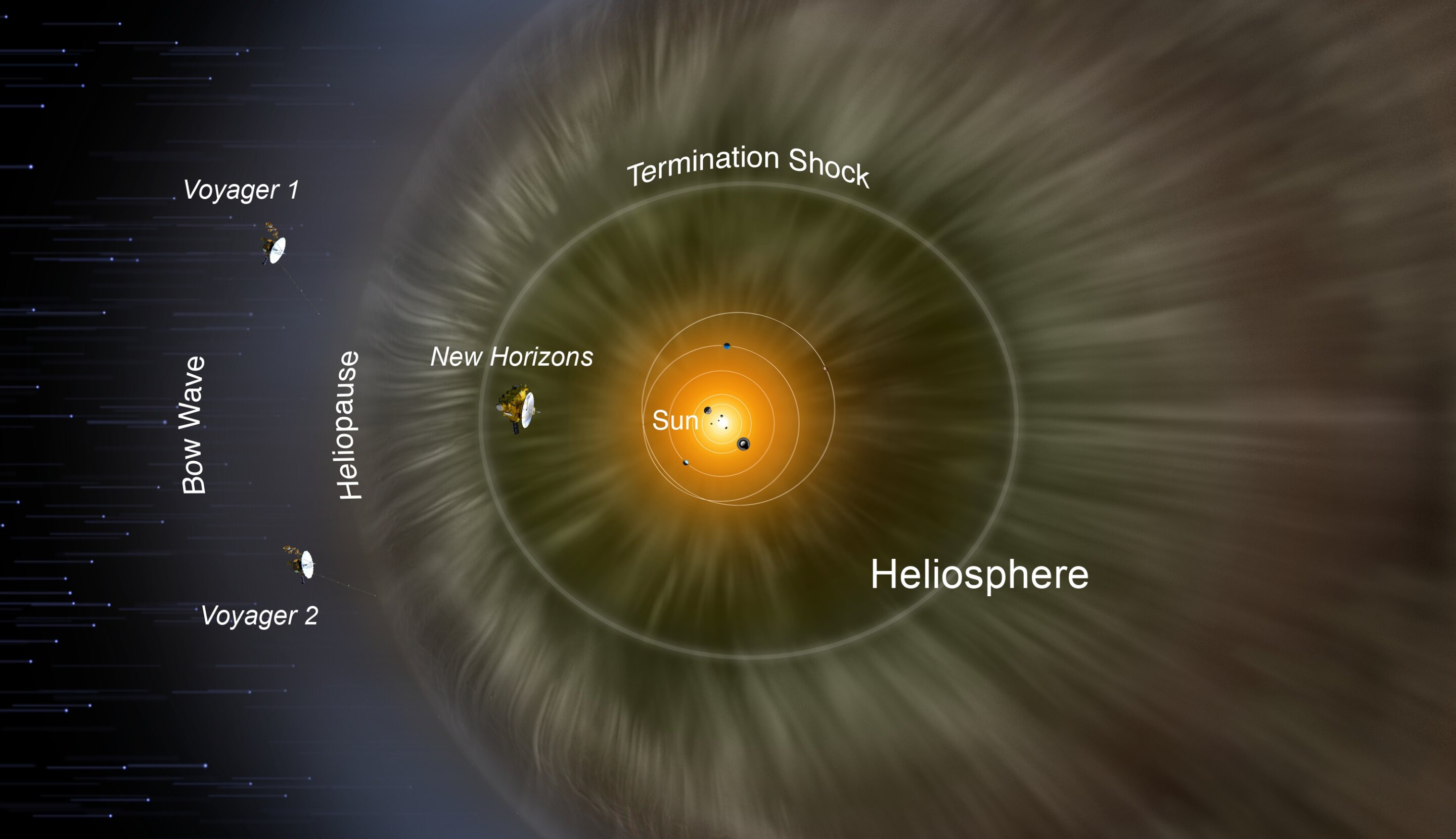
Southwest Research Institute scientists are using solar wind forecasting to estimate when NASA’s New Horizons spacecraft will reach a key boundary near the edge of the solar system. The timing matters because researchers want the spacecraft ready to collect and return data from a region only Voyager 1 and Voyager 2 have crossed, according to SwRI.
The work focuses on the termination shock, the first plasma boundary in the outer heliosphere. SwRI said researchers combined a solar wind forecasting method with analytical and numerical models of the heliosphere to study where that boundary may lie along New Horizons’ path.
The heliosphere is the broad bubble formed by solar wind flowing outward from the sun, according to SwRI. It surrounds the solar system and blocks much of the high-energy galactic radiation found in interstellar space.
Scientists have not settled on the heliosphere’s shape, SwRI said. Some researchers describe it as comet-like, with a rounded forward region and a trailing tail as the sun moves through the interstellar medium, while other models point to a croissant-like form.
A moving boundary
SwRI said the outer heliosphere changes as solar conditions change. The termination shock marks where the solar wind slows as it meets interstellar material, while the heliopause lies farther out, where that outward flow comes to an end.
Those borders do not stay fixed, according to the institute. During solar maximum, stronger solar wind pushes the heliosphere outward; during solar minimum, weaker solar wind lets it contract.
That motion complicates forecasts for New Horizons. Dr. Jonathan Gasser, lead author of two recent papers on the subject, said the spacecraft could reach the termination shock as soon as 2029 or as late as 2040.
“We want to understand when the spacecraft will reach the termination shock to prepare to take measurements and download data about this region,” Gasser said in the SwRI release. He added that New Horizons may cross the boundary more than once if the heliosphere expands and contracts around the spacecraft’s path.
New Horizons heads outward
New Horizons is continuing beyond the worlds it has already visited, according to SwRI. The spacecraft completed flybys of Pluto and the Kuiper Belt object Arrokoth before traveling deeper into the outer solar system.
SwRI said New Horizons is moving toward the heliosphere’s forward region. If it eventually leaves the solar system, it would follow Voyager 1 and Voyager 2 as the third spacecraft to reach interstellar space.
The research appears in two peer-reviewed papers. One, published in Advances in Space Research, addresses predictions for New Horizons’ termination shock crossing. The other, published in The Astrophysical Journal, examines solar wind forecasting for long-term changes in the global heliosphere.
SwRI said the studies could help scientists understand how the heliosphere interacts with interstellar space. The institute also said the work may aid future missions designed to study the region where the solar system gives way to the space beyond it.
This story draws on original reporting from Phys.org.