
Researchers make optical skyrmions with a simple laser setup
NTU Singapore scientists used the Poisson spot, a 19th-century diffraction effect, to generate stable light patterns studied for future computing and communications.
By Priya Raghavan · Science Reporter
3 min read
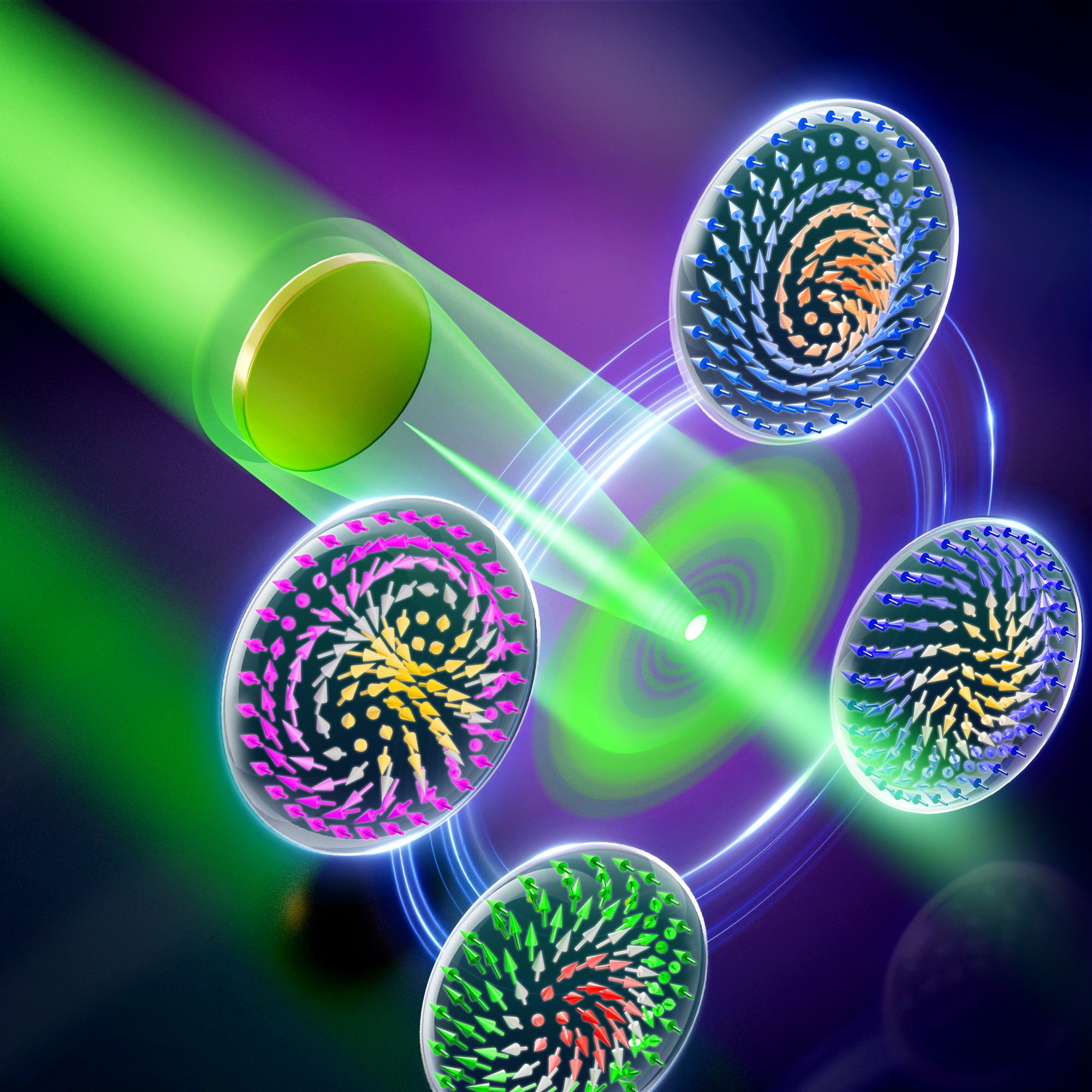
Scientists at Nanyang Technological University, Singapore have produced optical skyrmions using a basic laser-and-disk arrangement, offering a simpler route to a class of light structures studied for data storage, communications and computing. The work, published in Optica, shows that a Poisson spot can create several skyrmion patterns in one light field.
NTU Singapore said the team, led by Assistant Professor Shen Yijie of the university’s School of Physical and Mathematical Sciences and School of Electrical and Electronic Engineering, used a laser aimed at a small circular disk. That setup replaces the engineered metamaterials and specialized methods often used to make optical skyrmions.
Optical skyrmions are small, swirling arrangements in light’s properties. Researchers study them because skyrmions can behave as stable, particle-like patterns, a feature that has made them a subject of interest in photonics and other branches of physics.
A historic light effect put to new use
The Poisson spot is a bright point that appears in the center of the shadow of a circular object when coherent light, such as laser light, shines on it. NTU Singapore said the effect became important in the early 1800s during arguments over whether light traveled only as particles in straight paths or also behaved as a wave.
The bright spot arises from diffraction, the bending and spreading of light around an object or through an opening. In the Poisson-spot experiment, wave behavior predicts light at the center of a shadow, where a dark region might otherwise be expected.
According to NTU Singapore, Shen said the result shows optical skyrmions can be generated through light bending around an object, rather than through costly metamaterials or highly specialized systems. He said the lower technical barrier could make it easier for researchers to create and study these structures.
Four skyrmion patterns in one spot
The researchers reported that the Poisson-spot system can produce as many as four related topological field patterns at once: spin skyrmions, Stokes skyrmions, electric-field skyrmions and magnetic-field skyrmions. Spin refers to rotation-like properties of light, while Stokes parameters describe polarization, or the direction in which light waves vibrate as they move.
NTU Singapore said the “four-in-one” result gives scientists a way to compare how different optical skyrmions form and interact in the same light field. In simulations described by the researchers, the structures appear as rotating arrow patterns that map how light’s properties change across the Poisson spot.
Light can be shaped through properties including intensity, phase, polarization, spin and electric and magnetic field vectors. The team said these features provide different routes for forming topological structures, meaning patterns that can remain stable even when stretched or distorted.
Shen said several optical vector components in the light spot could form topological structures at the same time. According to NTU Singapore, he said comparing multiple skyrmions in one system may help researchers identify links among light’s electric, magnetic and other physical properties.
Possible research paths
Skyrmions were first proposed in particle and nuclear physics, later studied in condensed matter physics and magnetic materials, and more recently examined in photonics, according to NTU Singapore. Earlier optical work often relied on metamaterials, which are artificial microstructures made to control light in ways ordinary materials cannot.
The university said the findings provide a foundation for further work on topological light. Potential areas of study include photonics, advanced materials, information processing and computing.
The paper, “Optical skyrmions in Poisson spots,” was authored by Jun Yao and colleagues and published in Optica in 2026.
This story draws on original reporting from Phys.org.