
Study ties urban soil lead risk to housing, race and income
University of Vermont researchers found soil lead patterns in Hartford and Springfield tracked with housing, demographics and historical redlining.
By Lucas Ferreira · Science & Environment Writer
3 min read
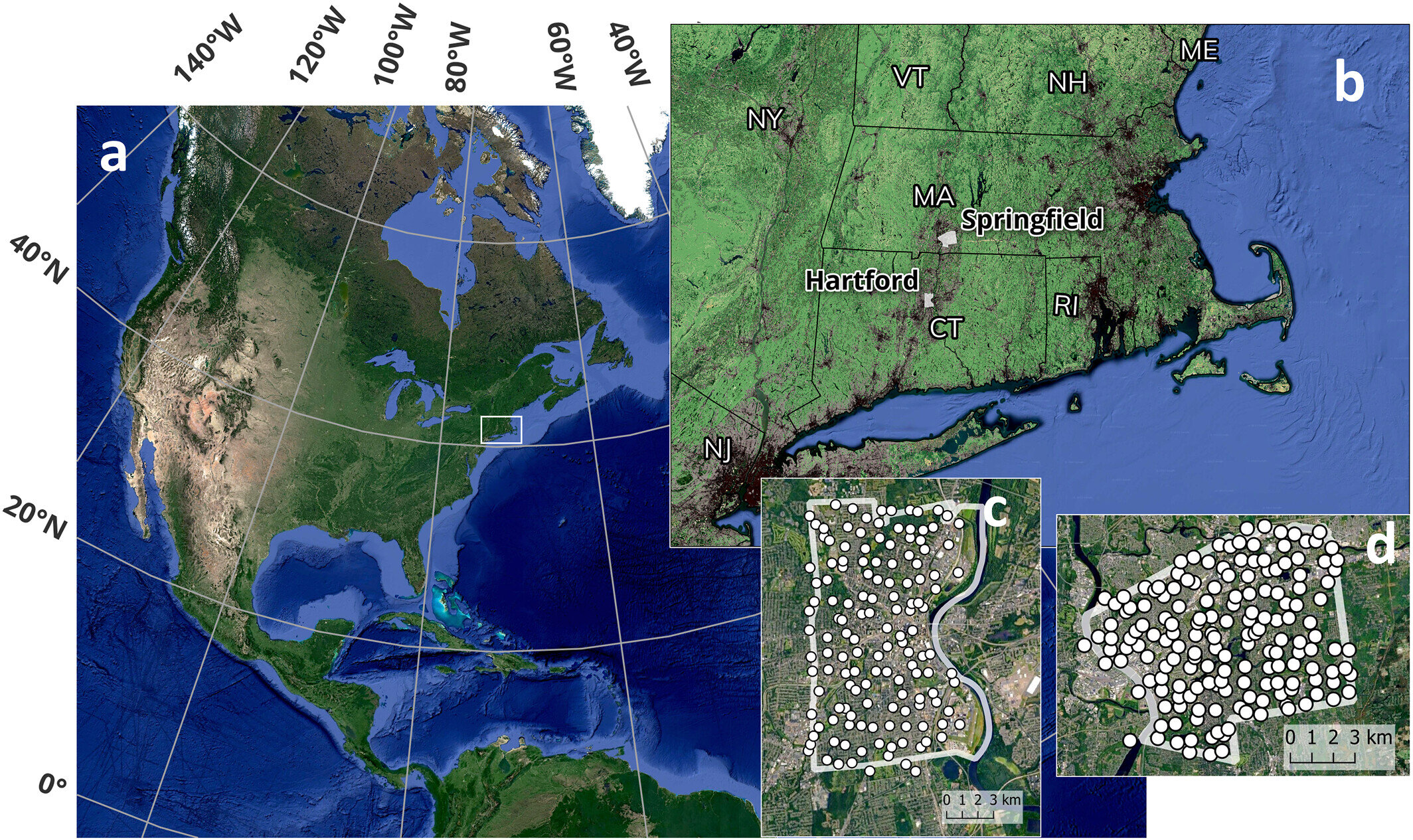
A University of Vermont study found that soil lead contamination in Hartford, Connecticut, and Springfield, Massachusetts, closely followed neighborhood patterns of housing, race and income. The findings, published in GeoHealth, point to a method cities could use to target soil testing and cleanup in areas where children may face higher exposure risks.
UVM said an estimated 25% to 40% of U.S. homes have lead-contaminated soil, a hazard tied to developmental harm in children. Researchers have long known that cities with industrial histories face elevated risks, but the study aimed to identify which parts of a city are more likely to have contaminated residential soil.
The research team tested about 300 soil samples, split roughly evenly between Hartford and Springfield, according to UVM. Lead author Nico Perdrial, a professor in UVM’s College of Arts and Sciences and an affiliate of the Gund Institute, said the study focused on residential areas because “this is where children play.”
The researchers compared the soil results with publicly available census and tax records, UVM said. The model included housing type, race, the presence and number of children, age data and residential tax values.
Hartford showed stronger contamination patterns
UVM said Hartford’s soils were more contaminated overall than Springfield’s. In Hartford, the group most likely to face exposure was children of color living in multifamily housing, according to the university.
Perdrial said the city showed a clear split between lower-risk and higher-risk areas. “In Hartford, we see that populations that typically live in single-family housing of higher value, in blocks that have lower-than-average Hispanic populations, have a lot less chance of being affected by, or being in contact with, soil lead,” he said, according to UVM.
In Springfield, neighborhoods with lower-than-average shares of white, non-Hispanic residents had a 1.7 times greater chance of elevated soil lead, UVM reported. Within those areas, sites with multifamily housing and more children than the city average were 2.4 times more likely to have high soil lead levels.
Redlining linked to Hartford soil risk
For Hartford, the researchers also examined historical redlining, UVM said. Redlining was a 20th-century mortgage-lending practice that restricted desirable urban housing for white families and pushed residents of color into crowded and less-desirable areas, including places affected by highway traffic, industry and related pollution, according to the university.
Perdrial said redlining was the strongest factor measured in Hartford. “Redlining drove lead exposure much more than any other parameter we measured,” he said, according to UVM.
Comparable redlining data were not available for Springfield, Perdrial said. In Hartford, UVM reported, neighborhoods historically rated “desirable” were less than half as likely to have high soil lead. Areas rated least desirable on Home Owners’ Loan Corporation maps were 20% more likely to have high soil lead, and soil near multifamily homes in those areas was 40% more likely to show high readings.
Perdrial said the results point to a continuing environmental legacy. “It’s an indication that a legacy of environmental racism exists in the soil,” he said, according to UVM. “The soil has this memory that we cannot just eliminate by changing policies.”
The UVM team said the statistical approach can be repeated in other cities with industrial pasts. Perdrial said identifying areas most likely to have contaminated soil can help public officials and residents decide where to test and where to reduce exposure, especially for children.
Perdrial also warned against treating lead as a closed chapter because lead paint and leaded gasoline were banned years ago. “We’re showing that there is a lasting memory in the cities,” he said, according to UVM.
This story draws on original reporting from Phys.org.