
Slow molecular switch reveals path for future nanoscale machines
Researchers slowed a molecular cage’s shape change enough to track how chemical signals shift it between mirror-image forms.
By Lucas Ferreira · Science & Environment Writer
3 min read
Researchers in Japan have tracked a molecular switch as it changed form over several hours, giving chemists a clearer view of a process that usually happens too quickly to follow. Kanazawa University said the work could aid the design of molecular machines, responsive materials and systems that store or process information at molecular scale.
The study, by Shigehisa Akine and colleagues at Kanazawa University’s Nano Life Science Institute, the Institute for Molecular Science and SOKENDAI, was published in the Journal of the American Chemical Society. According to Kanazawa University, the team designed a cage-shaped molecule whose guest uptake and structural rearrangement are unusually slow, allowing scientists to watch intermediate steps that are often missed.
A cage built to slow the switch
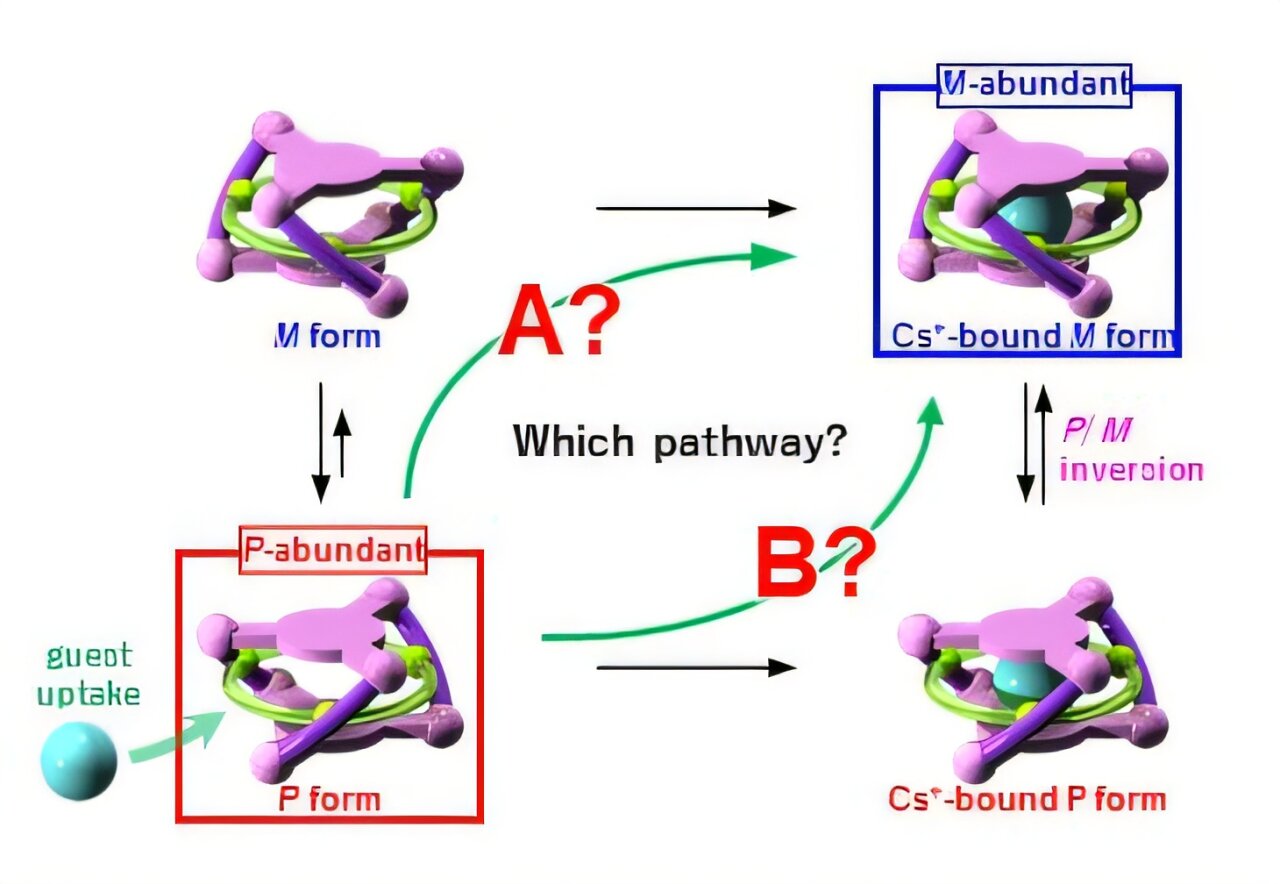
The molecule is a triple-helical cobalt metallocryptand, a cage formed from three intertwined molecular strands around an internal cavity. Kanazawa University said it can exist in two mirror-image shapes, described as right-handed, or P, and left-handed, or M.
In solution, the two forms convert into each other slowly, with the right-handed form usually more common. The researchers added flexible bridging ligands that partly close the cage entrances, a design that sharply slows the movement of guest ions into and out of the cavity, according to the university.
That slower timing let the team examine the full sequence after a chemical input rather than seeing only the starting and ending structures. Kanazawa University said the result shows that a molecular system’s response speed can be adjusted through molecular design.
Cesium pushes the balance left
When the researchers added cesium ions, the molecular population gradually shifted from mostly right-handed structures to mostly left-handed structures. Because the change unfolded over hours, the team monitored the process with nuclear magnetic resonance and circular dichroism spectroscopy.
The researchers also used X-ray crystallography and theoretical calculations to characterize the initial and final states, according to Kanazawa University. Those methods helped explain why the cesium ion favored one molecular form over the other.
The findings addressed a long-running question in chemistry about how guest-induced structural changes occur. One model, known as induced fit, holds that a guest first binds to a host and then triggers a shape change. Another, conformational selection, holds that multiple host shapes already exist and the guest binds preferentially to one of them.
Kanazawa University said the experiment supported the conformational-selection model. The cesium ions did not primarily bind to the dominant right-handed form and force it to change; instead, they preferentially bound to the less common left-handed form already present in solution.
Different ions, different responses
Once cesium was trapped inside the cage, the left-handed form became more stable, shifting the overall population toward that state. Kanazawa University described the switch as the result of guest recognition, molecular motion and equilibrium acting together.
The team also found that chloride ions had the opposite effect. According to the university, chloride favored the right-handed form by interacting with binding sites on the outside of the molecular cage.
Akine said most molecular switches are too fast for researchers to see the details of how they work. “By designing a system in which guest uptake and structural switching occur on similar time scales, we were able to uncover the hidden pathway that connects them,” he said, according to Kanazawa University.
The publication identifies the paper as “Interplay between Slow Chirality Inversion and Slow Guest Uptake in a Triple-Helical Closed-Cage Metallocryptand,” by Sk Asif Ikbal and co-authors. Kanazawa University said the principles shown in the work may help guide future smart molecular architectures, including responsive materials and molecular information systems.
This story draws on original reporting from Phys.org.