
Researchers demonstrate rotating high-intensity laser pulse
Lawrence Livermore and UC Irvine scientists say the “light spring” could help study plasma control, particle acceleration and intense magnetic fields.
By Lucas Ferreira · Science & Environment Writer
3 min read
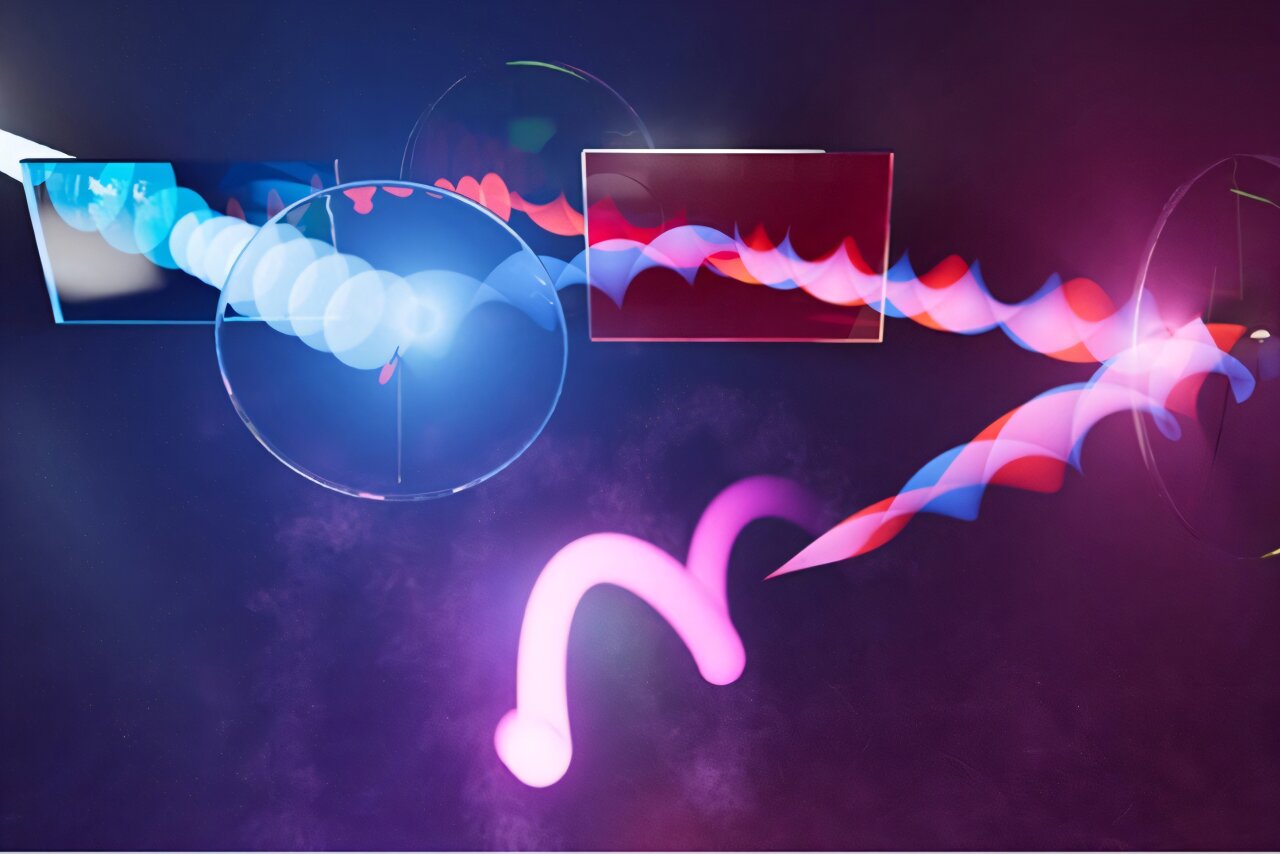
Scientists at Lawrence Livermore National Laboratory and the University of California, Irvine have demonstrated a high-intensity laser pulse that rotates around its axis, a design they say could give researchers new ways to control plasma. The work, reported in Nature Photonics, could open experimental paths in fusion energy, particle acceleration and laboratory astrophysics.
The researchers call the pulse a high-intensity “light spring.” According to LLNL, a conventional high-power laser usually strikes plasma as a plain, round beam, while the new pulse has structure in both space and time.
Andrew Longman, an LLNL scientist and lead author of the study, said the goal is to use shaped laser pulses to do more than push plasma back and forth. LLNL said the rotating beam could “stir” plasma and drive wave behavior that has not been tested in experiments before.
How the rotating beam was made
The team created the pulse with specialized beamsplitters and freeform optics made with extreme precision, according to LLNL. Researchers first divided a broadband laser into two parts: one containing shorter blue wavelengths and the other containing longer red wavelengths.
Each part then bounced off a custom nanostructured mirror. LLNL said the mirrors look flat to the eye, but each carries a faint spiral pattern; if the 6-inch mirrors were enlarged to a mile across, the height change in the spiral would be about half an inch.
Tayyab Suratwala, LLNL’s program director for Optics and Materials Science and Technology, said some of the finished optics differed from their intended design by only about five nanometers across the whole component. LLNL said that level of accuracy depended on advanced grinding and polishing methods for large optics.
After reflection from the mirrors, a second beamsplitter recombined the two beams so they matched in space and time. LLNL said the resulting pulse has a spring-like or DNA-like twist as it travels.
The laser was assembled and tested at UC Irvine by a group that included former LLNL intern Danny Attiyah and UC Irvine professor Franklin Dollar, according to LLNL.
Possible uses in plasma research
LLNL said the rotation rate of the beam can be adjusted across a wide range. The apparent motion can exceed the speed of light, the laboratory said, while still remaining consistent with relativity because no information or material object is traveling faster than light.
Computer simulations cited by the researchers suggest light springs can drive helical plasma waves that act like small electromagnetic coils. Using the precision optics, LLNL said a tabletop laser system could potentially generate magnetic fields above 100 teslas, a strength comparable to some of the strongest fields produced in laboratories.
Fields that strong could give scientists another way to study matter under extreme conditions, according to LLNL. The laboratory said researchers could use the setup to examine plasma processes linked to astrophysical environments and to test how intense magnetic fields affect atoms and the light they give off.
The team also sees a possible role in plasma-based particle acceleration. In standard plasma accelerators, LLNL said, electrons can eventually get ahead of the laser pulse that is speeding them up, which limits the energy they gain.
Simulations described by the researchers suggest helical plasma waves from light springs could keep electrons in the accelerating region over longer distances. Dollar said the approach could produce energies associated with much larger accelerator facilities over a distance on the order of a centimeter, according to LLNL.
Next steps
The scientists are continuing to test the laser and assess possible applications, LLNL said. They also are working on a version that would combine the optical elements into a single component, which the laboratory said could make light springs easier to use and scale.
The paper, “Spatiotemporal shaping of broadband helical light pulses at relativistic intensities,” was published in Nature Photonics with Longman as lead author.
This story draws on original reporting from Phys.org.