
Queen bees need custom wax nurseries, not just royal jelly, study finds
Research in Nature says worker bees build specialized queen cells that shape larvae into future egg-laying queens.
By Lucas Ferreira · Science & Environment Writer
3 min read
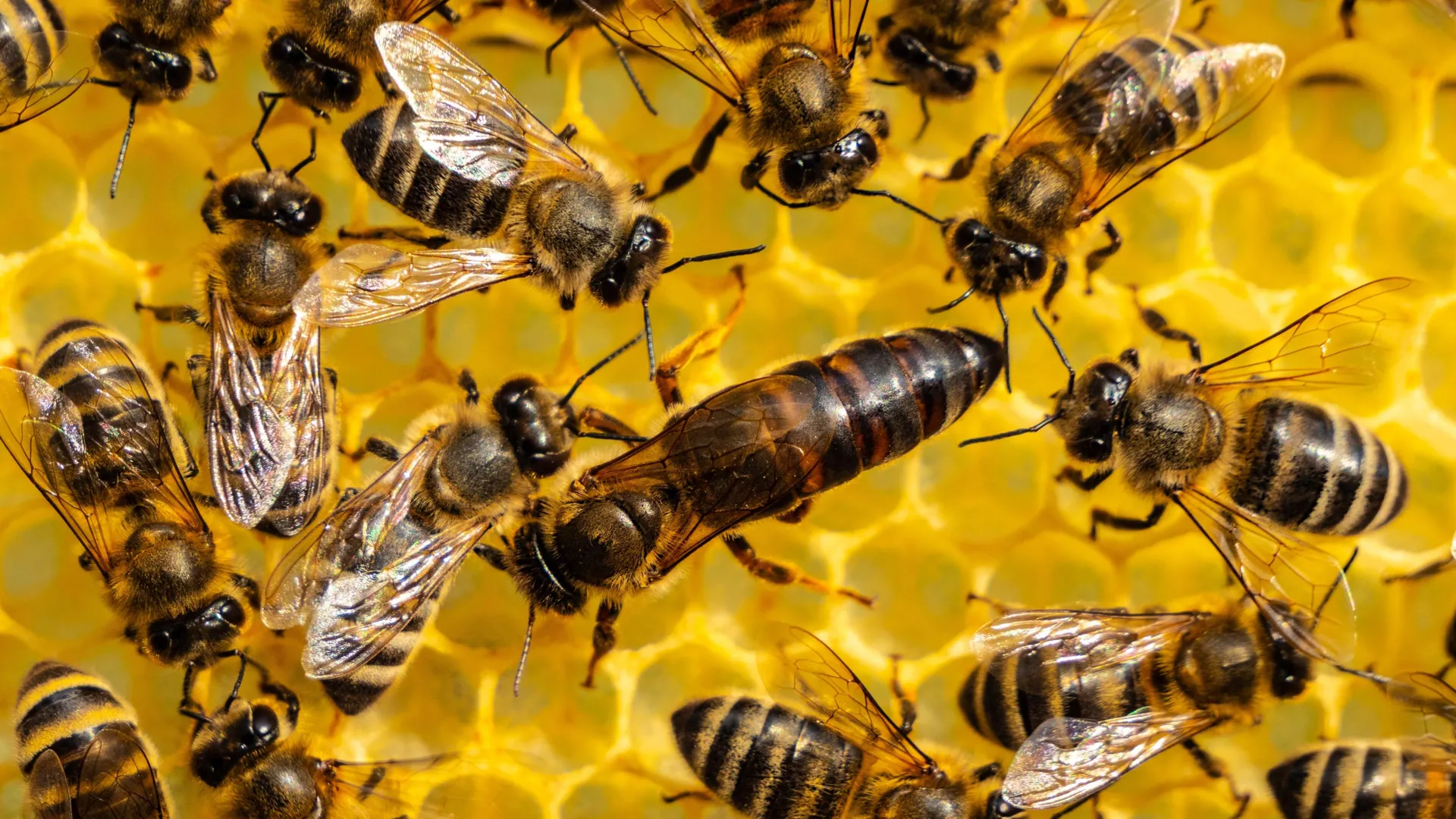
Queen honeybees develop with help from more than the rich food long credited for turning larvae into rulers of the hive. A study published in Nature reports that worker bees build specialized nursery cells, control the conditions inside them and provide dedicated care that affects whether a larva becomes a healthy queen.
The research, described by the University of California, Riverside, challenges the older view that royal jelly alone explains queen development. Boris Baer, an entomologist and director of UC Riverside’s Center for Integrative Bee Research, said the work shows a broader colony system behind queen production.
Royal jelly is only part of the process
Queens and worker bees begin as nearly identical eggs, according to UC Riverside. Queens then grow larger, mature faster and can live much longer than workers. They are also the colony’s only egg-laying females.
Scientists have long treated royal jelly, a nutrient-rich secretion fed to larvae by worker bees, as the central factor in that transformation. The new study says the physical and social setting around the larva also matters.
Researchers used thermal imaging, behavioral monitoring, materials analysis and chemical testing to study the chambers where queens are raised. They found that queen cells differ sharply from the six-sided wax cells used for worker larvae.
Queen cells act as engineered nurseries
According to the study, queen cells have a peanut-like form and are made from wax with different physical and chemical traits than ordinary hive wax. The wax is less dense, more pliable and better able to hold heat and moisture, conditions the researchers linked to queen development.
The team also reported differences in fatty acids and chemical signals in the wax. Those findings suggest that the chamber itself helps create a distinct developmental setting, rather than serving only as a container.
To test the effect, researchers raised queen larvae in cells made from queen-cell wax and in cells made from standard worker-cell wax. UC Riverside said larvae given the same food were more likely to die in worker wax, and surviving queens from those cells were smaller.
A distinct group of workers builds the cells
The study identified a previously unrecognized group of young worker bees that the researchers call queen cell builders. These bees create and maintain the queen nurseries, run at higher body temperatures while caring for future queens and show physiological changes tied to their role, according to UC Riverside.
That warmth may help queens mature quickly. UC Riverside said queen bees reach maturity in about 16 days, compared with roughly 21 days for worker bees, a difference that can matter when a colony needs a replacement queen.
The researchers found that these workers do more than reuse wax already present in the hive. They collect, alter and enrich material for queen cells, while activating biological pathways linked to wax production.
In one experiment, the team added small amounts of graphite to regular honeycomb. Darkened wax later appeared in queen cells, which UC Riverside said showed workers were selecting material from elsewhere in the hive and transforming it for queen rearing.
The pattern appeared in both Asian and European honeybee species, according to the researchers, suggesting the strategy may be an old and common feature of honeybee biology. The project was led by former UC Riverside postdoctoral researchers Yu Fang and Yahya Al Naggar and included specialists in behavior, physiology, chemistry, materials science and genomics.
Baer said the findings show honeybee colonies function as coordinated biological systems able to alter their own environments. The study’s authors said the work may also inform broader questions about how development is shaped by nutrition, genetics, physical surroundings and social care.
This story draws on original reporting from ScienceDaily.