
Proton hopping in water tied to local molecular imbalance
Quantum simulations link proton hopping in water to local molecular imbalance, refining a long-running model of acidity and transport.
By Priya Raghavan · Science Reporter
3 min read
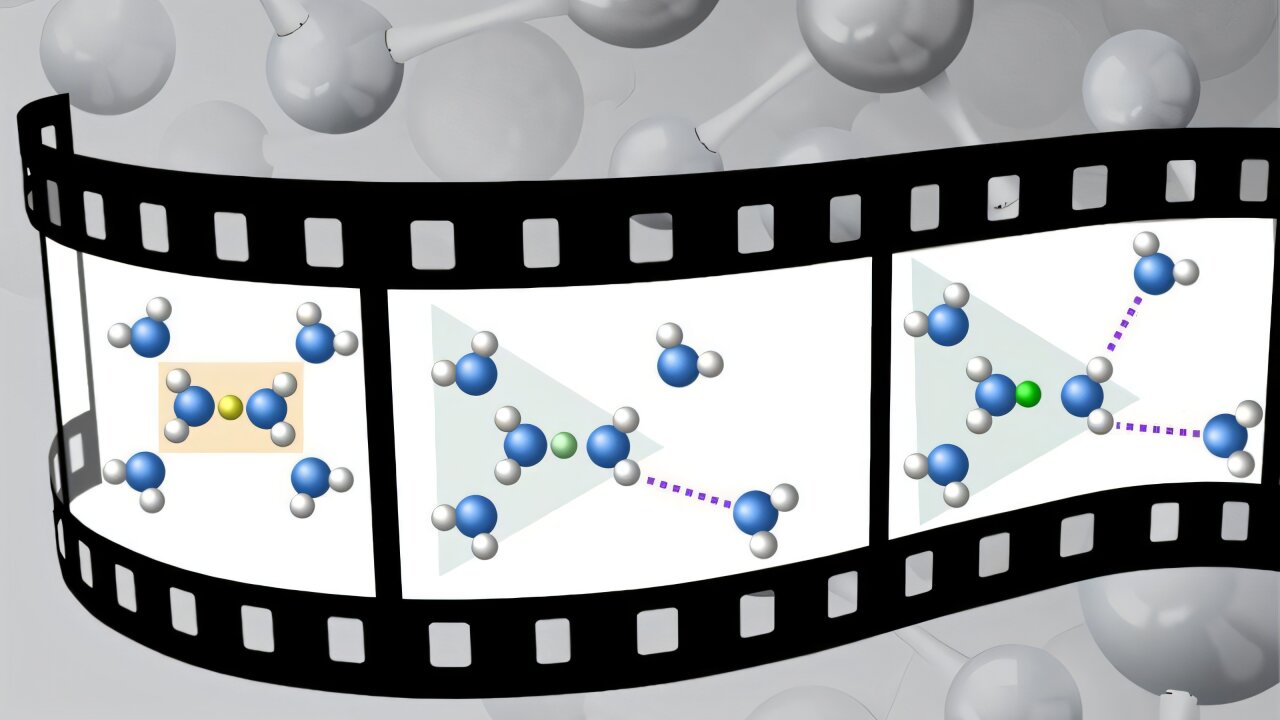
An international team led by Heidelberg University researchers has used quantum simulations to show that proton hopping in water is governed by local imbalance among nearby water molecules. The finding matters because proton transport helps explain acidity and plays roles in batteries and biological signaling, according to Heidelberg University.
The work, published in Nature Chemistry, modeled a hydrated proton shared within a cluster of six water molecules. Heidelberg University said researchers from Heidelberg, Cambridge, Ruhr University Bochum and Dijon traced the proton and its surrounding molecules in full quantum detail.
How does proton hopping in water work?
When an acid dissolves in water, it releases a proton, a positively charged hydrogen ion. Rather than staying attached to one water molecule, the proton is transferred through the hydrogen-bond network from molecule to molecule, a process known as the Grotthuss mechanism.
That mechanism has been recognized since the 19th century, Heidelberg University said, but the fine details have remained difficult to pin down because the motions are extremely fast and strongly coupled to the surrounding water structure.
Why the Zundel and Eigen models were not enough
Dr. Oriol Vendrell of Heidelberg University's Institute for Physical Chemistry said hydrated protons have often been described through two reference structures. In a Zundel cation, the proton is shared between two water molecules; in an Eigen cation, it is bound to one molecule as part of a hydronium center connected to three additional water molecules.
Dr. David Mendive-Tapia, a postdoctoral researcher in Vendrell's group and first author of the study, said recent infrared spectroscopy points to a more changeable state between those limits. The new simulations were designed to connect that experimental signal with the proton's quantum motion.
The researchers modeled an extended Zundel complex containing six water molecules and then altered the system by removing molecules. Heidelberg University said that let the team follow a progression from a more symmetric Zundel-like arrangement toward a more asymmetric Eigen-like one.
What the simulations found
The team tracked 51 coupled vibrations involving the hydrated proton and surrounding water molecules, according to Heidelberg University. By following those motions together, the researchers calculated the infrared spectrum and reproduced measurements across the reported range.
Dr. Dominik Marx of Ruhr University Bochum said the calculation depended on a highly accurate treatment of atomic forces. Heidelberg University said the team used an artificial neural network trained in Bochum on high-level quantum chemical data, which allowed the researchers to model the proton's quantum behavior without adjustable parameters.
Vendrell said the simulations identify the arrangement of nearby water molecules as the main factor controlling proton motion in aqueous solution. The study concludes that local asymmetry around the hydrated proton shapes both its infrared signature and its tendency to hop between molecules.
The paper, by Mendive-Tapia and colleagues, is titled "Deciphering the infrared spectrum of the hydrated proton using full-dimensional quantum dynamics." Heidelberg University said the findings broaden current understanding of how water's local structure directs proton transport.
This story draws on original reporting from Phys.org.