
Prolonged stretching tissue cells can free nuclei from keratin cages
An IBEC-led study found stretched epithelial tissues rebuild keratin networks over hours, a process tied to nuclei separating from their mesh.
By Tom Brennan · Health & Medicine Correspondent
3 min read
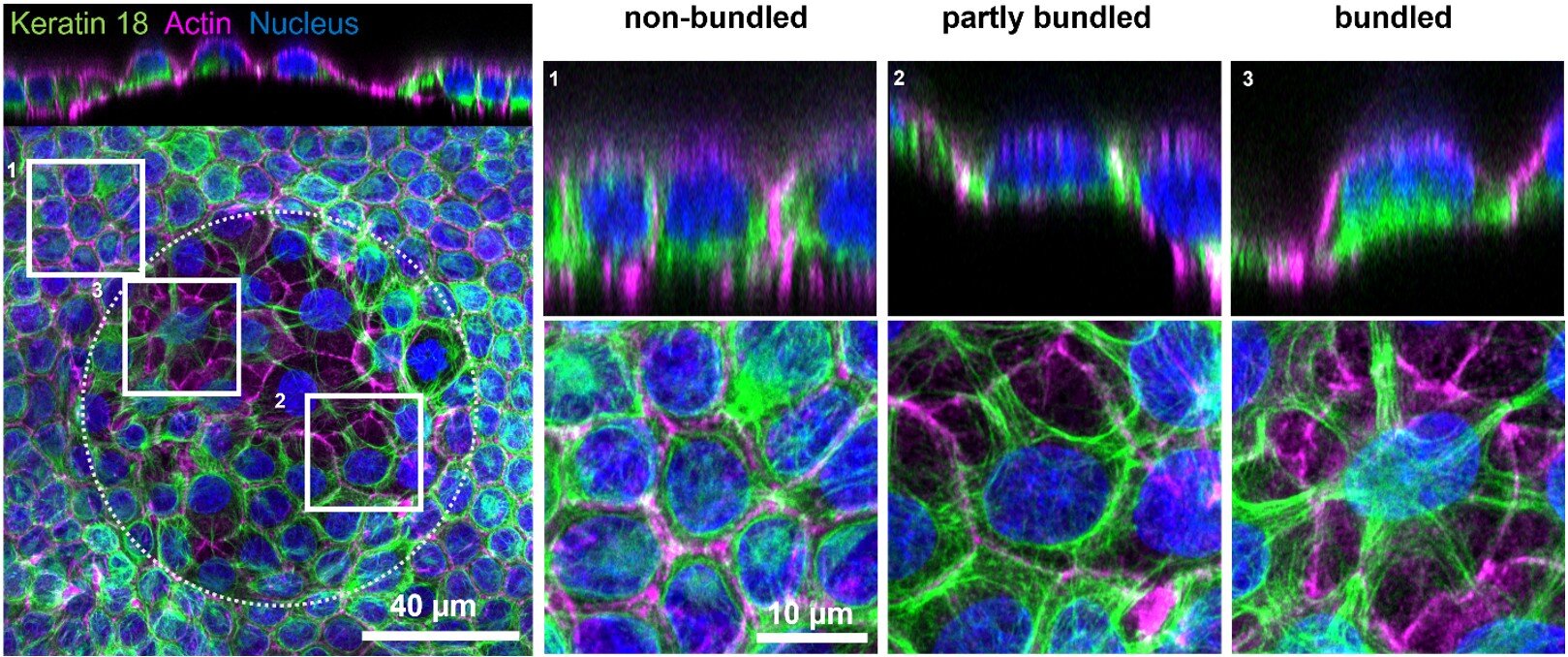
Prolonged stretching tissue cells causes their internal keratin scaffolds to rebuild over hours and can leave cell nuclei separated from much of their surrounding mesh, according to an Institute for Bioengineering of Catalonia-led study published in Nature Physics. The finding matters because tissues in developing embryos and organs that expand and contract must withstand mechanical forces for long periods.
The researchers studied engineered epithelial tissues using a custom microfluidic stretching system, live-cell microscopy and computational modeling across scales, according to IBEC. Their work focused on keratin, a major part of the cytoskeleton, the protein-filament framework that helps cells keep their shape and resist deformation.
IBEC said keratin is known to help protect tissues under large shape changes, but its response to sustained stretching had been unclear. In the experiments, keratin did not reorganize at once; over several hours, filaments gathered into thick, star-shaped bundles that linked neighboring cells and formed networks spanning more than one cell.
What happens to cell nuclei during prolonged stretching?
During sustained stretching, the keratin mesh around the nucleus can loosen until the nucleus separates from most of that network, according to the study. The researchers describe this as nuclear uncaging, and they found it was closely connected to the same keratin bundling process seen across stretched tissues.
The study reports that the reorganization began at junctions where three cells meet. Keratin filaments gradually disappeared from those regions and accumulated into larger bundles, first in scattered cells and then in neighboring cells, creating expanding clusters connected by shared keratin structures.
Marco Pensalfini, an assistant professor at Queen Mary University of London, developed the computational model with Marino Arroyo, a professor at the Universitat Politècnica de Catalunya and principal investigator of the Soft and Living Material Interfaces group at CIMNE. According to Pensalfini, the modeling linked the visible bundles in experiments to physical forces that could push the nucleus out of its keratin cage.
Live imaging supported the model, IBEC said. As keratin bundles thickened, nuclei progressively detached from the surrounding keratin network and in some cases remained linked to only a small amount of filament.
Why keratin and actin matter
The study also examined actin, another major cytoskeletal component. When researchers weakened the molecular connections between actin and keratin, keratin bundling sped up by almost threefold, according to IBEC, showing that the two filament systems help regulate how tissues respond to stretching.
Xavier Trepat, an ICREA research professor at IBEC and co-lead author of the study, said the work leaves open whether nuclear uncaging helps or harms the nucleus under sustained stress. IBEC reported that one possibility is that losing the keratin cage exposes the nucleus more directly to force; another is that separation from a stressed cytoskeletal network may reduce force transmission.
Tom Golde, a postdoctoral researcher in Trepat's group and first author of the paper, said the findings may apply to biological settings where tissues face long-lasting stretch. IBEC identified embryonic development and organs such as the bladder and mammary gland as examples, and said the mechanism could also be relevant in diseases involving altered keratin networks.
The paper, by Tom Golde and colleagues, is titled “Dynamics of supracellular keratin bundling and nuclear uncaging in stretched epithelia.”
This story draws on original reporting from Phys.org.