
Pressure explains water’s odd chemistry in nanoscopic gaps
Cambridge researchers say trapped water appears more reactive mainly because atom-thin materials can compress it to extreme pressures.
By Priya Raghavan · Science Reporter
3 min read
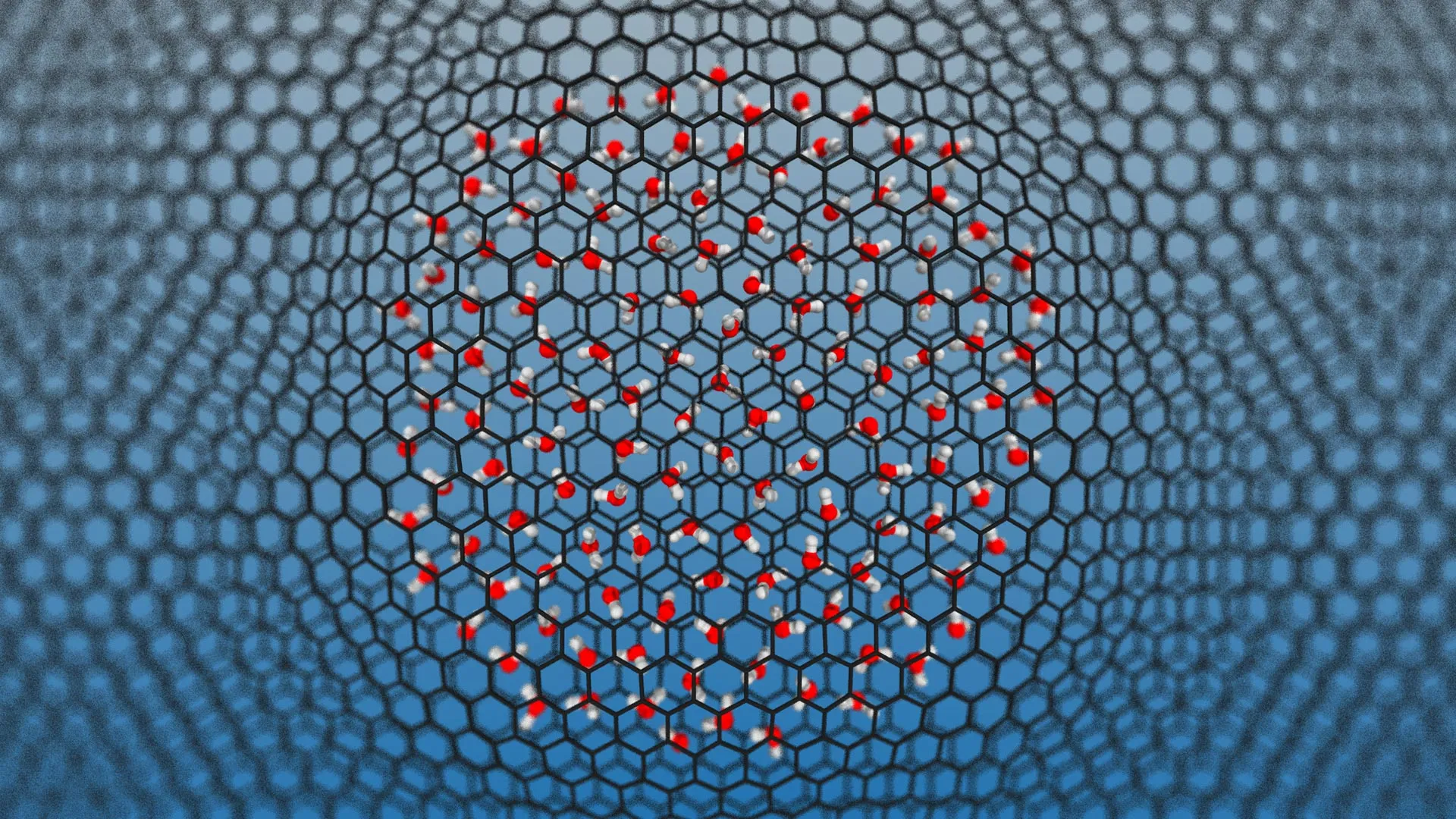
Water confined in spaces only a few molecules wide does not appear to gain unusual chemical reactivity from confinement alone, according to University of Cambridge researchers. The finding matters because nanoscale water sits inside membranes, biological channels and energy devices where acid-base reactions can affect performance.
The team reported in Science Advances that much of the long-running disagreement over confined water can be traced to pressure and density differences between experiments and simulations. The study examined how readily water splits into hydronium ions, H3O+, and hydroxide ions, OH-, a process central to pH and acid-base chemistry.
According to the University of Cambridge, researchers used machine-learning simulations designed to reach quantum mechanical accuracy across more conditions than conventional computational methods can cover. The simulations tested water held between sheets of graphene and hexagonal boron nitride, or hBN, two atom-thin materials with similar structures and different surface chemistry.
Extreme pressure inside tiny spaces
The Cambridge team found that droplets trapped between the two-dimensional sheets can reach pressures of several gigapascals, comparable to pressures deep inside Earth. The university said that pressure arises without an outside squeeze because van der Waals attractions pull the thin layers together across a broad surface area.
Those high pressures increased the amount of water splitting in the simulations, according to the study. When the researchers compared confined water with bulk water under the same pressure and chemical potential, the difference largely disappeared.
Xavier R. Advincula, the study’s lead author, said in the Cambridge account that confinement by itself did not intrinsically alter water’s reactivity when systems were compared under equivalent thermodynamic conditions. He said conflicting results in earlier work largely came from comparing water at different effective pressures or densities.
Angelos Michaelides of Cambridge’s Yusuf Hamied Department of Chemistry said the simulations showed that thermodynamics accounted for much of the apparent confinement effect. Once pressure and chemical potential were included, he said, many earlier complications became more consistent.
Material surfaces can still change the reaction
The study did find that the walls around confined water can affect chemistry when they interact with reaction products. In hBN-confined droplets, hydroxide ions formed near the edges bonded with the surrounding material, according to Cambridge.
That bonding stabilized the ions, reduced the energy needed for water molecules to split and increased dissociation, the researchers reported. The same behavior was absent with graphene, which Cambridge described as chemically inert in this setting.
Christoph Schran of Cambridge’s Theory of Condensed Matter Group said the work offers a framework for making sense of a decade of mixed findings. He said it also suggests a design rule: engineers can tune nanoscale water chemistry by selecting wall materials that interact with dissociation products and by controlling pressures inside confined spaces.
Cambridge said the results could affect technologies that rely on confined water, including hydrogen fuel cells, batteries, ion-selective membranes and catalytic systems. The researchers plan to study more realistic systems with defects and edges, compare predictions with spectroscopic and nanofluidic measurements, and screen families of two-dimensional materials for surfaces that enhance or suppress water reactivity.
This story draws on original reporting from ScienceDaily.