
Pegasus mission aims to lift NASA’s Swift observatory from decay
NASA plans to launch Katalyst Space’s LINK spacecraft to raise Swift’s orbit and keep the 2004 observatory from re-entering later this year.
By Tom Brennan · Health & Medicine Correspondent
3 min read
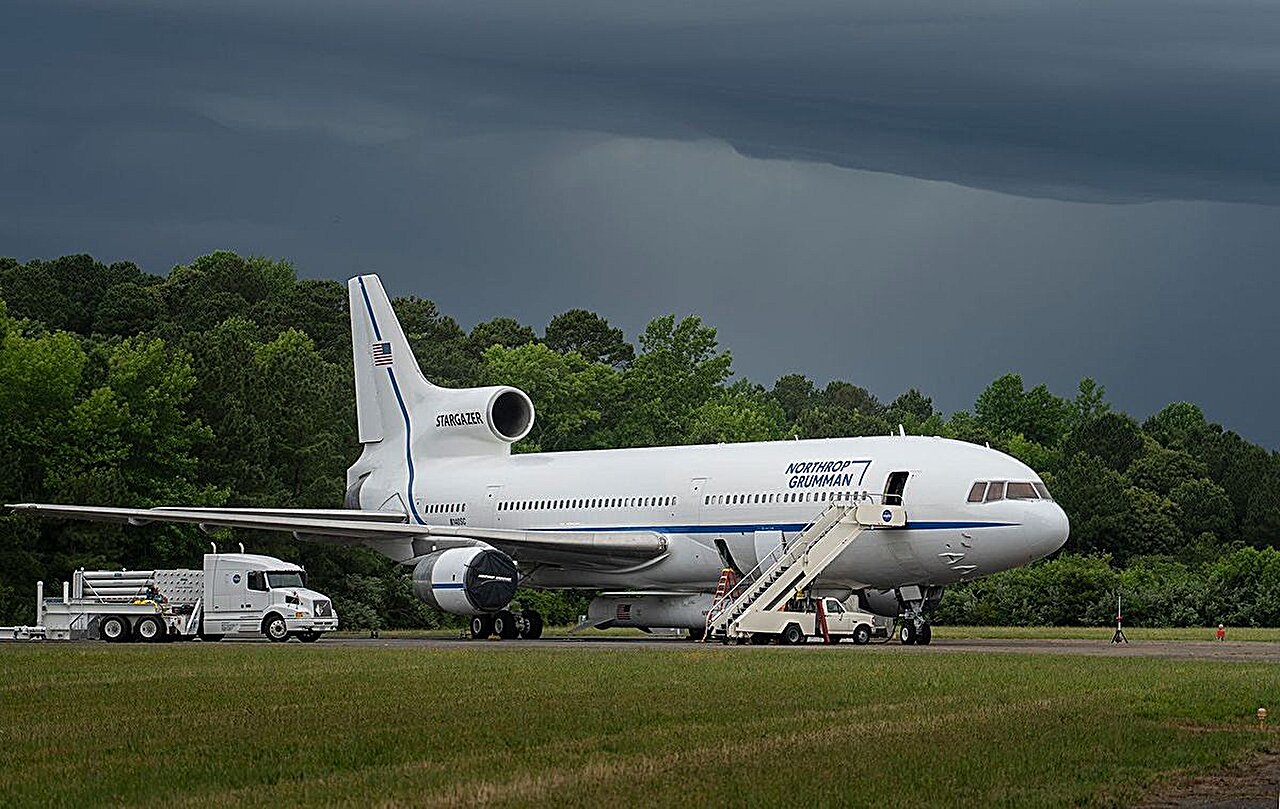
NASA is preparing a commercial satellite-servicing mission to save the Neil Gehrels Swift Observatory from a possible atmospheric re-entry later this year. The agency said Katalyst Space’s LINK spacecraft will try to rendezvous with Swift, grip it with robotic arms and spend months lifting it to a safer orbit.
The mission is scheduled to launch no earlier than Tuesday, June 30, at 6:23 a.m. EDT from Kwajalein Atoll in the Republic of the Marshall Islands, according to NASA. LINK will ride to space on a Northrop Grumman Pegasus XL rocket, which is launched from the company’s modified L-1011 aircraft, Stargazer.
Solar activity accelerated Swift’s descent
NASA said Swift, launched in November 2004, has been losing altitude because of atmospheric drag in low Earth orbit. Recent increased solar activity made that drag worse by expanding Earth’s upper atmosphere, increasing the effect on the spacecraft.
Swift has no propulsion system to counter the descent, according to NASA. The observatory studies the universe across several kinds of light and can quickly point at brief cosmic outbursts, then alert other telescopes in space and on the ground.
S. Bradley Cenko, Swift’s principal investigator at NASA’s Goddard Space Flight Center, called the observatory “NASA’s multitool” for studying the cosmos. He said Swift has played a central role for two decades and that the team expects to resume that work after the orbit-raising effort is complete.
LINK was built on a fast schedule
NASA contracted Katalyst Space in September to attempt the boost. The agency said the company had less than a year to design, build, test and launch a spacecraft capable of meeting Swift, attaching to it and raising its orbit.
Katalyst CEO Ghonhee Lee said Swift was not built for servicing. He said the mission could show that a commercial spacecraft can extend the life of satellites that were not designed for maintenance in orbit.
According to NASA, LINK weighs about 880 pounds and is about 5 feet tall, roughly one-third of Swift’s size. The spacecraft has nearly 20 feet of solar panels, three ion thrusters and three robotic arms.
NASA said LINK completed environmental testing this spring at Goddard, where engineers subjected it to launch and space-like conditions. Katalyst also conducted additional preflight checks at its facility in Broomfield, Colorado.
Swift’s operators bought more time
NASA said the boost attempt has the best chance if Swift remains above about 185 miles. Late last year, agency orbital projections showed the observatory could reach that threshold as early as July.
To slow the drop, Swift operators at Penn State’s Eberly College of Science changed how they point and manage the spacecraft, NASA said. Instead of choosing targets mainly for science, the team has selected pointing directions that put Swift in a more streamlined position and has cut power use to orient its large solar panels more aerodynamically.
NASA said newer orbital projections indicate those changes should keep Swift above the critical altitude until this fall.
Northrop Grumman’s Wes Collier said Pegasus and Stargazer give the mission flexible access to space from many locations. NASA said engineers loaded LINK into Pegasus XL and attached the rocket to Stargazer at Wallops Flight Facility in Virginia before the aircraft left for Kwajalein Atoll on June 18.
After launch, NASA said Katalyst will spend several weeks checking LINK’s propulsion, navigation and sensors. LINK will then approach Swift, inspect it, attach with robotic arms and raise the observatory to nearly 370 miles.
Shawn Domagal-Goldman, director of NASA’s astrophysics division, described the attempt as high-risk and high-reward. He said boosting Swift is more affordable than replacing its capabilities and could help advance the U.S. satellite-servicing industry.
This story draws on original reporting from Phys.org.