
Off-center star flare points to a roaming supermassive black hole
Researchers say AT2024tvd may reveal a stripped galaxy core carrying a supermassive black hole outside a galaxy’s center.
By Lucas Ferreira · Science & Environment Writer
3 min read
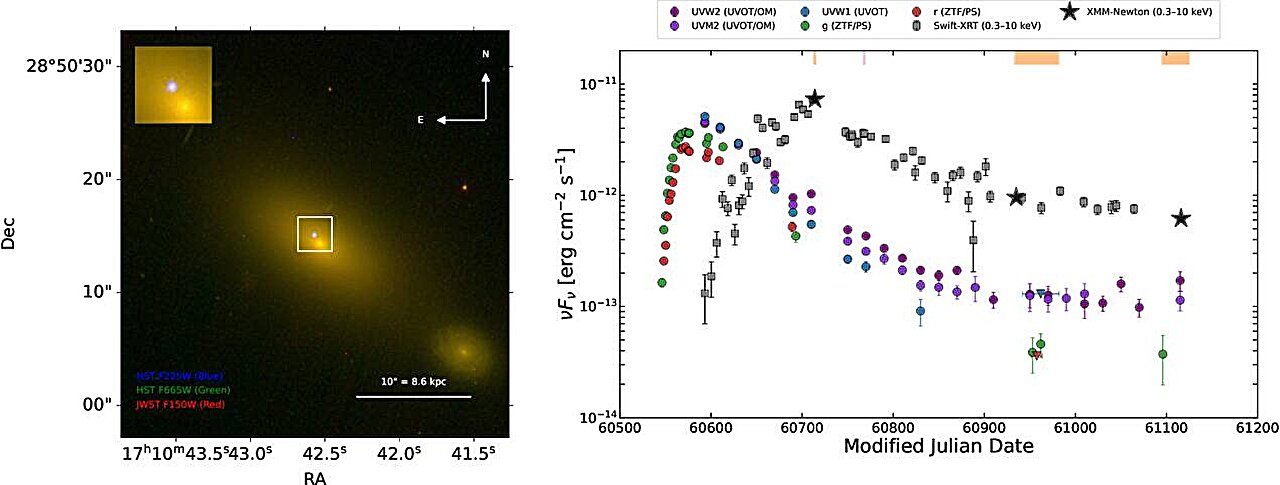
Astronomers say a star torn apart far from its galaxy’s center was likely destroyed by a wandering supermassive black hole. The event, called AT2024tvd, could give researchers a rare way to find large black holes that are not sitting in bright galactic nuclei.
M. Guolo and colleagues reported the findings in a paper published June 12 in The Astrophysical Journal Letters. The team studied a tidal disruption event, the flash produced when a star passes too close to a black hole and is pulled apart, feeding a hot disk of gas around it.
An unusual location
AT2024tvd was first detected in 2024, according to the researchers. It stood out because it occurred away from the nucleus of its host galaxy, where astronomers usually expect to find a galaxy’s main supermassive black hole.
The team placed the event about 0.8 kiloparsecs from the center of a galaxy with a mass of roughly 100 billion suns. By studying the fading emission after the flare, the researchers estimated that the black hole involved weighs about 1 million times the mass of the sun.
That mass estimate matters because it places the object in the supermassive category, according to the paper. The authors say the result argues against the event being powered by a smaller intermediate-mass black hole.
The researchers analyzed X-ray, ultraviolet and optical light from the event with a model of the accretion disk around the black hole. They said that approach produced a mass estimate consistent with known links between black hole mass and other properties measured in tidal disruption events.
A stripped survivor
The authors found no detected star cluster or dwarf galaxy around the black hole. They argue that the object may be the remnant nucleus of a smaller galaxy whose outer stars were stripped away during earlier gravitational encounters.
According to the study, the black hole’s mass is more than 3% of the surrounding stellar mass, a high fraction for such a system. The researchers say that ratio supports the idea that the original galaxy was reduced to a dense core containing a black hole.
The team favors a minor merger as the likely route for that stripping. In that scenario, a smaller galaxy is gradually absorbed by a larger one, and its central black hole can remain on a wide orbit rather than quickly reaching the larger galaxy’s center.
The authors said this explanation fits earlier work on AT2024tvd. They also cautioned that the lack of a detected stellar cluster does not rule out all surrounding stars; it only means current observations have not revealed such a population.
The study also compared AT2024tvd’s black hole with the black hole expected at the host galaxy’s true center. The researchers calculated that the central object should exceed 1 billion solar masses, supporting the conclusion that the black hole behind AT2024tvd is a separate displaced object.
More searches ahead
The paper notes that only two off-center tidal disruption events had been identified before AT2024tvd, and those involved intermediate-mass black holes in ultra-compact dwarf galaxies. The researchers say AT2024tvd shows that off-center stellar disruptions can expose hidden wandering supermassive black holes in the nearby universe.
The authors expect future wide-field surveys, including the Vera C. Rubin Observatory’s Legacy Survey of Space and Time, to find more examples. They said X-ray observations will remain needed for reliable mass estimates because they trace material close to the black hole.
This story draws on original reporting from Phys.org.